Semaphore flag alphabet: chart and translator
Semaphore, also called the semaphore alphabet or the flag alphabet, sends messages over a distance with two flags. You show each letter by where your two arms point. Each arm can point in only eight directions, which are easiest to imagine as the hands of a clock: 6:00 is down, 9:00 is to the side, 12:00 is up, and in between are the diagonal directions 7:30, 10:30, 1:30 and 4:30. For example, A is one arm down (6:00) and the other diagonally down (7:30). Which hand shows which direction is explained below, in the section on sending.
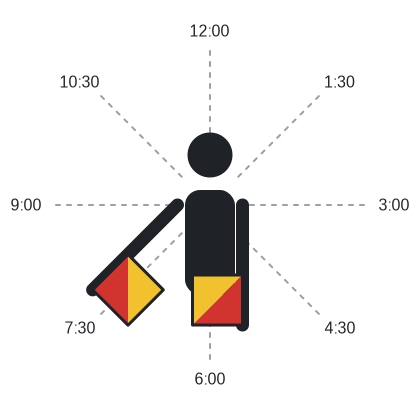
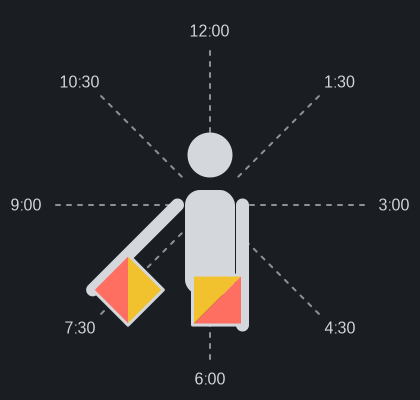
All the pictures in the article are drawn from the point of view of a reader standing facing the signaller. Like Morse code, semaphore is a code, not a cipher: it hides nothing and anyone who knows the alphabet can read it. The difference between a code and a cipher is explained in the article Cryptography.
Text to semaphore translator
Type a message and the translator shows how to wave it. It drops accents (č is shown as c) and leaves out digits and punctuation.
The default text, “Sraz u ohniste”, is Czech for “meet at the campfire”.
The translator cannot read semaphore; for that, use the picture of the whole alphabet below.
The semaphore alphabet in a picture
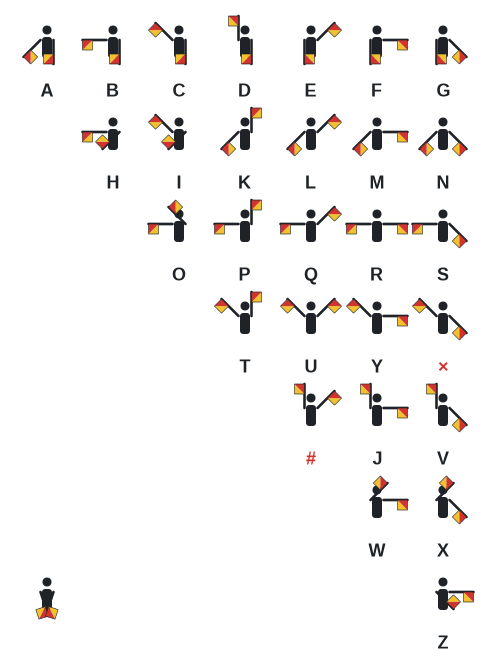
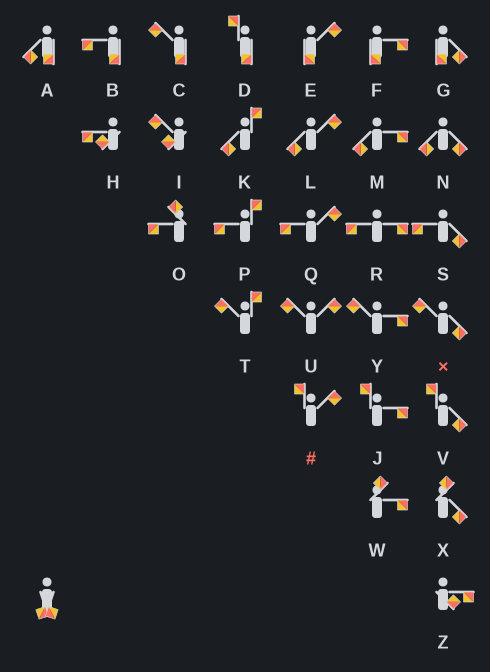
You do not have to learn the alphabet by heart sign by sign; it is enough to know the pattern. In each row of the picture one arm stays in place and the other goes round like the hand of a clock, 45° at a time. That is why the rows are called “circles”:
- A to G: one arm stays down at 6:00 and the other goes round: A 7:30, B 9:00, C 10:30, D 12:00, E 1:30, F 3:00 and G 4:30.
- H to N: one arm stays at 7:30, the other goes round from 9:00: H 9:00, I 10:30, K 12:00, L 1:30, M 3:00, N 4:30.
- O to S: one at 9:00, the other from 10:30: O 10:30, P 12:00, Q 1:30, R 3:00, S 4:30.
- T, U, Y and cancel: one at 10:30, the other from 12:00: T 12:00, U 1:30, Y 3:00, cancel × 4:30.
- Numerals, J and V: one arm up at 12:00, the other from 1:30: the numeral sign # 1:30, J 3:00, V 4:30.
- W and X: one at 1:30, the other from 3:00: W 3:00, X 4:30.
- Z: arms at 3:00 and at 4:30.
Each circle starts one step further on and is one letter shorter, because the positions do not repeat. The pair 7:30 and 6:00 is the same as A from the first circle (it does not matter which arm is the “standing” one), so the second circle starts only at 9:00.
Watch out for J and V, which are missing from the alphabetical order. K follows straight after I, and Y follows U. You find both only in the fifth circle, with one arm up. The signs marked in red are not letters: # announces that numerals are coming, and × cancels the previous sign when the signaller makes a mistake. The figure at the bottom left shows the rest position, which we come to below.
Why semaphore has exactly 28 signs
How many different positions can two arms manage? The first arm chooses one of 8 directions, the second one of the remaining 7, because the two arms should not point in the same direction. That gives 8 · 7 = 56 possibilities. But we have counted every position twice: “left at 9:00, right at 3:00” and “right at 9:00, left at 3:00” look the same from a distance, since the receiver sees only two flags pointing in two directions. So we divide the number by two:
A mathematician would say that we are choosing 2 directions out of 8 and the order does not matter, so we are counting combinations,
Of the 28 positions, 26 go to letters and 2 to the signs # and ×. On top of that there is the rest position: both arms point down and the flags cross in front of the body. It is the only position in which they point the same way, so it is never mistaken for a letter.
How to send and read semaphore
Stand facing the receiver, ideally with the sky or a light wall behind you. The figure in the pictures stands facing you, so to copy it you have to swap sides: the arm that it has on the left in the picture is raised with your right hand. For the letter A you therefore point your right hand diagonally down to the side and your left stays down.
Keep your arms straight, with each flag as an extension of the arm. Hold each position for a moment so that the receiver has time to read it. Pause briefly between letters and at the end of a word lower your arms to the rest position.
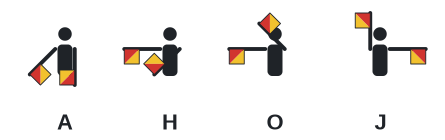
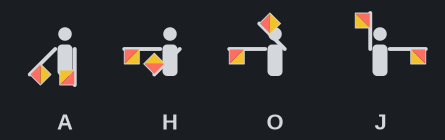
Let’s try the word AHOJ (Czech for “hello”). We already know A; for H one arm points to 9:00 and the other to 7:30, which goes across the body. O is similar, except that the arm across the body points up to 10:30. J is one arm up and the other horizontal at 3:00.
Numerals have no positions of their own. The signaller first shows the # sign, and then the letters A to I mean the numerals 1 to 9 and K means 0. You return to letters with the sign J, which serves as a switch here. For example, 12 is # A B and then J.
At camp or at a scout meeting, two scarves on sticks make good flags. A group of three works well: one sends, the second reads and the third writes down, so that the reader does not have to take their eyes off the sender. To begin with, it is enough to learn the first circle, A to G.
Where semaphore comes from
In the early 1790s Claude Chappe built an optical telegraph in France. It consisted of towers with a mast and movable arms, and the first line, from Paris to Lille, operated from 1794. Around 1866 a hand version with two flags appeared, in which the signaller’s arms replaced the arms of the mast. Some navies still use semaphore today. But you meet it elsewhere too: the well-known peace symbol ☮ is two semaphore letters, N and D, from “nuclear disarmament”.