Black Friday discounts: how to tell a real one from a fake
It is Black Friday, 27 November 2026, and shop windows are red with stickers saying −20%, −30% or −50%. How many of those Black Friday discounts are real? On 26 November, the consumer organisation Euroconsumers summed up what its members had found. Its Spanish member, OCU, checked more than 12,000 prices of electronics and household appliances in 50 online shops in the week before Black Friday, and only 6% of them offered what Euroconsumers calls a genuine and substantial discount. Altroconsumo, the Italian member, had already gone through 208 popular online shops in January. In 62% of them, discounts were not shown the way the law requires.
How can a discount be fake when the price really has gone down? The trick is hidden not in the percentage but in the price it is taken from.
A percentage is only as honest as its base
A percentage is always a part of some whole, as we explain in the article on percentages. A discount of 20% is 20% of some price. Of which one? That is the whole question. The price we take the percentage of is called the base.
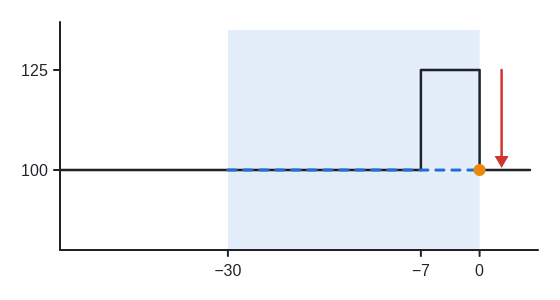
Imagine a pair of headphones that has cost €100 for months. A week before Black Friday, the shop raises the price to €125. On Black Friday, it puts up a −20% sticker. Let’s work out the new price. After a 20% discount we pay 80%, so we multiply by 0.8:
And the headphones are back at €100. The sticker doesn’t lie about the arithmetic: 20% of €125 really is €25. It lies about the base. Compared with the price you could have paid two weeks ago, the discount is the old price minus the sale price:
Zero euros, which is 0%.
Notice that the shop had to raise the price by 25%, not 20%, to end up back at €100. The €25 it added is a quarter of the old price of €100, but only a fifth of the new price of €125. Percentages with different bases simply don’t cancel each other out. Suppose the shop had raised the price by 20% and then cut it by 20%. First the headphones would cost
euros, and after the “discount”
euros. The sticker shouts −20%, yet compared with the original €100 the headphones are cheaper by a mere 4%. We work through the same trap in the article on a discount on a discount.
How to tell a fake Black Friday discount
A fair base is the lowest price the shop charged in the 30 days before the sale. The real discount is then
Let’s test it on a coffee machine with a crossed-out price of €200 and a −30% sticker. The sale price is
euros. Now suppose that in the last 30 days the same machine never cost less than €150. We put the numbers into the formula:
So the real discount is under 7%, not 30%. You save €10, not €60.
A real case was decided by the Court of Justice of the European Union. The German discounter Aldi Süd advertised price reductions in its weekly brochures, for example on bananas and pineapples. In one of the examples, the reduced price was €1.29, while the price just before the offer was €1.69. But the lowest price in the previous 30 days was also €1.29, exactly the same as the “reduced” one. Measured from €1.69, the reduction looks like
Measured from the 30-day lowest price, it is
How do you check a discount on your own? First find the lowest price from the last few weeks. In the EU, the shop must show it in the announcement of the discount (more on that below), and some price comparison sites draw a chart of the price history. Then put that price into the formula above, not the crossed-out one. And if the sale price is the same as the lowest recent price, there is no discount, whatever the sticker says.
What the rule says
Since 28 May 2022, EU law has required every announced price reduction to show the “prior price”: the lowest price the trader charged in a period before the reduction. That period must be at least 30 days long. In Czechia, the same rule has been in the Consumer Protection Act (§ 12a) since 6 January 2023, with a period of exactly 30 days. The Czech law makes an exception for goods that spoil quickly or have a short shelf life.
In the Aldi Süd case, on 26 September 2024, the Court of Justice sided with a consumer association: printing the lowest price somewhere in the advert is not enough. A reduction announced as a percentage must be calculated from that 30-day lowest price. A trick like the one with the headphones is therefore not allowed in the EU: measured from €100, there is no discount to announce.
What the consumer groups found
The reports before this Black Friday contain two kinds of numbers, and it pays not to mix them up.
The first kind comes from price checks: someone recorded real prices and compared them. According to Euroconsumers, OCU in Spain did not use the 30-day rule but a different, demanding yardstick: the lowest price offered by the main online platforms in September and October. Measured against it, just 6% of the more than 12,000 prices offered a genuine and substantial discount. That does not mean 94% of discounts were fake. It describes one sample of electronics and household appliances, compared with the cheapest prices of the autumn, and OCU does not say exactly how big a discount had to be to count as substantial. Altroconsumo checked the 208 Italian shops in January 2026, not at Black Friday. Only 24% of them showed the 30-day lowest price properly. The 62% that broke the rule split into two groups: 21% gave a wrong reference price, for example an average or a recommended price instead of the lowest one, and 41% gave no reference price at all.
The second kind comes from an opinion survey: Altroconsumo asked 2,017 Italians aged 18 to 74 in October 2026. That says what people think, not what the prices did. 55% of them suspect that some shops raise prices before promotions. Only 1.4% correctly identified what price information the law requires in an announced reduction. So suspicion is everywhere, while knowledge of the rule is rare. One subtraction and one division are enough to beat both.
Sources
- Euroconsumers: Black Friday is back: beware of the dodgy discounts (26 November 2026)
- OCU press release on Black Friday prices (24 November 2026, in Spanish)
- Altroconsumo: investigation of discounts on 208 online shops (12 February 2026, in Italian)
- Altroconsumo: survey on Italians and Black Friday (12 November 2026, in Italian)
- Directive (EU) 2019/2161, Article 2 inserting Article 6a into Directive 98/6/EC, EUR-Lex
- Court of Justice of the EU, press release No 152/24, Case C-330/23 Aldi Süd (26 September 2024)
- Czech Consumer Protection Act No. 634/1992 Coll., § 12a
- Act No. 374/2022 Coll., which inserted § 12a (effective from 6 January 2023)