
A discount on a discount
A shop advertises a sale: 20% off, and a further 20% off the items that are already reduced. How much do we save? It is tempting to simply add the two discounts and declare it 40%. In fact we save only 36%.
Why it is not 40%
Everything depends on what the second discount is worked out from. The second discount is calculated from the reduced price, not from the original one. The rest is an ordinary calculation with percentages.
Let’s try it on a jacket that costs £100. First we work out the first discount, 20% of £100:
We subtract the discount from the original price:
So after the first discount the jacket costs £80. The second discount is 20% of this new price:
We subtract that as well:
The jacket therefore costs £64. Altogether we have saved
pounds, which is exactly 36% of the original £100. The second discount took off only £16 instead of £20, because it was worked out from a smaller amount.
A quicker way: multiplying
We can skip the subtraction completely. With a 20% discount we pay 100% − 20% = 80% of the price, so it is enough to multiply the price by 0.8. The second discount means multiplying by 0.8 once more:
We pay 64% of the original price, so the discount is 100% − 64% = 36%. For the jacket:
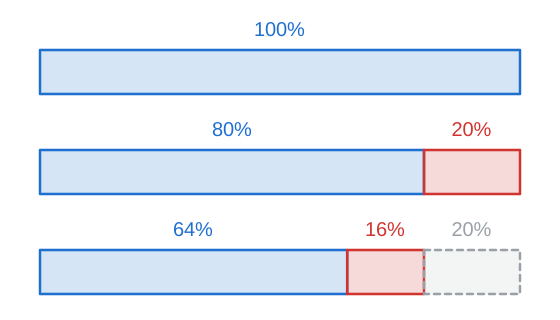
The blue part is the price we would pay, the red part is what the last discount took off, and the grey dashed part is the piece that disappeared with the first discount. In the third bar the red piece is smaller than in the second, even though it is still a 20% discount. But it is worked out from a shorter bar.
For an original price c and any discounts a and b in per cent, the price after both discounts is
Interestingly, the order of the discounts does not matter. A 10% discount followed by 30% gives the same price as 30% followed by 10%, because multiplication is commutative. So the shopkeeper cannot offer you a better order, however generous they make it sound.
A price rise and a price cut
A similar trap awaits goods that first go up in price by 20% and then come down by 20%. It seems that the price has returned to where it was. But a 20% rise means multiplying by 1.2, and so we get
The price ends up at 96% of the original, which is 4% lower. After the price rise, a £500 phone costs
pounds. A 20% cut is now worked out from £600:
In the end the phone costs £480, which is £20 less than at the start. You can find a similar example with a book in the article on percentages.
Calculator
The price after two discounts can also be worked out by a calculator. Enter the discounts in per cent.
See also
Chapters: Working with percentages, Per mille, Calculating VAT, A discount on a discount
