Why do car seats lower birth rates?
On 25 November 2026 Katie Miller posted on X: “The fastest way to kill the birth rate is mandating more car seats.” Her target was a new California car seat law. The post made the news and brought back a study on car seats and birth rates that people have been quoting since 2020.
The study is “Car Seats as Contraception” by the economists Jordan Nickerson and David Solomon, published in 2024. It estimates that car seat laws have cost the United States about 145,000 births since 1980. Let's look at how the authors got there and what it really means.
Why car seat laws could lower birth rates
Since 1977, US states have kept raising the age up to which a child must ride in a car seat. By 2020, the median age across states was eight. In many ordinary cars, three car seats simply don’t fit side by side in the back row. With two adults in front, a third child can mean shopping for a bigger car. That is expensive, so some families put off a third child until the older ones outgrow their car seats, or never have one at all.
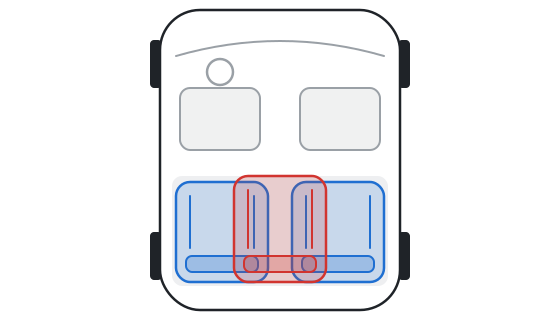
How much lower are the odds of a third child?
Take women aged 18 to 35 who already have two children. Roughly nine in a hundred of them have another baby within a year; in the authors’ data the figure is exactly 9.36%. But when both their children are still young enough to need car seats, slightly fewer of them do. The chance drops by 0.73 percentage points, which leaves
Careful: the drop is 0.73 percentage points, not 0.73%. A percentage point is just the plain difference between two percentages. To get a percent figure, we compare the drop with the starting value:
So these women have about 8% fewer births than otherwise similar women. For every 10,000 such women, about 73 fewer babies are born each year. The same gap between an absolute and a relative change matters when you read about vaccine effectiveness.

How do we know it’s the car seats?
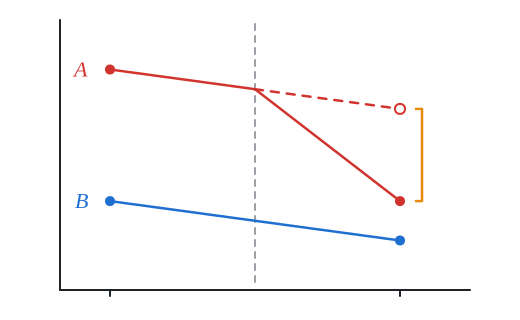
Birth rates in the US fell while the laws got stricter, but plenty else changed too, and a correlation alone proves nothing. The authors take advantage of the fact that states changed their laws in different years. The idea behind it is called difference in differences. Here it is with made-up numbers.
Take two states, A and B. In state A, 11% of women with two small children have a third child each year; in state B it is 10%. Then A raises its car seat age and B leaves it alone. A falls to 10%, B to 9.7%. State B tells us what would have happened anyway: a drop of 0.3 points. The effect of the law is the difference of the two differences:
So the law cost 0.7 percentage points. Mind the catch: this only works if both states would otherwise have moved alike.
The paper also looks in places where the effect should not appear, and there it indeed doesn’t:
- it appears only before a third birth; with one child in a car seat, or with two children of whom only one needs a seat, the authors find no effect that stands out from chance,
- it comes entirely from households with a car,
- it is bigger when an adult man lives in the household, because then both front seats are probably taken. A single mother can move her oldest child to the front.
Postponed or never born?
Some families simply wait until the older child outgrows the car seat, and the third baby then arrives later rather than never. The authors separated the two in the data, and by their estimate such postponed births are only a minority. Roughly seven in ten of the missing children are never born at all.
How much car seats change birth rates
According to the study, the stricter laws prevented about 8,000 births in 2017 alone and about 145,000 since 1980, measured against laws that would have ended the requirement at a child’s second birthday. The working paper adds that over 90% of them fall after 2000, as the laws got stricter. Set against that, about 150 million children were born in the US between 1980 and 2017, between roughly 3.6 and 4.3 million every year. So
That is one birth in a thousand over the whole period. In 2017 alone, 8,000 out of 3,855,500 births comes to about 0.2%.
The study estimates an effect that is noticeable for families with two small children, but small compared with all US births. Nor does it say anything about the “fastest” way to lower birth rates. It measures one factor and never sets car seats against housing, childcare or anything else.
How many children’s lives have car seats saved?
On the other side of the scales, the authors estimate that the laws prevented the deaths of 57 children in car crashes in 2017, or 140 under the most favourable estimate. That works out to between 57 and 141 births lost for every life saved.
In most of their calculations, though, the authors cannot rule out zero. Every estimate from data is uncertain, so statisticians report a range of values that fit the data, called a confidence interval. If zero lies inside it, the data can’t tell a small benefit from none. That still doesn’t mean the laws saved no one.
The safety research is also divided. The economist Steven Levitt (2008) found that for children aged two to six, a car seat protects against death no better than a seat belt. A medical study by Elliott and colleagues (2006), by contrast, found a 28% lower risk of death for children of the same age in a correctly used car seat.
Sources
- Nickerson, J., Solomon, D.: Car Seats as Contraception, Journal of Law and Economics 67(3), 2024 (abstract, working paper 2020)
- What the Fact: Is mandating car seats the fastest way to kill the birth rate? (26 November 2026)
- Elliott, M. R. et al.: Effectiveness of Child Safety Seats vs Seat Belts in Reducing Risk for Death in Children in Passenger Vehicle Crashes, Archives of Pediatrics & Adolescent Medicine 160(6), 2006, pp. 617–621