
Why we have seasons
Why do we have seasons? Why do spring, summer, autumn and winter follow one another? Many people believe that summer and winter are caused by the Earth’s distance from the Sun changing during the year. After all, the Earth does not orbit the Sun in a perfect circle. There are times when the Earth is farther from the Sun and times when it is closer. See the following picture:
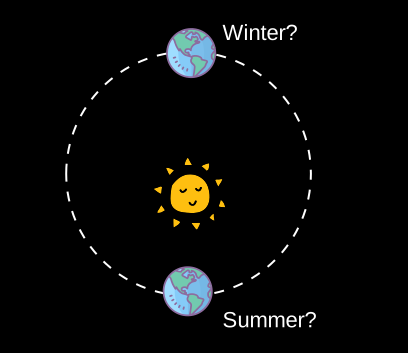
We can see that when the Earth is at the “top”, it is farther from the Sun than when it is at the “bottom”. At first glance it makes sense that when the Earth is farther from the Sun we have winter, and when it is closer we have summer. But the Earth is farthest from the Sun around 5 July and closest around 4 January – so it is exactly the other way round: when the Earth is farthest from the Sun, we have summer, and when it is closest, we have winter.
We also know that when it is summer in the Northern Hemisphere, it is winter in the Southern Hemisphere, and vice versa. When we are freezing here in the UK, it is summer in Australia. So the seasons cannot be caused by the changing distance between the Earth and the Sun. If they were, it would be summer all over the planet, not just in one hemisphere.
What is more, the picture makes it look as if the distance from the Earth to the Sun changes dramatically, but in reality the difference is much smaller. When the Earth is closest to the Sun, the distance is about 147 million kilometres. When it is farthest, it is about 152 million kilometres. That is a difference of roughly 3%, which is not big enough to cause such a large change in the weather as we see between summer and winter.
It is all down to the Earth’s axis
The Earth’s axis is an imaginary line around which our Earth rotates. This axis is tilted slightly relative to the imaginary plane in which the Earth orbits the Sun. Look at the picture:

The axis is shown by the white lines at the top and bottom, and the black line across the Earth marks the equator. It divides the Earth into two hemispheres – the southern and the northern. The arrow at the bottom shows the direction in which the Earth rotates about its axis. We can see that the axis is not vertical but slightly tilted. Even in this picture we can notice that the Sun shines much more on the Southern Hemisphere than on the Northern. We can also notice other things: the Sun shines on the South Pole, while it does not shine on the North Pole. And this situation will last for a long time. Imagine that one day has passed and the Earth has turned once about its axis. Because of the Earth’s tilt, the Sun shone on the South Pole the whole time – it did not set there at all! And, the other way round, at the North Pole the Sun did not rise all day! And the whole time the Sun lit up a much larger part of the Southern Hemisphere than of the Northern – so it is summer in the Southern Hemisphere and winter in the Northern. That fits what we know: in winter the days are shorter than in summer.
But that does not yet explain why the Sun is “colder” in winter than in summer. All right, in winter the Sun shines for less time, we already know why – but why does it not warm us as much as it does in summer? That is down to the angle at which the rays strike.
The angle at which the Sun’s rays strike
Imagine a wall that rays of light strike at right angles. And a second wall of the same length, which rays of light also strike, but not at right angles – compared with the first wall, the second wall is turned by 45 degrees:

We can see that although the two walls are the same length and are exposed to an equally strong source of light, fewer rays strike the second wall than the first. And not only that, the rays strike farther apart. So the second wall is not lit as well as the first. The same applies to the Sun’s rays – it depends on the angle at which they strike the ground. If they strike at right angles, a lot of them reach the ground, which we feel as warmth. If they strike at a smaller angle, fewer rays reach the ground, “farther apart”, and we feel it as cold. The same thing happens on Earth:

All the rays that strike the ground at right angles strike the Southern Hemisphere. So more of the Sun’s rays fall on each square metre of the Southern Hemisphere, which makes it warmer there than in the Northern Hemisphere, which the rays do reach, but at a smaller angle, so fewer of them arrive. That is also why it tends to be colder to the north of us and warmer to the south of us. To the north of us the Sun’s rays strike at a smaller angle, so fewer of them arrive than arrive here.
