
Angle
If you have an angle and want to copy it somewhere else, you can use the method of copying an angle.
What is an angle
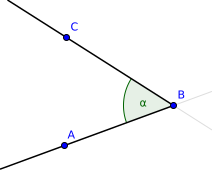
The definition of an angle is not entirely simple, and there are different versions. For our purposes this one will do: an angle is the part of the plane bounded by two rays that share a starting point. The important thing about this definition is that the angle is not just the two arms but the whole region, the whole part of the plane, that the two arms enclose. See the next figure:
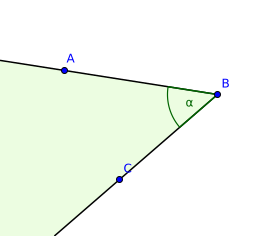
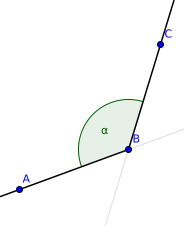
The previous figure was not entirely accurate, though, because we did not say which angle we mean. At first glance we might imagine angle ABC as the region shown, but we could just as well imagine the other part of the plane:
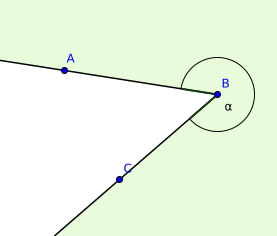
So when we write down angles, we should distinguish whether we mean the angle of less than 180° or the reflex angle (more than 180°). This can be done, for example, with a directed angle.
An angle can have either a positive or a negative orientation. For a positive orientation we turn anticlockwise, and for a negative one clockwise. So when we write angle ABC, ray BA is mentioned first and ray BC second. In the positive direction we look at ray BA and keep turning anticlockwise. In our example above we would get the first figure, the angle of less than 180°. If we chose the negative direction, we would get the reflex angle, that is, the second figure. The positive direction is the standard one, and in this article all angles are written in the positive sense.
So an angle consists of two arms that bound it, the vertex of the angle from which those rays start, and the region that the arms enclose. If we have angle ABC, the arms are BA and BC and the vertex is B.
Size of an angle
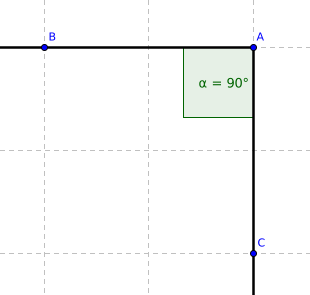
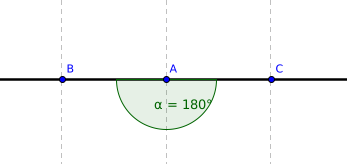
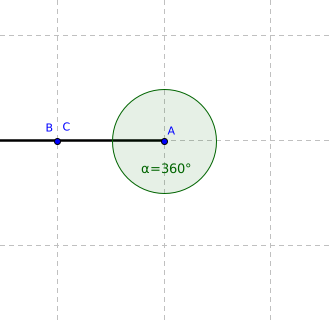
Just as we can measure the length of a line segment, we can also measure the size of an angle. It is measured either in degrees, which you certainly know, or in radians. Degrees are simple: 90° is a right angle (for example, each interior angle of a square is 90°), 180° is a straight angle (formed, for instance, by opposite rays), and 360° is a full turn (formed by rays that lie on top of each other – such an angle is made up of the whole surrounding plane). A degree is further divided into minutes (written ′) and seconds (written ″). One degree has 60 minutes and one minute has 60 seconds: 1° = 60′ and 1′ = 60″.
Pictures of the individual angles:
Radian measure is a little harder to picture, because it uses radians, which are dimensionless. I have already described the size of a radian and its other properties in the section on trigonometric functions, so I will not repeat myself.
By size, we can further divide angles into acute angles, which are less than 90°, and obtuse angles, which are between 90° and 180°. These are, so to speak, subsets of the angles of less than 180° shown above. An angle of more than 180° is a reflex angle, which is not divided any further.
Pairs of angles
Some specific pairs of angles have properties that are good to know about.
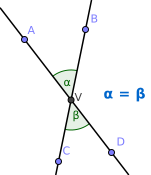
- Vertically opposite angles are angles that share a vertex and whose arms form opposite rays. Vertically opposite angles are always congruent, which means they have the same size.
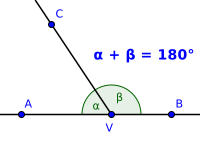
- Angles on a straight line are angles that have one arm in common while the other arms are opposite rays. Angles on a straight line always add up to 180°, a straight angle.
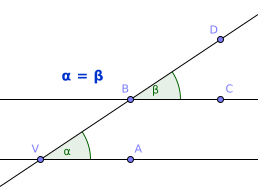
- Corresponding angles are angles whose first arms are parallel and whose second arms lie on one line. The angles must also have the same orientation. Corresponding angles are congruent.
There are other types of angles too, but they are just positions that can be derived from the three arrangements described above.
Operations with angles
We can carry out some elementary operations with angles. The most basic is addition. Numerically there is hardly anything to get wrong: you simply add the sizes of the angles. If an angle is more than 360°, it is usually converted to a simpler form, somewhere in the interval 0° − 360°. It is just as if you were working in base 360. Similarly, if an example has minutes or seconds, you have to calculate in base 60 (like ordinary clocks).
So, to be safe, here is one worked example. Add these angles: α = 183° 51′ and β = 222° 24′. First we work out the minutes: 51′ + 24′ = 75′ = 1° 15′ (the method is simple: divide 75 by sixty. The result gives the number of degrees and the remainder gives the number of minutes left over). Now we work out the degrees: 183° + 222° = 405°. To this partial result we add the previous result: 405° + 1° 15′ = 406° 15′. Now we keep subtracting 360 from this angle until it lies in the interval between 0 and 360. We do this because if we trace out an angle of 360°, we are back at the start, and an angle of 361° will look the same on paper as an angle of 1°. This gives us the calculation 406° 15′ = 46° 15′.
Chapters: Angle, How to construct an angle bisector, Copying an angle, Radian measure of angles, Directed angle, Sum of angles in a polygon, Converting road gradient to an angle
