
Circle
A circle is the set of all points in a plane that are the same distance from a given point, the centre of the circle. A circle is also one of the conic sections.
Describing a circle
Take a look at the diagram of a circle:
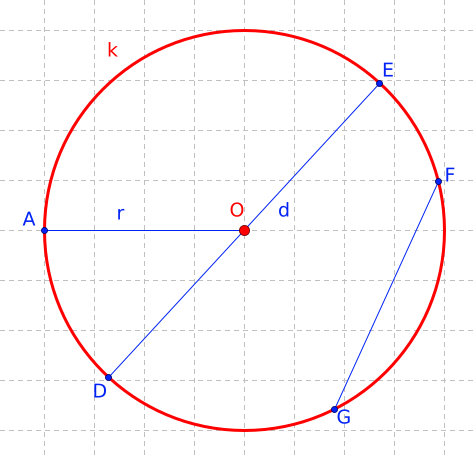
We usually label a circle with a lowercase letter k or l.
- Every circle has a centre, labelled O.
- All points on the circle are the same distance from the centre O. This distance is called the radius of the circle and is labelled r. In the diagram it is the line segment AO.
- A line segment that joins two different points on the circle is called a chord. In the diagram it is the line segment FG.
- A chord that passes through the centre O is called a diameter of the circle and is labelled d. So 2r = d.
We also talk about the inside and the outside of a circle. The inside is the set of all points whose distance from the centre is less than the radius. The outside is all the points whose distance from the centre is greater than the radius. If we take the circle together with its inside, we get a disc.
Circumference and area
What is the relationship between the diameter of a circle and its circumference? How many times bigger is the circumference than the diameter? If you take a disc and try measuring its diameter and then its circumference, you will find that it is about three times. More precisely, 3.1415 times, and more precisely still, π times.
The number π (pi) is an irrational number, that is, a number with an infinite decimal expansion that does not recur. So if the diameter of a circle is a fixed whole number, you can never find its circumference exactly. In everyday life, though, an approximate value is more than enough.
The formula for the circumference of a circle looks like this:
The formula for the area S of a circle:
Positions of two circles relative to each other
-
Concentric circles have a common centre O.
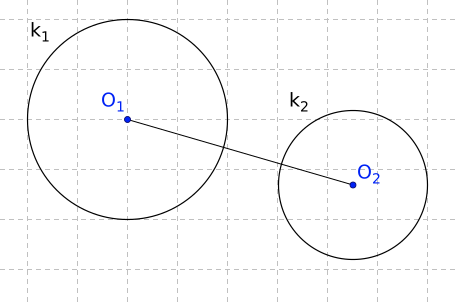
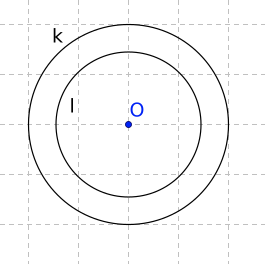 Circles that do not have a common centre are called non-concentric. The line segment that joins their centres is called the line of centres.
-
Circle k1 lies outside k2, and the circles have no common point.
-
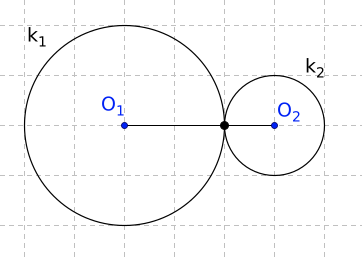
Circle k1 lies outside k2, but they touch at one point.
-
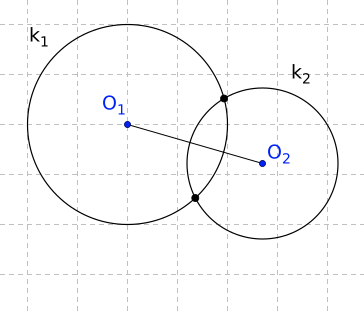
The circles intersect at two points.
-
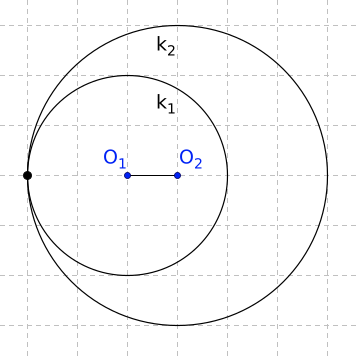
Circle k1 lies inside k2 and they touch at one point.
-
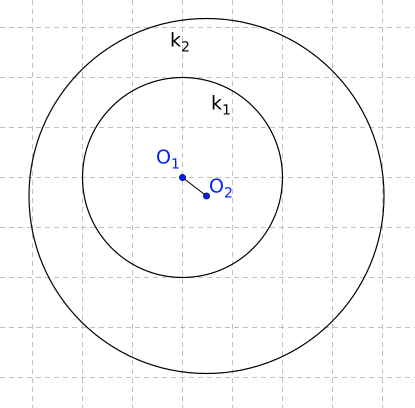
Circle k1 lies inside k2.
Arcs
Every chord with end points A and B divides the circle into two parts called arcs. Every point on the circle other than A and B is then an interior point of one of the arcs. We label an arc, for example, AXB, where X is an interior point of the arc.
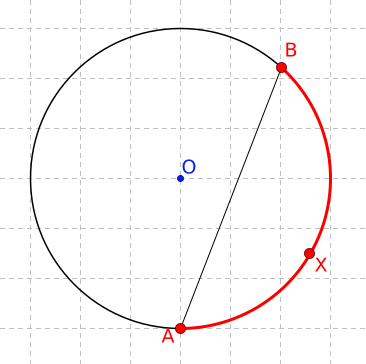
If the chord is also a diameter, it divides the circle into two congruent arcs, which we call semicircles. Otherwise the circle is always divided into two arcs of different lengths.
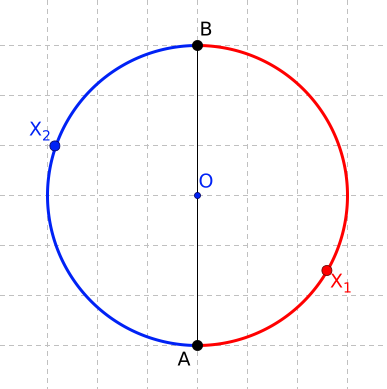
Angle at the centre
Take a circle k with centre O and an arc AB. Then we call angle AOB the angle at the centre subtended by arc AB. The smaller arc subtends an angle less than 180°, and the larger arc subtends a reflex angle (more than 180°).
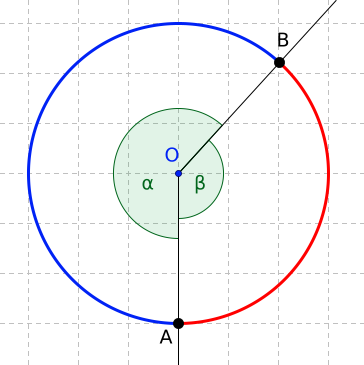
The circle in the diagram has two arcs AB marked. The angle α belongs to the larger arc and the angle β to the smaller one.
Angle at the circumference
Take a circle k with centre O and an arc AB. Now choose a point V that is not on this arc but is on the circle. Then angle AVB is called the angle at the circumference.
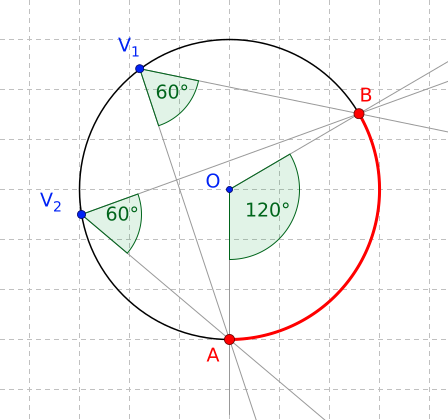
The diagram shows two angles at the circumference, AV1B and AV2B. Notice that both are the same size, 60°, and that this is half the size of the angle at the centre, 120°.
Chapters: Circle, Thales’ circle
