Dishwasher energy use: calculator vs. washing up by hand
A dishwasher for 12 to 14 place settings uses 0.55 to 0.95 kWh of electricity and about 10 litres of water on the eco programme, and the intensive programme at 70 °C takes up to 1.6 kWh. At an electricity price of 26p per kWh, one eco wash costs roughly 25p: 21p for electricity and 4p for water. If you run the dishwasher four times a week, you will pay around £52 a year.
Washing the same dishes in the sink usually costs more, often several times as much. The calculation below shows why.
Calculator based on the energy label
Since 1 March 2021, dishwashers have carried a label with classes from A to G. The main figure on it is the eco programme energy consumption in kWh per 100 cycles, and next to it you will find the eco programme water consumption in litres per cycle and the duration of the eco programme. Everything is measured on the eco programme with the dishwasher loaded to its rated capacity, so a hundredth of the figure on the label is the energy use of one wash: 80 kWh per 100 cycles means 0.8 kWh.
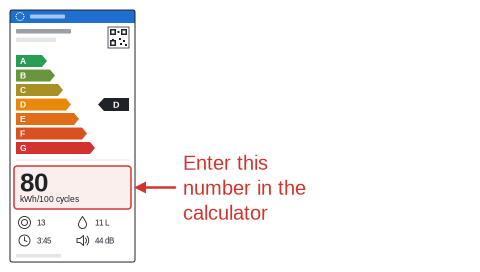
In this simplified drawing of the label, the number framed in red is the one that goes into the calculator.
The default values are for an ordinary dishwasher for 13 place settings. With four washes a week, it uses 0.8 · 208 = 166.4 kWh a year, which costs about £43.
How much energy each programme uses
Other programmes are given only in the manual, and only roughly. A fully loaded dishwasher for 12 to 14 place settings uses approximately the following (electricity at 26p per kWh):
| programme and duration | electricity | water | cost of electricity |
|---|---|---|---|
| pre-rinse, 15 min | about 0.05 kWh | about 4 l | about £0.01 |
| short, 30 min | 0.7 to 0.8 kWh | 9 to 10 l | £0.18 to £0.21 |
| quick 65 °C, 1 h | 1.1 to 1.3 kWh | 10 to 11 l | £0.29 to £0.34 |
| intensive 70 °C, 2 to 3 h | 1.3 to 1.6 kWh | 12 to 16 l | £0.34 to £0.42 |
| auto, 1.5 to 3 h | 0.75 to 1.5 kWh | 7 to 15 l | £0.20 to £0.39 |
| eco, 3 to 5 h | 0.55 to 0.95 kWh | 8.5 to 11 l | £0.14 to £0.25 |
Of the programmes that really wash the dishes, the longest one uses the least. Only the short programme comes out similar, and it is enough for lightly soiled dishes. The pre-rinse does not count.
The auto programme uses sensors to tell how dirty the water is, and with lightly soiled dishes it can use even less than eco.
Calculator for the cost of a wash by programme
You will find the energy use of each programme in the manual, and the table above is a rough guide:
The default values are for an ordinary dishwasher on the eco programme. We use 26p per kilowatt hour and £4.30 per cubic metre of water, which are typical prices in 2026, and you will find your own prices on your bill. The cost of a wash is the energy use in kWh times the price of a kilowatt hour, plus the litres of water times the price of a litre: for electricity we pay 0.8 · 0.26 = £0.208, ten litres at £0.0043 a litre add £0.043, and a wash comes to £0.251. Over a year we run the dishwasher 4 · 52 = 208 times and pay
The same calculation works for a washing machine, a fridge and a tumble dryer.
Dishwasher or washing up by hand?
A study by the University of Bonn looked for the answer. It invited 113 people from seven regions of Europe to a laboratory and gave each of them the same pile of dirty dishes, 12 place settings with 140 pieces, to wash the way they normally would. On average, it took 103 litres of water and 2.5 kWh of energy for heating, and they spent 79 minutes at the sink.
People from the Czech Republic and Poland ended up with 94 litres and 2.1 kWh, and the most economical, the Germans, with 46 litres and 1.3 kWh. And half of the participants did not get the dishes properly clean.
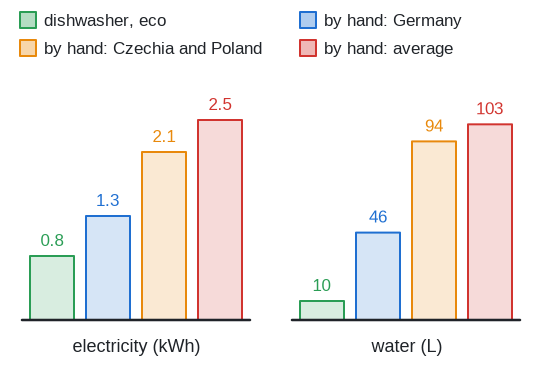
Where do the 2.5 kWh come from? The heat needed to warm up water is given by the formula
where m is the number of litres of water, Δt is how much we heat it, and c is the heat needed to warm a litre by one degree. Of the 103 litres, part is hot and part lukewarm, so let’s calculate as if all of it were at 36 °C. Tap water is at about 15 °C, so we heat it by 21 °C:
That is exactly the figure from the study, and the energy conversion calculator converts joules to kilowatt hours. The water in the sink was on average only lukewarm, and yet it used three times as much energy as the dishwasher. The dishwasher does wash at 50 to 65 °C, but it heats ten times less water: even ten litres heated from 15 to 65 °C cost only 0.58 kWh. So at the sink, what matters most is how much hot water runs through.
Work out your own washing up: you only need to estimate how much hot water you use for one dishwasher load of dishes:
The default values are the average of the Bonn study with electric heating. An efficiency of 100% is a lower estimate, because a hot water cylinder or a boiler loses some of the heat. One wash costs 2.51 · 0.26 ≈ £0.65 for heating and 103 · 0.0043 ≈ £0.44 for water, £1.10 in total. For 208 washes that is about £230 instead of the £52 for the dishwasher, a difference of about £180 a year.
With a gas boiler at about 6p per kWh and an efficiency of 80%, washing up by hand costs about 63p, which is still two and a half times as much as the dishwasher.
With a saving of £180 a year, a £400 dishwasher pays for itself in a little over two years, and with gas heating, where it saves around £79, in about five years. On average, it lasts around 12 years. And you also gain time: with four washes a week, more than half an hour a day.
Why eco takes three hours
Four things decide how clean the dishes get: temperature, chemistry, mechanical action (how forcefully the water sprays) and time. Whatever is taken away from one has to be added to another. The intensive programme heats the water to 70 °C and is done in two hours, while eco makes do with about 50 °C and lets the detergent tablet work for longer.
Most of the electricity goes on heating, and running the pump for longer costs almost nothing. The rest of the time goes on drying, when the water evaporates from the hot plates and condenses on the cooler walls.
How to save
- Use eco and run the dishwasher full. A half-empty dishwasher heats almost as much water as a full one, so each plate works out dearer.
- Do not rinse under running water. It is enough to scrape the leftovers into the bin, and manufacturers even have to state in the manual that rinsing by hand increases consumption. A mixer tap delivers several litres a minute, so a few minutes of rinsing use more water than a whole wash in the dishwasher. If the dishes have to wait until tomorrow, use the pre-rinse programme, which takes 4 litres.
- Keep the short and quick programmes for exceptions. The one-hour programme at 65 °C uses half as much again as eco. The difference of about 0.4 kWh comes to 208 · 0.4 · 0.26 ≈ £22 a year with four washes a week.
Sources
Chapters: Fridge energy consumption, Washing machine energy use, Tumble dryer energy use, Dishwasher energy use, Hot water cylinder energy use, TV energy use