Fridge energy consumption: calculator and running costs
A new fridge-freezer uses roughly 100 to 270 kWh a year, depending on how efficient and how big it is. At an electricity price of 26p per kWh, that works out at about £26 to £70 a year. An old fridge-freezer from the years 2000 to 2010, however, can easily use 300 to 450 kWh, which is roughly £78 to £120 a year. Compared with an efficient new fridge, that can be as much as three times as much.
A fridge works all year round without a break, day and night. So it is worth finding out how much it really uses.
Calculator based on the label
The energy label gives the annual consumption as a number with the unit kWh/annum. Enter it into the calculator together with the price of electricity. If the fridge is not new, add its age too, because consumption rises with age.
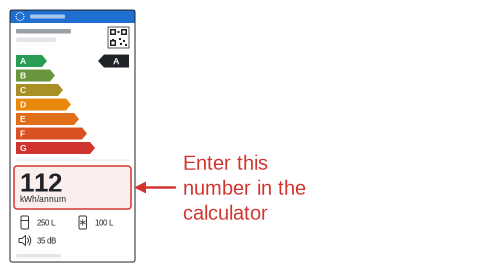
In this simplified drawing of the label, the number framed in red is the one that goes into the calculator.
The figure on the label comes from a laboratory test, so at home a fridge usually uses a little more (why).
The calculator is pre-filled with a price of 26p per kWh, which is the average unit rate under the Ofgem energy price cap for 1 October to 31 December 2026, and it changes every quarter. We only use the price per kilowatt hour. The daily standing charge, about 55p a day, is something you pay either way, whether you own the fridge or not. You will find your exact price on your bill or on the Ofgem page.
How consumption grows with age
The insulation in a fridge ages over time, and the fridge then has to work harder to keep cool. According to a study by German universities in Paderborn and Bonn (a model backed by insulation tests), consumption rises by at least 1% a year. That may not sound like much, but just as with exponential growth, the percentage is calculated each year from an already higher consumption. So every year we multiply the consumption by 1.01.
Take a fridge labelled 112 kWh a year. After one year it uses
after two years 112 · 1.01 · 1.01 = 112 · 1.012, and after ten years
In ten years the fridge’s consumption has gone up by roughly 10%, and after twenty years it would be 1.0120 ≈ 1.22, that is 22% more. At 26p per kWh, a ten-year-old fridge costs us
a year, which comes to
How much different fridges use
The consumption of a fridge depends mainly on its size, on whether it has a freezer and on its energy class. Typical values for appliances sold in 2026 are these:
| appliance | consumption per year | cost per year at 26p/kWh |
|---|---|---|
| small under-counter fridge without a freezer, class E | about 92 kWh | about £24 |
| fridge-freezer, class A | about 112 kWh | about £29 |
| 200 l chest freezer, class E | about 200 kWh | about £52 |
| fridge-freezer, class E | 245 to 270 kWh | £64 to £70 |
| American-style fridge-freezer, class F | about 435 kWh | about £110 |
| old fridge-freezer from 2000 to 2010 | 300 to 450 kWh | £78 to £120 |
Notice that a small class E fridge gets by on less energy than a large class A fridge-freezer. The class does not say how much a fridge uses, but how economically it cools for its size. The American-style fridge-freezer uses almost four times as much as a class A fridge-freezer.
For perspective: the average newly sold fridge-freezer in the European Union needed around 477 kWh a year in 1990, and by 2020 only 181 kWh.
What the energy label says
Since 1 March 2021 a new label with a scale from A to G has been in use. On it you will find:
- a QR code that takes you to the appliance’s details in the European database,
- the manufacturer and model name,
- the energy class,
- the annual consumption in kWh,
- the volume of the fridge and freezer compartments in litres,
- the airborne acoustical noise emissions in decibels and the noise emission class from A to D.
In Great Britain a UK version of the label has applied since 2021, with the same A to G scale and the same way of measuring (Northern Ireland uses the EU label).
The class is determined by the energy efficiency index (EEI). It says what percentage of the “standard” consumption of an appliance of the same size and type the fridge uses. Class A means at most 41% of the standard consumption. Then come B up to 51%, C up to 64%, D up to 80%, E up to 100%, F up to 125% and G above 125%. A class E fridge therefore uses 80 to 100% of what is expected from a fridge of its size, and a class A fridge less than half.
Why the old A+++ cannot be converted
The old label had classes from A+++ to G. It is tempting to assume that A+++ corresponds to today’s A, A++ to today’s B and so on. But it does not work like that. The old label was measured at an ambient temperature of 25 °C and with a different formula for standard consumption. The new one uses the average of the consumption measured at 16 °C and at 32 °C. So there is no conversion table, and many fridges that had A+++ or A++ now fall into class D or E. They did not get any worse, they are just measured differently and graded more strictly.
Why it uses more at home than the label says
For the label test, the fridge is set to 4 °C and the freezer to −18 °C, the doors stay closed and no food is put inside. At home, by contrast, the door is opened, the fridge stands in a warmer or colder kitchen and, above all, it gets older. The figure on the label is good for comparing fridges in a shop, but yours will almost certainly use a bit more at home.
Why a fridge does not guzzle power all the time
An efficient fridge-freezer uses 112 kWh a year. How many watts is that on average? A year has 365 · 24 = 8,760 hours. Let’s convert kilowatt hours to watt hours:
And divide by the number of hours in a year:
So on average a fridge draws only about 13 W, yet its compressor draws 50 to 150 W while it is running. How does that add up? The compressor does not run all the time. It switches on, cools the inside, switches off and starts again once the fridge has warmed up. The technical term for this is that the compressor cycles.
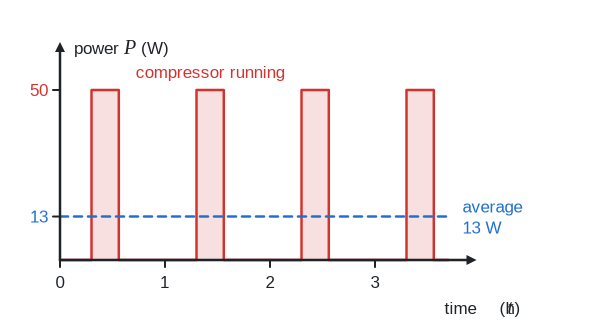
In the picture, the horizontal axis shows time in hours and the vertical axis shows power in watts. The red rectangles are the moments when the compressor is running and drawing 50 W. The blue dashed line is the average, 13 W. What fraction of the time does the compressor run? We divide the average power by the power while running:
So the compressor works for roughly 26% of the time, which is about 16 minutes in every hour. The area of the red rectangles comes out the same as if the fridge drew 13 W the whole time. Modern inverter compressors do it differently: they run most of the time, but at a lower power. The percentage of running time alone therefore tells us nothing, and what matters is the average power.
An old fridge using 400 kWh a year draws on average
Measure your own fridge
The most reliable approach is to measure the consumption. All you need is a plug-in energy meter for around £15 or a smart plug with energy monitoring. Plug the fridge into it and let it measure for at least a week.
Why not just a short while? With a five-minute measurement you would hit either the compressor running or a pause, and you would get 50 W one time and almost nothing the next. A fridge with automatic defrosting also switches on a heating element now and then, the door is opened more often at weekends than on weekdays, and in summer the kitchen is warmer than in winter. A week-long measurement evens all this out.
Suppose the meter showed 6.6 kWh after seven days. Per day that is
At 26p per kWh, that comes to
a year. A fridge like that is a real power hog.
The calculator works out the average power too. Our fridge draws about 39 W on average, three times as much as the efficient fridge-freezer from the previous section.
What raises consumption
Temperature in the fridge. Every degree colder means roughly 6% higher consumption. Someone who keeps the fridge at 2 °C instead of 5 °C pays about 1.063 ≈ 1.19 times as much, that is 19% more. The Food Standards Agency advises keeping the fridge at 5 °C or below and the freezer at −18 °C. A sensible setting is 3 to 5 °C, and it is worth checking it with a thermometer from time to time.
A warm room. Of everything you can influence at home, the surrounding temperature has the greatest effect on consumption. The warmer the room, the more the fridge has to cool, and the direction is clear: a fridge does not belong next to the cooker or a radiator, or anywhere the sun shines on it.
Ventilation. The fridge gets rid of the heat taken from the inside through a grille at the back or at the bottom. If you block it with furniture or it gets clogged with dust, the compressor has to run for longer.
Seals and frost. A cracked or hardened seal lets warm air in. A layer of frost in the freezer, on the other hand, acts as insulation on the wrong side, so defrost the freezer now and then.
Age. As we showed above, consumption rises by at least 1% a year.
And what about opening the door? That is what worries people most, but according to the same study, opening it twelve times a day adds only about 2% to consumption. Opening the fridge and spending five minutes pondering what you fancy is a different kettle of fish :-).
Is it worth replacing an old fridge?
A new fridge does save electricity, but it also costs something. You can work out when the investment pays off from the difference in consumption between the old and the new fridge.
We will use our measured fridge with 344 kWh a year and a new class A fridge-freezer with 112 kWh a year costing £750. The difference in consumption is
a year. At 26p per kWh we save
a year. How many years will it take to save the price of the new fridge? We divide:
The new fridge pays for itself in roughly 12 years. So replacing it is worthwhile, just not very quickly.
If the old fridge used only a few tens of kWh more than the new one, the payback would stretch to decades. The German consumer organisation Stiftung Warentest therefore advises replacing a working fridge only when it uses two to three times as much as a new efficient one. Otherwise it is better to let it serve out its time.
The saving shows up more reliably when you choose a new fridge. Imagine that in a shop you are choosing between a class A fridge-freezer for £750 and a similarly sized class E fridge-freezer for £450, which uses 138 kWh a year more. That is
a year. The extra £300 pays for itself in
So the more efficient fridge pays for itself in about 8.4 years and from then on it only saves you money. If electricity gets more expensive, it will pay for itself sooner.
How the calculation works
Let’s sum up how consumption is calculated. Energy is power times time. When an appliance with a power of P watts runs for t hours, it uses
watt hours. A thousand watt hours make one kilowatt hour, so we divide the result by a thousand. For example, a compressor with a power of 50 W running 6 hours a day draws 50 · 6 = 300 Wh a day, that is 0.3 kWh. You can find more about the conversion in the watt to kWh calculator.
The cost is the consumption times the price per kilowatt hour:
where E is the consumption in kWh and c is the price of one kWh. So the daily running of the compressor costs us 0.3 · 0.26 = 0.078 pounds, which is just under 8p.
From a measurement over d days we get the annual consumption by the rule of three: in d days Ed, in 365 days
After n years of ageing, consumption grows to E · 1.01n, because 1% is added every year (percentages are calculated from last year’s value).
And the payback of a replacement is the price of the new appliance divided by the annual saving:
It comes out in years. When the denominator is small, that is, when the new fridge saves only a little, the payback comes out long and replacing is not worthwhile.
Sources
Chapters: Fridge energy consumption, Washing machine energy use, Tumble dryer energy use, Dishwasher energy use, Hot water cylinder energy use, TV energy use