Washing machine energy use: cost per wash calculator
One wash in a modern washing machine uses 0.3 to 2.5 kWh, depending on the programme. At 20 °C it is about 0.3 kWh, at 40 °C around 0.9 kWh and at 90 °C more than 2 kWh. At an electricity price of 26p per kWh, a 40 °C wash costs about 23p for electricity and roughly another 22p for water. If you wash four times a week, the machine costs you around £93 a year, and about half of that goes on water.
The efficiency of the machine itself is not the main thing, though. What matters far more is the temperature and the programme you choose.
Calculator based on the energy label
Since 1 March 2021, washing machines have carried a label with a scale from A to G. Besides the class, it shows the weighted energy consumption in kWh per 100 cycles, the rated capacity, the weighted water consumption per cycle, the programme duration and the airborne acoustic noise emissions. Everything is measured on the eco 40-60 programme.
You get the energy use of one wash by dividing the figure on the label by a hundred: a machine with 47 kWh per 100 cycles uses 0.47 kWh on average. But that is an average of full, half and quarter loads. With a full drum the same machine uses more, say 0.79 kWh.
The calculator works out the annual consumption and cost from the label. It only applies to the eco 40-60 programme, so if you wash at 60 °C or 90 °C, you will pay more. How much each programme uses is shown in the table below.
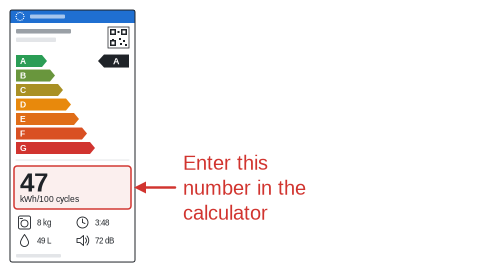
In this simplified drawing of the label, the number framed in red is the one that goes into the calculator.
With four washes a week, our class A machine on the eco 40-60 programme uses roughly 0.47 · 208 = 97.76 kWh a year, which costs you 97.76 · 0.26 ≈ £25.
How much energy a wash uses at each temperature
The energy a wash uses depends above all on the temperature. A machine with a capacity of 7 to 9 kg and a full drum typically uses:
| programme | energy per wash | cost of electricity at 26p/kWh |
|---|---|---|
| cotton 20 °C | about 0.3 kWh | about £0.08 |
| cotton 30 °C | about 0.4 kWh | about £0.10 |
| cotton 40 °C | about 0.9 kWh | about £0.23 |
| eco 40-60 | 0.7 to 1.0 kWh | £0.18 to £0.26 |
| cotton 60 °C | 1.2 to 1.8 kWh | £0.31 to £0.47 |
| cotton 90 °C | 2.2 to 2.5 kWh | £0.57 to £0.65 |
| wool 30 °C (about 2 kg) | 0.2 to 0.35 kWh | £0.05 to £0.09 |
A 90 °C wash uses seven to eight times as much energy as a 20 °C one, even though the same amount of laundry gets washed. Figures for programmes other than eco 40-60 are only a rough guide, because every machine controls its programmes in its own way, and so, for example, “60 °C” heats the water to only 55 °C in some machines. A half-empty drum on an ordinary programme saves less than you would expect (why).
The wool programme washes only about 2 kg of laundry in cold or lukewarm water, so it cannot be compared with a full drum. It uses little electricity, but you pay about 16p for the 35 to 40 litres of water, which is more than for the electricity.
Calculator for the cost of a wash by programme
Enter how many kWh one wash uses, how many times a week you wash and what you pay for electricity and for water. How much each programme uses is in your machine’s manual, or in the table above.
The default values are for a cotton wash at 40 °C with a full drum. We use 26p per kilowatt hour and £4.30 per cubic metre of water, which are typical prices in 2026. We leave out fixed monthly charges, because you would pay those even without a washing machine. You will find your own prices on your bill.
We can do the same without the calculator. One wash costs 0.9 · 0.26 = £0.234 for electricity, and for fifty litres of water at £0.0043 per litre another 50 · 0.0043 = £0.215. With four washes a week we do 4 · 52 = 208 washes a year and pay
Of that, 208 · 0.234 ≈ £48.7 is for electricity and 208 · 0.215 ≈ £44.7 for water. So electricity costs a little more than water, but not by much: water still makes up almost half of the bill.
Why 40 °C instead of 60 °C saves so much
The drum and the pump together use only 0.1 to 0.4 kWh per wash. In a 60 °C wash, more than half of the energy, according to one manufacturer even two thirds, goes on heating. The heat the water needs is given by the formula
where m is the mass of the water in kilograms, c is the specific heat capacity of water, that is 4,180 joules per kilogram per degree, and Δt is the temperature difference. The machine heats only the water for the main wash, and rinses in cold water. How much that is depends on the machine. Let’s estimate it as 15 litres. Tap water is usually about 10 to 15 °C, so we take the upper limit. To get it to 40 °C we have to heat it by 25 °C:
A kilowatt hour is 3,600,000 joules (energy conversion), so the heating costs about 0.44 kWh. The same calculation for 60 °C gives 0.78 kWh.
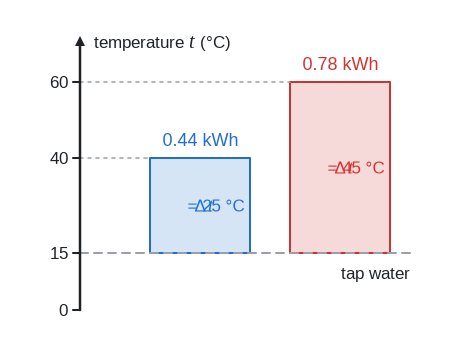
The energy grows with the temperature difference, not with the number on the display: the temperature on the display goes up by half, but Δt rises from 25 to 45 °C, which is 1.8 times as much, so heating for 60 °C is 80% more expensive. Heating the laundry and the drum and heat losses add another half, according to a European study, and the motor with the pump about 0.25 kWh, so we get 0.91 kWh for 40 °C and 1.42 kWh for 60 °C, which is of the same order as in the table. Someone who washes twice a week at 60 °C and switches to 40 °C saves, according to the table, roughly 104 · (1.5 − 0.9) = 62.4 kWh a year, which is about £16.
Why the eco programme takes so long and still saves energy
In a single wash, the eco 40-60 programme has to clean normally soiled cotton that is meant to be washed at both 40 and 60 °C, and it usually runs for 3 to 4 hours. How clean the laundry gets depends on temperature, detergent, time and the movement of the drum, and whatever we take away from one, we have to add to another. So the eco programme heats the water less, perhaps only to 33 to 39 °C, and lets the laundry soak and tumble for longer, which costs almost nothing, because turning the drum uses very little.
How to save
- Wash at a lower temperature. Normally soiled laundry comes clean on a 30 or 40 °C programme, lightly soiled laundry even on the 20 °C programme that every new machine must have, and you can keep higher temperatures for towels, bed linen or the laundry of someone who has been ill.
- Whenever you are not in a hurry, leave it on the eco 40-60 programme, which by regulation has to be set as the default: our 8 kg machine uses 0.79 kWh on it with a full load instead of 1.75 kWh on the cotton 60 °C programme, so only 45%.
- Wash with a full drum: people put only 3.3 to 3.4 kg of laundry in the machine on average, and in a European study a 7 kg machine used 0.88 kWh on the cotton 40 °C programme with a full load and 0.70 kWh with 3.4 kg of laundry, so two half loads cost almost 60% more, on the eco 40-60 programme only about 6%.
- If you use a tumble dryer, spin at a higher speed: after 1,000 rpm the laundry still holds about 60% water relative to the weight of the dry laundry, after 1,400 rpm around 50%, and according to the spin-drying efficiency class on the label A is below 45%, B 45 to 54% and C up to 63%, and whatever you do not spin out, the dryer has to evaporate (how much that costs).
- If you dry on a line, do not chase high spin speeds: a higher speed does not save electricity there, the laundry just dries sooner and comes out more creased.
Is a new washing machine worth it?
Suppose that an old washing machine uses 1.2 kWh per wash and a new one 0.7 kWh, so over 208 washes a year that is 250 and 146 kWh. The difference of 104 kWh comes to 104 · 0.26 = £27.04 a year, and a new machine for £400 pays for itself, through the electricity saving alone, in
The calculator takes only electricity into account. If the new machine uses 15 litres less water per wash, it saves another £13 or so a year (3.12 m³ at £4.30), and the payback shortens to
How the calculation works
The cost C of one wash is
where E is the energy use of the wash in kWh, cE is the price of one kWh, V is the water use in litres and cV is the price of a litre of water, that is the price per cubic metre divided by a thousand. For the annual cost, we multiply it by the number of washes per week and by 52 weeks. The payback of a new machine is its price divided by the annual saving on electricity and water. How to work with kilowatt hours and watts is explained in the watts to kWh calculator.
Sources
Chapters: Fridge energy consumption, Washing machine energy use, Tumble dryer energy use, Dishwasher energy use, Hot water cylinder energy use, TV energy use