Hot water cylinder energy use: yearly cost calculator
An electric hot water cylinder for two people uses about 2,060 kWh a year, or around 5.6 kWh a day. At 15p per kWh on Economy 7, that comes to roughly £310 a year. Someone living alone gets by on about £180, and a family of four pays £580. Where an immersion heater heats the water, the cylinder is usually the biggest electricity user in the home, hungrier than the fridge, the washing machine and the dishwasher put together.
Hot water cylinder energy use calculator
A cylinder has no “kWh per use” printed on it. But you can build an estimate from figures you know: how many of you there are, roughly how much hot water you use and what temperature the cylinder is set to. Heat loss is added on top, that is, the heat that slowly leaks out of the tank even when nobody is running the hot tap.
Forty litres per person per day covers a short shower, washing hands and washing up; people who love a bath need more. If you do not know the heat loss of your cylinder, keep 1 kWh a day, which is typical for a tank of 80 to 100 litres, and assume mains water at 10 °C. A price of 15p per kWh is a typical Economy 7 night-rate price in 2026, and you will find your own prices on your bill.
How much a hot water cylinder uses by number of people
In the table, every person has the same 40 litres of water at 60 °C, electricity costs 15p per kWh and the annual figures are rounded. A bigger household needs a bigger cylinder, though, and that loses more heat.
| people | cylinder | heating + losses per day | kWh per year | £ per year |
|---|---|---|---|---|
| 1 | 50–80 l | 2.3 + 1.0 kWh | 1,210 | 180 |
| 2 | 80 l | 4.6 + 1.0 kWh | 2,060 | 310 |
| 3 | 125 l | 7.0 + 1.2 kWh | 2,980 | 450 |
| 4 | 160 l | 9.3 + 1.4 kWh | 3,900 | 580 |
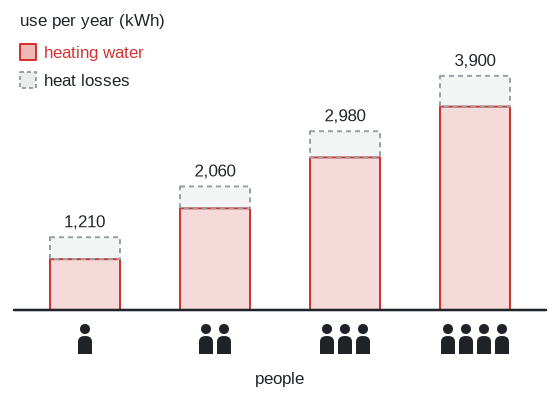
For one person, heat loss makes up almost a third of the energy use, for four people only about an eighth. The tank cools at the same rate whether a little or a lot of water is drawn from it.
More important than the number of people, however, is how you wash. A full bath takes about 4.2 kWh, a shower 1.63 kWh (calculation below). A daily bath instead of a shower therefore adds about £140 to the annual bill.
How much energy a single shower uses
The heating element in the cylinder turns electricity into heat practically without waste. The heat needed is given by the same formula as for a washing machine or a dishwasher:
where m is the mass of the water in kilograms (a litre of water weighs a kilogram), c = 4,180 is the specific heat capacity of water, that is, how many joules a kilogram of water needs to warm up by one degree, and Δt is the temperature difference by which we heat the water.
An ordinary showerhead lets through 10 litres a minute, so 50 litres in a five-minute shower. We run it at 38 °C and the water comes in from the mains at 10 °C, a difference of 28 °C. If we divide the result by 3,600,000, the number of joules in a kilowatt hour (energy conversion), we get kWh directly:
At 15p per kWh, one shower costs you roughly 24p.
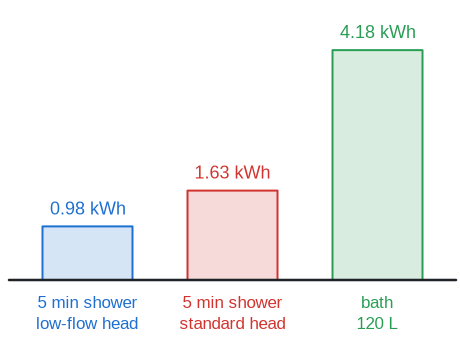
The bars in the picture run from the left: a shower of the same length with a water-saving head at 6 litres a minute takes 0.98 kWh, the middle one is an ordinary shower with 1.63 kWh, and on the right is a bath of 120 litres of water at 40 °C, which swallows 4.18 kWh, as much as two and a half showers.
The cylinder calculator above rests on the same principle. Two people with 40 litres each, heated from 10 to 60 °C, need
a day, and with a loss of 1 kWh it is 5.64 kWh. Over a year this adds up to 2,060 kWh and £309.
Work out your own. You can measure the flow in a few seconds: run the shower flat out into a bucket for 10 seconds and multiply the litres by six.
Someone who showers once a day pays about £89 a year for heating alone. Water and sewerage charges are paid separately.
Economy 7 and the size of the cylinder
Most cylinders heat on Economy 7, that is, on cheaper electricity in the off-peak night hours. For the rest of the day the heating element stays off, so the tank has to keep enough hot water for about a whole day. For a couple using 40 litres each, 80 litres is enough, and for a family with a bath 160 litres is handy. Heating the daily amount takes a few hours, so the cylinder manages it in the off-peak hours even after an evening bath.
What the energy label shows
Since September 2017, water heaters have carried a label with classes from A+ to F, and cylinders with an immersion heater are usually in class B or C. The annual energy consumption on the label comes from a standard test draw-off. It is useful for comparing water heaters with each other, but it cannot estimate your actual consumption.
What raises consumption and how to save
- Take a shower, and a short one. Every minute under an ordinary shower costs about 5p, and a bath is two and a half showers.
- Get a water-saving showerhead at 6 litres a minute; for two people showering daily it saves about 475 kWh and £71 a year.
- Do not set the cylinder higher than 60 °C: going from 70 to 60 °C cuts losses by about a fifth, which for an ordinary cylinder is over 90 kWh and £14 a year.
- But do not go below 60 °C, because legionella can multiply in cooler water in the cylinder. A lower temperature also saves only on losses, since you then mix less cold water into the shower.
- Heat on Economy 7: at the standard price of 26p, two people would pay about £540 for the same cylinder instead of £310.
- Insulate the pipes from the cylinder and do not put the tank in an unheated room.
- Switch the cylinder off before a holiday; for every day away you save about 15p.
Is a new cylinder worth it?
An old and a new cylinder use the same energy for heating the water; only the losses differ. An older one with worse insulation may lose, say, 2 kWh a day, a new one 1 kWh. For two people that makes 2,425 kWh and 2,060 kWh a year, a difference of 365 kWh worth 365 · 0.15 = £54.75. A new cylinder for £600 pays for itself in
Add the cost of installation to the price of the cylinder. You can find out the losses of your own on holiday: when nobody is running the hot tap, the night-rate reading on your meter only goes up by what the cylinder loses, plus whatever runs on its own, such as the fridge. A heat pump water heater takes roughly a third of the electricity, but it costs several times as much to buy.
Sources
Chapters: Fridge energy consumption, Washing machine energy use, Tumble dryer energy use, Dishwasher energy use, Hot water cylinder energy use, TV energy use