Tumble dryer energy use: calculator and when it pays off
A heat pump tumble dryer uses about 1.5 kWh to dry a full drum, while an older condenser dryer with a heating element uses around 4.4 kWh. At 26p per kWh, one load therefore costs about 39p or £1.14. If you dry twice a week, you pay roughly £41 a year with a heat pump and almost £120 with a heating element.
That is three times as much, even though both machines do the same thing: they drive the water out of the laundry.
Calculator based on the energy label
Since 1 July 2025, new tumble dryers have carried a label with a scale from A to G. Besides the class, it shows the weighted energy consumption in kWh per 100 cycles, the rated capacity, the duration of the eco programme and the airborne acoustic noise emissions. The old label with classes A+++ to D cannot be converted to the new one.
The energy use of one load is a hundredth of the figure on the label: a dryer with 85 kWh uses 0.85 kWh on average. But that is an average in which a half load carries much more weight than a full one, because people mostly fill the dryer only halfway. With a full drum the same dryer uses more, say 1.5 kWh.
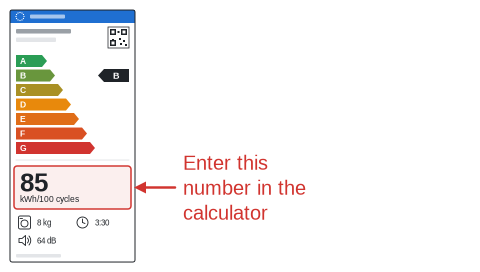
In this simplified drawing of the label, the number framed in red is the one that goes into the calculator.
With two loads a week, a dryer with 85 kWh on the label uses 0.85 · 104 = 88.4 kWh a year, which costs you 88.4 · 0.26 ≈ £23. If you dry full drums, expect higher consumption than the calculator shows.
Condenser or heat pump?
Tumble dryers differ in two ways: how they heat the air and what they do with the water that evaporates from the laundry. A vented dryer heats the air with a heating element and then blows the damp air out of your home through a hose. A condenser dryer with a heating element cools the air inside the machine, the vapour condenses into water, which runs into a tank. A dryer with a heat pump is also a condenser dryer, but it replaces the heating element with a heat pump, the same device that cools a fridge. A European study from 2019 summarised how much each type uses, for the average dryers sold in 2016:
| type of dryer | full load | half load | full load at 26p/kWh |
|---|---|---|---|
| vented with a heating element, about 7 kg | 4.0 kWh | 2.2 kWh | £1.04 |
| condenser with a heating element, about 8 kg | 4.4 kWh | 2.4 kWh | £1.14 |
| heat pump, older, about 8 kg | 1.9 kWh | 1.0 kWh | £0.49 |
| heat pump, efficient, 9 kg | about 1.5 kWh | about 0.8 kWh | £0.39 |
The figures in the last row come from the manual of an efficient 9 kg dryer, and the rest are market averages.
A half load takes more than half of the energy, because the drum, the air and the metal parts have to be heated just the same, whether there is a little laundry inside or a lot.
A heat pump has a catch, though: it dries more slowly. A full load took it 163 minutes on average, while a condenser dryer with a heating element took 129 minutes. It is also dearer in the shop: a new 8 kg heat pump dryer costs roughly £350 to £700.
You no longer have to choose anyway. Since 1 July 2025, new vented or condenser dryers with a heating element for more than 3 kg of laundry may no longer be placed on the EU market. So the only new dryers made are heat pump, gas and small ones of up to 3 kg. You will mostly meet a heating element in a dryer that you already own.
Calculator for the cost of drying by programme
Enter how many kWh your dryer uses for one load, how many times a week you dry and what you pay for electricity. You will find the consumption in the manual, and the table above gives a rough guide.
The default values are for a 9 kg heat pump dryer, fully loaded, after a spin at 1,000 rpm. We use 26p per kilowatt hour, which is a typical price in 2026. We leave out fixed charges, because you would pay those even without a dryer. Even two loads a week is not made up: according to a manufacturers’ survey from 2018, a European dryer runs 2.05 times a week on average.
On paper it is simple. One load costs
Twice a week makes 2 · 52 = 104 loads a year, for which the dryer uses 104 · 1.5 = 156 kWh. For that we pay
How much energy the water in the laundry swallows
Why does drying cost so much in the first place? It is not enough to heat the water: it has to turn into vapour, and for that every kilogram of water swallows the so-called latent heat of vaporisation, about 2,260,000 joules. With the same energy you could heat that kilogram of water from 0 to 100 °C more than five times over. After a spin at 1,000 revolutions per minute, a washing machine leaves about 60% water in 8 kg of laundry, which is 4.8 kg. To evaporate it, we need the heat
where m is the mass of the water in kilograms and L is the latent heat of vaporisation in joules per kilogram. Substituting:
A kilowatt hour is 3,600,000 joules (energy conversion), so we get about 3.0 kWh, with which a kettle would boil roughly 30 litres of water. That is the physical minimum for a dryer that makes heat with a heating element, and a real condenser dryer needs 4.4 kWh, because it also heats the drum, the air and the laundry, and some of the heat escapes into the room.
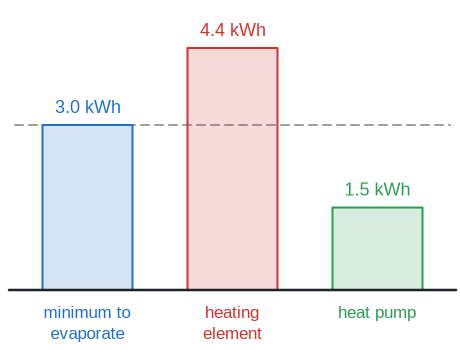
The green bar of the heat pump dryer ends far below the grey dashed line of the minimum, and yet no law of physics is broken. The heat released when the vapour condenses is not thrown out into the room: a compressor pumps it back to heat the air for the drum. For every kWh of electricity, the machine therefore delivers about 3 kWh of heat, altogether 1.5 · 3 = 4.5 kWh, roughly as much as a dryer with a heating element uses.
How to spin out more water in the washing machine
The cheapest kilogram of water is the one that never goes into the dryer, and according to the German Federal Environment Agency, the energy for a higher spin speed is negligible.
| revolutions per minute | residual moisture | water in 8 kg of laundry | minimum for evaporation |
|---|---|---|---|
| 1,000 | 60% | 4.8 kg | 3.0 kWh |
| 1,200 | 53% | 4.2 kg | 2.7 kWh |
| 1,400 | 50% | 4.0 kg | 2.5 kWh |
| 1,600 | 44% | 3.5 kg | 2.2 kWh |
The manual of one 9 kg heat pump dryer gives, for a full drum, 1.47 kWh after 1,000 rpm, 1.25 kWh after 1,400 rpm and 1.10 kWh after 1,600 rpm. Going from 1,000 to 1,400 rpm therefore saves about 23 kWh and £5.98 over 104 loads a year. A dryer with a heating element saves more, up to about £20 a year. The spin-drying efficiency class on its label gives you an idea of how many revolutions your washing machine can manage (washing machine energy use), but do not put shirts and delicates on 1,600 rpm, because they will crease. The spin speed also affects how long drying takes.
Is a heat pump dryer worth it?
A condenser dryer with a heating element uses 4.4 kWh with a full drum and a new heat pump one 1.5 kWh, so over 104 loads a year they use 458 and 156 kWh. The difference of 302 kWh comes to 302 · 0.26 = £78.52 a year, and a new dryer for £500 pays for itself in
The average household, though, fills the drum only halfway. With consumption weighted as on the label, that is 2.88 kWh for the old dryer and 0.97 kWh for the new one, the saving is about £52 and the payback around 10 years, whereas a dryer lasts 12 years on average. If you dry often and your old dryer uses a heating element, replacing it may pay off; if you dry only now and then, let the old one serve out its time.
Washing line or dryer?
On a washing line outside, laundry really does dry for free, even in frost, only more slowly. But what about a clothes airer in the living room in winter?
Water does not evaporate from laundry on its own. It needs heat to evaporate, and it takes that heat from the air in the room. You know this from swimming: wet skin feels cold precisely because of the water evaporating from it. Wet laundry on an airer therefore quietly cools the room, and the heating has to make up for it.
How much is that? The airer has to evaporate the same 4.8 kg of water as the dryer, and that takes roughly 3 kWh of heat. If you heat with electric heaters, one load on the airer costs about 3 · 0.26 = £0.78, more than a heat pump dryer. With a gas boiler or a heat pump for the whole house the heat is cheaper, but it is never free.
On top of that comes humidity. Without ventilation it condenses on cold windows and in corners, where mould can then start to grow. So it is best to dry outdoors or in an unheated, well-ventilated room. If you must dry indoors, ventilate properly for a short time at regular intervals, even though every open window lets some heat escape.
A condenser dryer, on the other hand, leaves all the heat from drying in your home, so in winter it helps to heat your home. A vented one blows it out through the hose.
How the calculation works
The cost of one load is the energy use in kWh times the price of a kWh, and for the annual cost we multiply it by the number of loads per week and by 52 weeks. A hundredth of the figure on the label is a weighted average in which a full load has a weight of 24% and a half load 76%, which is why a full drum uses more. The payback of a new dryer is its price divided by the annual saving on electricity. Conversions between watts and kilowatt hours are shown by the watts to kWh calculator.
Sources
Chapters: Fridge energy consumption, Washing machine energy use, Tumble dryer energy use, Dishwasher energy use, Hot water cylinder energy use, TV energy use