TV energy use: calculator for an hour and a year of viewing
An ordinary 55-inch TV uses around 70 W while you watch. An hour in front of the screen therefore costs less than 2p: 0.07 kWh at 26p comes to 1.82p. If you watch four hours a day, it uses about 102 kWh a year and costs roughly £27. A small 32-inch set costs less than half of that, and a giant 75-inch one about £38 a year.
We assume four hours a day, including online videos.
Calculator based on the energy label
The label is dominated by a large letter showing the energy efficiency class, and below it is the energy consumption in kWh per 1,000 hours. If you divide the number by a thousand, you get the energy use of one hour of watching: 70 kWh per 1,000 hours means 0.07 kWh per hour. The same number is also the average power in watts.
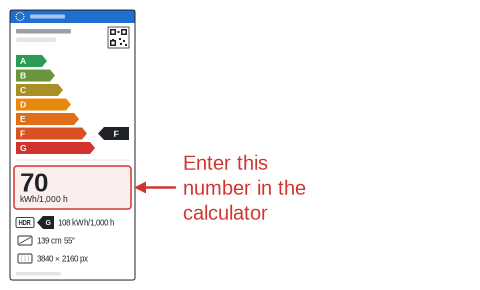
In this simplified drawing of the label, the SDR number framed in red is the one that goes into the calculator; the HDR number is at the bottom in smaller print.
The calculator is set to an ordinary 55-inch TV. Over a year it uses 0.07 · 4 · 365 = 102.2 kWh, which comes to about £27. A price of 26p per kWh is typical in 2026; you will find your own on your bill.
There are two energy consumption figures on the label. The calculator needs the main number in the middle of the label (SDR), which applies to ordinary broadcasts and films. The HDR figure at the bottom is higher and applies to the brighter picture from paid streaming services and games. If you watch those often, try that figure too.
In Great Britain a UK version of the label applies, with the same A to G scale (Northern Ireland uses the EU label).
How much a TV uses by size
Typical power of new TVs in the default settings and in SDR, with the energy use and cost per year at four hours a day (1,460 hours a year) and 26p per kWh:
| TV | power | kWh per year | cost per year |
|---|---|---|---|
| 32″ LED (81 cm) | 30 W | 44 | £11 |
| 43″ LED (109 cm) | 50 W | 73 | £19 |
| 55″ LED/QLED (140 cm) | 70 W | 102 | £27 |
| 55″ OLED (140 cm) | 80 W | 117 | £30 |
| 65″ LED/QLED (165 cm) | 85 W | 124 | £32 |
| 65″ OLED (165 cm) | 95 W | 139 | £36 |
| 75″ LED/QLED (191 cm) | 100 W | 146 | £38 |
The most economical sets of the same size manage with a quarter less power, and the worst ones use a third more. The inches to centimetres calculator converts the sizes.
The picture mode matters more than the technology, though. Vivid or shop mode turns the brightness all the way up, and consumption jumps a third, or even half, above the figure on the label.
Calculator for an older TV based on the power rating
TVs sold before 2021 have an older label, which shows the power in watts directly and the energy use in kWh per year at four hours a day. Enter the power from it straight into the calculator below. The oldest TVs have no label, but the power is usually on the rating plate at the back or in the manual. This is usually the maximum power, and during ordinary viewing the TV uses less, so the result tends to be on the high side.
The example is an older LCD TV of about 40 inches with 120 W, which waits in standby at 1 W for the rest of the day. Over a year it uses 182.5 kWh (7.3 kWh of it in standby), costing about £47, almost twice as much as a new 55-inch one. Plasma TVs used as much as 200 to 300 W. To simply convert watts to kilowatt hours, use the watts to kWh calculator.
Does a new TV pay for itself? Including standby, a new 55-inch TV saves about £20 a year compared with the old one, and around £200 over ten years. So the saving on electricity will not normally pay for replacing a TV that works.
Why a big TV uses more
Most of the electricity goes on lighting the screen, and the whole area has to light up. But the area does not grow with the diagonal, it grows with the square of the diagonal.
A screen is a rectangle with an aspect ratio of 16:9. If we express both sides by the diagonal d using the Pythagorean theorem, we get the area
For 55 inches, that is 139.7 cm, this comes to roughly 83 dm². A 32-inch screen has only 28 dm², and a 75-inch one 155 dm².
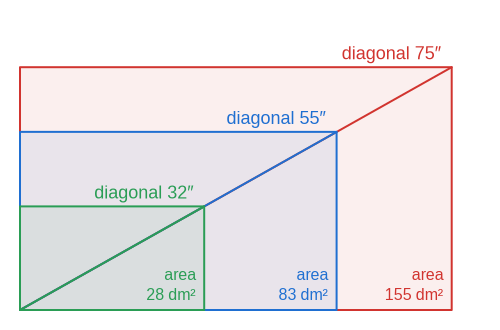
In practice, a diagonal twice as long gives an area about four times as big. The power grows more slowly, though, because part of the electricity goes on the power supply, the processor and the speakers, and those are no bigger in a large TV. Going from 55 to 75 inches almost doubles the area, but raises the power by only about 30 W, which at four hours a day means £11 a year.
Standby, set-top box and soundbar
In standby a new TV may use at most 0.5 W, which comes to about £0.95 a year. If you have switched on “smart” standby (networked standby) so that the TV can be woken from your phone or by voice, it may use up to 2 W, which is around £3.80 a year.
The devices around the TV have their own consumption. A set-top box for terrestrial broadcasts uses 5 to 8 W while you watch. A satellite or cable receiver with recording, however, often just dozes in standby, and at 7 W without a break it uses 61 kWh a year, almost as much as a 43-inch TV. A soundbar adds roughly 10 to 30 W. Altogether a TV comes to about the same per year as an efficient fridge, and next to a hot water cylinder it is small change.
How to save
- Keep the default or eco picture mode. Vivid mode with the brightness at full uses up to half as much again.
- Turn on automatic brightness. In the evening in a dim room it dims the screen and easily saves a fifth.
- Turn off smart standby and quick start, unless you switch the TV on from your phone.
- Switch the set-top box off completely, ideally plugged into the same switched extension lead as the TV.
- Do not leave the TV on as background noise in an empty room. Two extra hours a day cost about £13 a year for a 55-inch set.
Sources
Chapters: Fridge energy consumption, Washing machine energy use, Tumble dryer energy use, Dishwasher energy use, Hot water cylinder energy use, TV energy use