Election decided by one vote? Why a Czech Senate race must start over
Voters in the Žďár nad Sázavou Senate district will have to vote again, starting from the first round. On 18 November 2026 the Supreme Administrative Court declared both October rounds invalid. In the first round, on 9 and 10 October, a single vote decided who reached the run-off, the second round that only the top two candidates contest. Josef Klement (KDU-ČSL) finished second with 11,373 votes; Radek Černý (ODS) was third with 11,372 and missed the run-off. Klement went on to beat Michal Šmarda (nominated by Volt) in the second round, although Šmarda had led the first with 12,254 votes.
Černý challenged the result in court. The judges reopened the ballots from 26 polling stations and found counting mistakes. Once corrected, the mistakes might have put Černý second after all, but in several places the paperwork was in such disorder that nobody could say for sure. When the gap is smaller than the mistakes that ordinary hand counting makes, the count no longer tells you who won; only a careful recount can, and here the paperwork was too messy for one.
What did the court find?
The district has 265 polling stations, and 44,386 valid votes were cast in the first round. That is about 170 votes per station, roughly a village hall full of voters. Černý asked the court to check 26 stations where an unusually large share of envelopes held no valid vote, between 7% and 38%, while across the whole district it was 3.4%. In 15 of the 26 the court found problems.
Two of these directly affected Černý. In Ždánice, the local commission threw out two ballots because they were torn. The law, however, rejects only a ballot torn through, and these were torn, but not all the way. One of them was a vote for Černý, so he should have had 20 votes there, not 19. In Karlov, the court counted 27 valid ballots for Černý, one more than officially recorded, but also one envelope fewer than ballots, so it could not tell whether a vote had been missed or an invalid ballot had slipped in.
Together, the two corrections would give Černý 11,374 votes, one more than Klement. Elsewhere, though, the number of envelopes did not match the records (in one village by 11), empty envelopes were mixed with full ones and one package of ballots was sealed with ordinary sticky tape. The court could not work out the true result, so it voided the whole vote. It found no sign of deliberate fraud; the presiding judge, Vojtěch Šimíček, called it human failure.
How big are counting errors when you add them up?
One miscounted vote sounds negligible, and the court itself notes that some errors are natural. But there are 265 stations, and what matters is how the mistakes together shift the gap between Černý and Klement.
Let's build a simple model. Suppose that in one polling station out of ten the gap between Černý and Klement is off by one vote, for example because a vote for one of them was filed among the invalid ones. In half of these cases the error favours Černý, in the other half Klement. That is roughly what the court found in the 26 stations it opened, picked because they looked suspicious: one such vote for certain, one more possible. In each station, the error in the gap is then +1 with probability 0.05, −1 with probability 0.05 and 0 otherwise.
One in ten of 265 stations means about 26 mistakes. If they all went the same way, the gap would shift by 26 votes. They don't: like 26 coin tosses, they partly cancel out, and a few more heads than tails is normal. What remains is measured by the standard deviation. It does not add up from station to station, but its square, the variance, does. One station has variance (+1)2 · 0.05 + (−1)2 · 0.05 = 0.1, so all 265 together have 265 · 0.1 = 26.5, and the standard deviation is its square root:
The counting noise is about five votes either way, and the noise grows with the square root of the number of stations, not with the number itself. Four times as many stations would give only twice the noise, about ten votes. Even if only one station in fifty erred, the noise would still be
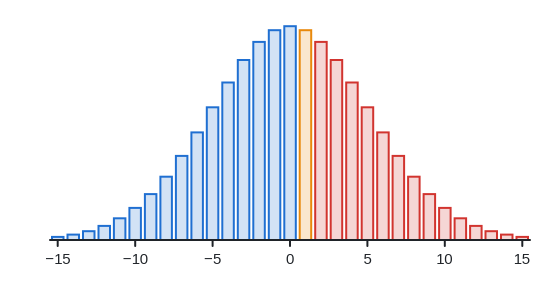
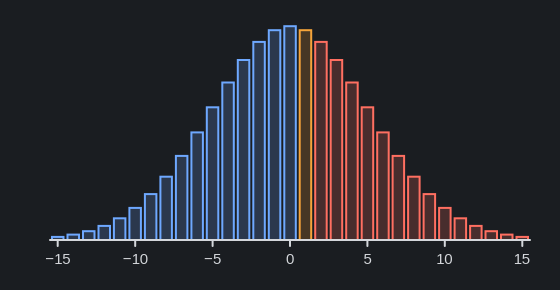
A gap of one vote lies well within this noise. In the model, Černý would really have been ahead with a probability of about 38%, it would have been a tie with about 8% and Klement would have stayed second with about 54%. Not far from a coin toss.
The gap between the leader Šmarda and third-placed Černý, 882 votes, is about 170 times the noise. To push Šmarda out of the run-off, the commissions would have needed more than three mistakes in every one of the 265 stations, all against him. Ordinary sloppiness cannot produce that.
How often is an election decided by one vote?
Rarely. Since 1996, 462 first rounds of regular Czech Senate elections have ended in a run-off. In half of them the gap between second and third place was more than 1,450 votes. Only three had a gap of ten votes or less: Žďár with 1, Prostějov in 2018 with 5, and Ostrava in 1998 with 7.
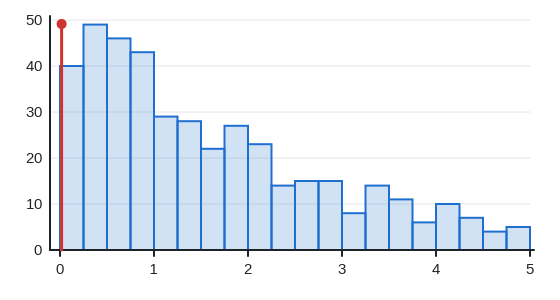
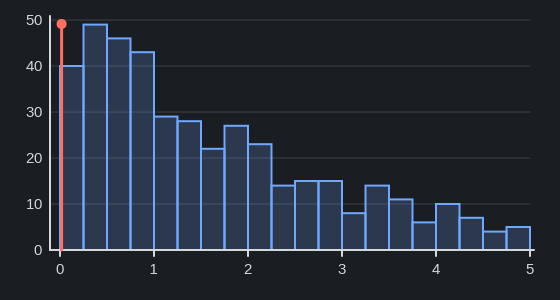
Near zero the bars are about the same height, so a rough estimate is easy. 29 races had a gap of 200 votes or less. If the gap is about equally likely to be any of the 201 numbers from 0 to 200, the chance of a gap of exactly one vote in a single race is
At each Senate election, held every two years, about 25 races go to a run-off, so a one-vote gap should turn up about once in 130 elections, or once in two and a half centuries. Rare, but not impossible.
The court itself stressed that neither a tight result nor statistically odd numbers justify opening the ballot boxes. Here the reason was the high share of invalid ballots in particular villages.
What happens next?
The president must call the repeat vote within 30 days of receiving the ruling, that is by late December. The Interior Ministry expects the earliest possible date, perhaps in January. The same five candidates will be on the ballot, and Černý, Klement and Šmarda have said they will run. Whoever wins will serve only the remainder of the six-year term. The last time the court ordered a Senate election to be repeated was in 2016, in Most.