Dimorphos crater: how hard did DART really push the asteroid?
The first close-up images of the crater on the asteroid Dimorphos came on 25 November 2026, when the European Space Agency (ESA) released pictures from its Hera spacecraft. Dimorphos is a small moon of the larger asteroid Didymos. On 26 September 2022, NASA's DART spacecraft flew into it on purpose, as a test of whether an asteroid can be knocked off course. Hera has now come to see the damage.
Even the mission team was surprised by what the images showed. The side that DART struck has been flattened into a crater the size of a sports stadium, spanning the asteroid's entire width. The rest of Dimorphos looks just as it did in DART's photos from 2022. The asteroid now tumbles chaotically, and hundreds of boulders, each only a few metres across, circle the pair.
Dimorphos is as wide as one and a half football pitches laid end to end, about 151 m. DART weighed about as much as a horse, a little over half a tonne. Still, the impact shortened the time Dimorphos takes to go once around Didymos by 33 minutes. The debris blasted out of the crater pushed Dimorphos at least as hard as the spacecraft itself, possibly several times harder; exactly how much depends on a mass that Hera is only now going to measure. All of this can be worked out with school maths.
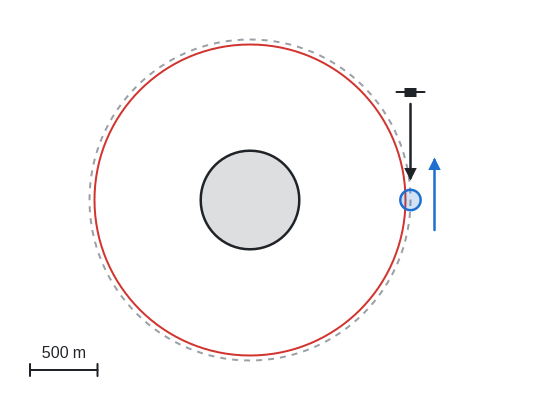
How much closer did Dimorphos get?
Before the impact, Dimorphos went once around Didymos in 11 hours 55 minutes, which is 11.92 h. The centres of the two asteroids were 1189 m apart. Telescopes on Earth then timed the new lap at 11.37 h, 33 minutes less.
The time for one lap is the period T. In 1619 Johannes Kepler published a rule for planets circling the Sun: the square of the period grows like the cube of the distance r. The same holds for a moon circling an asteroid. For Dimorphos before and after the impact this means
Taking the cube root of both sides and multiplying by r1 gives the new distance:
Dimorphos now orbits about 37 m closer to Didymos, roughly the height of a twelve-storey building. In the picture above, this is the gap between the dashed and the red circle.
Why closer, when DART slowed it down? DART hit Dimorphos head-on, against its direction of motion. At the moment of impact Dimorphos lost a little speed, so Didymos's gravity pulled it slightly inwards. On the tighter orbit it actually moves a bit faster than before and has a shorter way round, so a lap takes less time.
How fast was Dimorphos moving? In one period it travels the circumference of its orbit, so its speed is
where 42,912 s is 11.92 h in seconds. That is about 17 centimetres per second, an eighth of walking pace. From the change of the period, the DART team worked out that Dimorphos lost 2.70 mm/s of this speed at the moment of impact, about one and a half per cent. Such a small change was enough to move the orbit by 37 m.
Could the spacecraft alone do that?
Let's check with momentum, mass times velocity. DART flew fast enough to cross from London to Paris in under a minute, 6144.9 m/s, and weighed 579.4 kg at impact:
Next we need the mass of Dimorphos. Nobody has weighed it yet, so we have to estimate it. Treat Dimorphos as a ball 151 m across: its radius is 75.5 m and its volume is
The speed of Dimorphos's orbit also gives astronomers the mass of the whole pair, and combined with the measured sizes this gives a density of about 2400 kg/m3. The DART team assumed that Dimorphos is as dense as the pair. Then its mass is
more than seven million times the mass of DART. Suppose DART simply got stuck in Dimorphos and handed over all its momentum, as in the conservation of momentum. Even if all of it went straight against the motion of Dimorphos, the asteroid would slow down by only
The measured change, however, was 2.70 mm/s, about 3.3 times as much.
The extra push came from the crater. The impact threw out a huge amount of rock and dust, and most of it flew away backwards, roughly towards where DART had come from. Just as a rifle recoils when it fires a bullet, Dimorphos was pushed the other way: in DART's direction of travel, that is, against its own orbital motion. The number of times the total push exceeds DART's own momentum is called the momentum enhancement factor and is written β:
With the real shape of Dimorphos and the exact angle of the impact, the DART team arrived at β ≈ 3.61 instead of our rough 3.3: DART itself supplied one part of the push and the flying debris the remaining 2.61 parts.
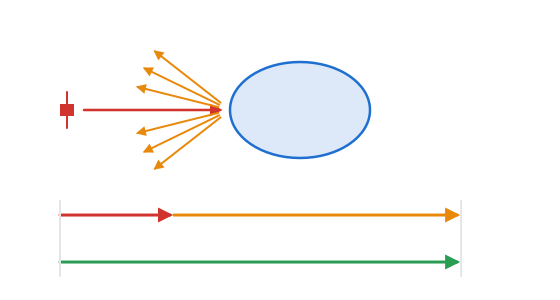
Why does Hera need to weigh Dimorphos?
Look at where the mass entered our calculation. The change of speed Δv is measured, DART's momentum p is known precisely, so
grows roughly in proportion to the mass of Dimorphos, and that mass rests on a guess of its density. If Dimorphos were as light as 1500 kg/m3, β would be about 2.2. If it were as heavy as 3300 kg/m3, β would be about 4.9. The value 3.61 assumes the middle one.
A study published in March 2026, which measured how the impact also changed the pair's path around the Sun, suggests that Dimorphos is lighter than Didymos, at about 1540 kg/m3. That would put β near the low end, around 2.3: the debris would then have added about 1.3 times DART's own push rather than 2.6 times.
Settling this is part of Hera's job. It will measure the mass of Dimorphos from how it makes Didymos wobble, which it can follow by tracking boulders on Didymos's surface. In December, Hera is scheduled to move in to about 13 km from the pair, and in January 2027 it plans to release two shoebox-sized satellites that will fly closer still.
When the mass is measured, we will know β properly, and with it how large a spacecraft must be to nudge a truly dangerous asteroid off course.
Sources
- ESA: Hera reveals stadium-sized asteroid crater from spacecraft impact (25 November 2026)
- Cheng et al.: Momentum transfer from the DART mission kinetic impact on asteroid Dimorphos, Nature (2023)
- NASA: NASA's DART mission changed orbit of asteroid Didymos around Sun (March 2026), study by Makadia et al. in Science Advances