
Roots
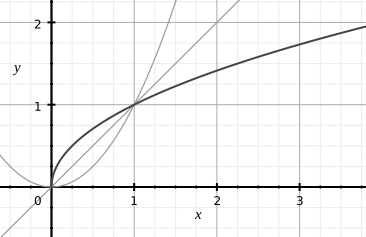
A root is a partial inverse function of a power. The most common one is the square root: it looks for the number which, when multiplied by itself, gives the original number that we took the root of.
Square root
The symbol for a root is
To begin with we deal only with the square root of a real number. We define it like this:
If you multiply the square root of a by the square root of a, you get a. So the square root of 9 is 3, because 3 · 3 = 9.
We can also write the previous expression like this:
It is just another way of writing the same multiplication, this time using a power.
An important point is that this equation holds only for those a that are in the domain of the square root. That is because we cannot take the square root of a negative number. We can take the square root of any positive number, we can take the square root of zero, but not of a negative number. Why not?
Suppose we want to work out the square root of −25. We basically have two options for which number to choose: a positive one or a negative one. If we choose a positive number, we get 5 · 5 = 25. We did get 25, but we want −25. So let’s try −5; but after multiplying we get 25 again. Simply put, if you multiply two negative numbers you get a positive number, and the same happens when you multiply two positive numbers. You would have to multiply −5 · 5 to get −25, and that doesn’t work, because you would be multiplying two different numbers, even if they differ only in sign. That is why the square root of a negative number cannot be worked out.
Higher roots
Just as we can square an expression, cube it, or raise it to the fourth power, we can have cube roots, fourth roots and finally the nth root of a real number. The number is usually written in the notch of the root sign, like this:
This notation means the fifth root of thirty-two. We define the nth root using the nth power like this:
If we substitute two for n, we get the square root as we defined it a moment ago. In short, we could also define it like this:
By convention, for the square root we don’t need to write the 2, so these two expressions are equivalent:
So, for example, for the fourth root we would have:
And a specific example:
Conversely, 4 · 4 · 4 = 64.
Roots of negative numbers
We already know that the square root of a negative number does not exist, because a2, where a is a real number, is never negative. However, with higher roots we no longer multiply just twice, so there may be cases where the nth root of a negative number does exist. So how does it work?
The problem was that when we multiply a negative number by itself, we get a positive number. To get −25 we needed the product −5 · 5. But what happens when we multiply three negative numbers? After multiplying the first two we have a positive number. But after multiplying by the last negative number we are back to a negative number. If we multiplied once more (four times in total), we would be back in the positives.
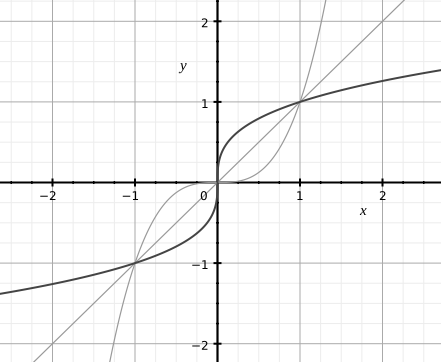
The lesson is that when we multiply n negative numbers together, the product is positive if n is even and negative if it is odd. From this we conclude that the nth root of a negative number exists when n is odd. Example:
Converting a root to a power
We can easily convert roots to powers, and this is often done because roots are then easier to work with. The following relationship holds:
The nth root of a is the same as a raised to the power 1/n. This is also handy when you need to enter a root higher than a square root somewhere. Often this can’t be done directly, but you can enter a fraction as the index. If you want to plot the graph of the fourth root, plot the graph of the function
The conversion used most often is the one for the square root:
Laws for roots
Since a root can easily be converted to a power, expressions with roots inherit the laws of indices. So the following relationships hold:
The following basic facts also hold:
Simplifying surds
Simplifying a surd is a technique used to make roots simpler, and it uses one of the laws above:
Some expressions under a root can be factorised into a product, then split into two roots, and finally one of those roots can be worked out. A typical example is this:
Using the previous law, we can rewrite this expression like this:
Now we can take the square root of 4:
In the same way we can rewrite an ordinary number if we want to keep the exact form. For example:
Calculator
If you need to work out a root, you can use our roots calculator 🧮.
