
The Millennium Prize Problems
On 24 May 2000, mathematicians gathered in a hall of the Collège de France in Paris to hear an unusual offer. The Clay Mathematics Institute of Cambridge, Massachusetts, had picked out seven open questions that it considered the most important and the hardest in the whole of mathematics, and offered a prize of one million dollars for solving each of them. Ever since, these seven questions have been known as the Millennium Prize Problems.
The place and the time were no accident. Exactly a hundred years earlier, in August 1900, the German mathematician David Hilbert had presented in Paris some of the problems from a list of 23 questions (the whole list appeared in print soon afterwards) which he thought should keep mathematics busy in the twentieth century. Mathematicians have since solved many of them. The only problem that appeared on both lists is the Riemann hypothesis about prime numbers. So it held out, unsolved, for a whole century and made it onto the list for the next one too.
The catch is that in a quarter of a century only one problem fell. And the person who solved it turned down the million. Then came the autumn of 2026, and within three months, with the help of artificial intelligence, more problems saw progress than in the whole 26 years before. Below we will try to untangle what is certain and what has so far only been announced.
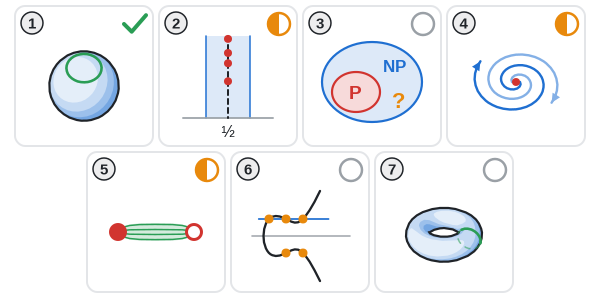
The rules of the game
The million dollars does not go to whoever sends the institute a letter with a proof. The Clay Institute does not accept solutions directly at all. Under the rules from 2018, a solution must first be published in a recognised scientific journal or another qualifying outlet, then at least two years must pass, and during that time it must be accepted by the mathematical community. Only then does the institute start to consider the solution, and it decides on the prize itself.
There is a good reason for this slowness. Proofs at the very frontier of mathematics often run to hundreds of pages, and finding the mistakes in them takes years. History is full of famous announcements in which a hole was later found. Two years of waiting give experts time to take the proof apart, understand it and test whether it holds up.
That is why one simple thing is worth bearing in mind when reading all the news from 2026: so far nobody except Grigori Perelman has been awarded the prize. And Perelman didn’t take it.
For each problem you will find a short account of what it asks, why it is hard and how things stand with it. The details, the pictures and the whole story are always in a separate article.
1. The Poincaré conjecture
Imagine a rubber skin, say the surface of a ball. Wherever you put a loop of string on it, you can shrink the loop to a point along the surface. On the surface of a doughnut that doesn’t work: a loop around the hole gets stuck. The Poincaré conjecture claims that this property is enough: a closed space in which every loop can be shrunk to a point is a sphere. For surfaces this is easy; the trouble is with three-dimensional space, which we cannot inspect from the outside.
Status: solved. The Russian mathematician Grigori Perelman published the proof in 2002 and 2003 in three short papers on the internet. Several teams of mathematicians then spent years checking and filling it in, and they found no significant error. In March 2010 the Clay Institute awarded him a million dollars and Perelman turned it down, just as he had turned down the Fields Medal before.
Full article: The Poincaré conjecture.
2. The Riemann hypothesis
Prime numbers look as if they were scattered at random, and yet on a large scale they follow a precise rule. The Riemann hypothesis claims that they never stray far from that rule. Equivalently, it says that all the “interesting” zeros of one function, the so-called zeta function, lie on a single line. Computers have found trillions of them on it, but that is not a proof for all of them. And hundreds of other theorems rest on the hypothesis, theorems that begin with the words “if the Riemann hypothesis holds”.
Status: an announced proof, checked by computer. On 20 November 2026 Levent Alpöge, a mathematician at the company Anthropic, published a proof that he says he found together with the AI model Claude. The proof exists only in the Lean language (we explain it below); a conventional text for mathematicians does not exist yet. A day later, on 21 November, the community around Lean and its mathematical library Mathlib declared that the statement in Lean really is the Riemann hypothesis (experts examined it, and the computer confirmed that it matches the definition in the Mathlib library) and that the proof is correct. But the certification doesn’t explain the ideas of the proof; understanding them is still to come. Under its rules, the Clay Institute cannot yet assess it.
Full article: The Riemann hypothesis.
3. P versus NP
Finding the solution to a sudoku is hard. Checking a finished solution is easy. The P versus NP problem asks whether that is really so, or whether every problem whose solution we can check quickly can also be solved quickly. Most computer scientists believe it can’t, but proving that some fast method doesn’t exist is much harder than finding a method. You have to rule out every program, even those nobody has thought of yet.
Status: open. Nothing fundamental happened here in the autumn of 2026. In October OpenAI did announce a refutation of the related exponential time hypothesis, but the group of experts assessing it has not yet reached a decision and stresses that its involvement is not an endorsement. And even if the claim held, it would not settle the P versus NP problem.
Full article: The biggest problem in computer science: P versus NP.
4. The Navier–Stokes equations
Weather forecasts, the airflow around a wing and the flow of blood are all calculated with these equations. The problem asks whether they always make sense: whether a smooth, calm flow can ever give rise, in a finite time, to a “blow-up” in which the velocity of the water shoots up without limit. It is hard because eddies in flowing water break up into smaller and smaller ones, and nobody can guarantee that this cascade ends somewhere.
Status: formally perhaps solved, but through a loophole. The problem statement allows two routes: prove that a blow-up never happens, or find a counterexample, in which a smooth external force may also push the water. On 8 September 2026 OpenAI published a proof of a blow-up in which the force is tailored precisely to bring the blow-up about. If the proof is correct, it formally meets the problem statement, but many experts regard this force as a loophole. A solution to the real question, a blow-up without an external force, is claimed by Levent Alpöge and Tristan Buckmaster in a paper from 20 November. But they have not yet published the key computer calculation their proof rests on, so nobody has been able to verify it.
Full article: The Navier–Stokes equations.
5. Yang–Mills theory and the mass gap
A proton is made of three quarks, but nobody has ever seen a quark on its own. They are held together by the strong force, which physics describes with Yang–Mills theory. It works brilliantly for physicists, but mathematicians didn’t know whether such a theory even exists as a precise mathematical object. On top of that, the mass gap has to be proved: that the lightest particles arising from the theory have positive mass, even though the messengers of the force, the gluons, have none.
Status: the first half announced. On 26 October 2026 OpenAI announced a proof, written in Lean, that the theory exists. On 9 November a panel of five physicists and mathematicians chaired by David Gross, who was chosen by OpenAI itself, stated that in its assessment the proof does establish existence according to the standard problem statement. At the same time it admitted that it does not yet fully understand the proof. The mass gap, the harder half, remains open, and Clay awards the million only for both.
Full article: Yang–Mills theory and the mass gap.
6. The Birch and Swinnerton-Dyer conjecture
Some curves given by an equation, for example y2 = x3 − x + 1, pass through points whose coordinates are both fractions. Sometimes there are finitely many such points, sometimes infinitely many. The conjecture claims that you can tell from counting: if we count how many solutions the equation has on a “clock” for different prime numbers, this tells us how many fraction points the curve has. The trouble is that the fraction points can have hundreds of digits, and the test does say that they exist, but not how to find them.
Status: open. For curves where the calculation points to at most one “independent” fraction point, part of the conjecture was proved back in the late 1980s. In October 2026, among hundreds of manuscripts, OpenAI published a claimed partial result for a further group of curves. Nobody has verified it independently, and the problem as a whole has not moved.
Full article: The Birch and Swinnerton-Dyer conjecture.
7. The Hodge conjecture
The most abstract of the seven. On shapes described by equations you can draw loops and surfaces that wrap around holes, like a loop around the tube of a doughnut. The conjecture claims that every such surface that passes a certain test can be put together from pieces that are themselves described by equations. It is hard for the same reason as the previous problem: the test says that the pieces ought to exist, but it gives no instructions for constructing them.
Status: open. For shapes with at most three complex dimensions the conjecture holds. In the same batch of manuscripts from OpenAI there is a claimed proof for one special, highly symmetric family of shapes, but nobody has verified it independently. The general conjecture remains open.
Full article: The Hodge conjecture.
What happened in the autumn of 2026
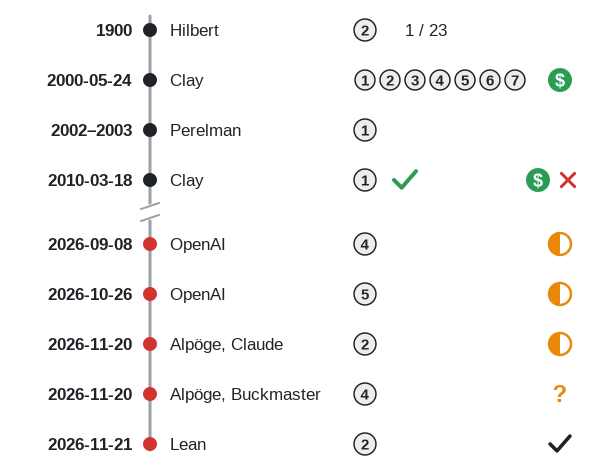
In a quarter of a century one problem fell, and then within three months announced solutions, or large parts of them, appeared for three more. Artificial intelligence is behind all of them. For the Navier–Stokes equations and Yang–Mills theory, OpenAI’s internal models; for the Riemann hypothesis and the blow-up without an external force, the mathematician Levent Alpöge, who works with the model Claude from the company Anthropic.
The second common thread is Lean. It is a programming language in which a mathematical proof can be written down in such detail that a computer checks it step by step and lets no hole slip through. That is an enormous help. People don’t have to spend months reading such a proof line by line to know that it is correct. The one thing that has to be checked is that the Lean version really is that proof: for the Navier–Stokes equations, three mathematicians pointed out that OpenAI’s formalisation does not match the text of the proof.
So why is this still not the end of the story? The computer verifies that the proof proves the statement written in Lean. Whether it is written correctly, that is, whether the computer really proved the Riemann hypothesis and not some similar-looking statement, has to be judged by people. For the Riemann hypothesis the Lean community did this, for Yang–Mills theory a panel of experts. And then there is understanding. Mathematics is not just a collection of true theorems, it is above all an understanding of why they hold. A proof made of hundreds of thousands to millions of lines of code that nobody yet understands tells us that something holds, but not why. From a good proof mathematicians usually learn new methods that help elsewhere too. Here they are still waiting for them.
Not everything went smoothly, either. Over the Navier–Stokes equations, OpenAI got into a dispute over credit with Alpöge and Buckmaster, who claim that information about their approach reached OpenAI and could have influenced the result. OpenAI says it could not have. Of the hundreds of manuscripts OpenAI published in October, it has since withdrawn or corrected some.
The Clay Institute has not yet awarded anything to anyone. In September it wrote of the Navier–Stokes equations that the problem had “apparently been settled” and that its assessment process is “deliberately unhurried”. Under its own rules it can decide on a prize no earlier than two years after publication in a peer-reviewed journal, and none of the new results has appeared in a journal yet. OpenAI has also announced that it will not apply for the prize for the Navier–Stokes equations.
We are writing this article on 23 November 2026, and the situation will change quickly. Perhaps within a year it will turn out that most of the announced proofs have held up. Perhaps a mistake will be found in one of them, or it will turn out to prove a slightly different statement than it seemed. Only one thing is certain: P versus NP, the Birch and Swinnerton-Dyer conjecture, the Hodge conjecture and the mass gap are as open as they were in 2000.
All seven in one place
| Problem | Field | Status as of 23 November 2026 |
|---|---|---|
| Poincaré conjecture | topology | solved (Perelman), prize turned down |
| Riemann hypothesis | number theory | announced proof in Lean, statement and proof certified by the Lean community |
| P versus NP | computer science | open |
| Navier–Stokes equations | fluid dynamics | announced blow-up with an external force, without a force unverified |
| Yang–Mills theory | particle physics | existence announced, gap open |
| Birch and Swinnerton-Dyer conjecture | number theory | open |
| Hodge conjecture | algebraic geometry | open |
You will find more articles on famous questions in mathematics in the category Famous problems.