
The Birch and Swinnerton-Dyer conjecture
A right-angled triangle with sides 3, 4 and 5 has area 6. Is there a right-angled triangle with area 5? Not with whole-number sides, but with fractions there is: shorter sides (legs)
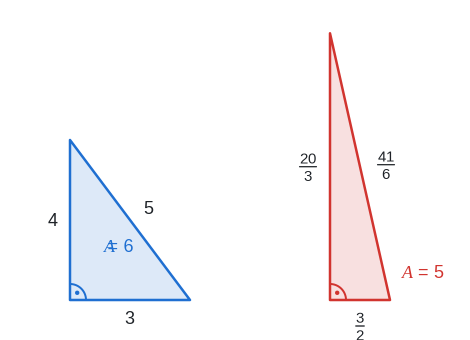
Let’s check it. According to Pythagoras’ theorem the following must hold:
And the area is half the product of the two shorter sides:
What about one? No such triangle has area one, and Pierre de Fermat already proved that in the 17th century. The number 157 is congruent, but the simplest triangle with this area, found by the mathematician Don Zagier, has a shorter side of
and the numerator of the hypotenuse has 48 digits. Nobody would find it by searching blindly, even if they tried for their whole life. So how can you tell which numbers are congruent? There is a test, and it is so simple that a school pupil could do it with a pencil, but there is a condition: it is only guaranteed to work if the Birch and Swinnerton-Dyer conjecture holds. It is one of the seven Millennium Prize Problems, each carrying a million-dollar prize from the Clay Mathematics Institute. We will get to the test only at the very end; first let’s get clear what the conjecture is actually about.
Fraction points on a circle
People have been looking for solutions of equations in fractions since time immemorial; Diophantus of Alexandria was already studying them in the 3rd century. Let’s start with a simple equation, the circle x2 + y2 = 1. There are infinitely many points with fractional coordinates on it, and there is an elegant trick for finding all of them.
We take the point (−1, 0) and draw through it a line with a fractional slope k. The line meets the circle at one more point, and that point again has fractional coordinates. When we calculate the intersection, we get
and these are fractions, because all we did was add, multiply and divide fractions. For
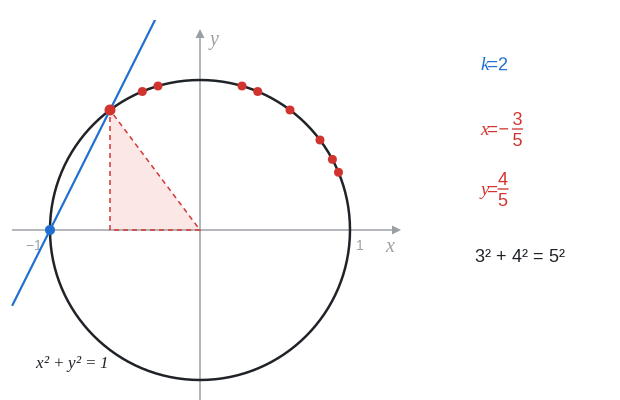
That is the circle done. Let’s try the same with an equation one degree higher; there it won’t go so smoothly.
Elliptic curves
An elliptic curve is the set of points that satisfy the equation
where a and b are some integers. It has nothing to do with an ellipse; it inherited its name from the integrals used to calculate the perimeter of an ellipse. Depending on the numbers a and b, it has either one piece or two: an egg and an infinite branch.
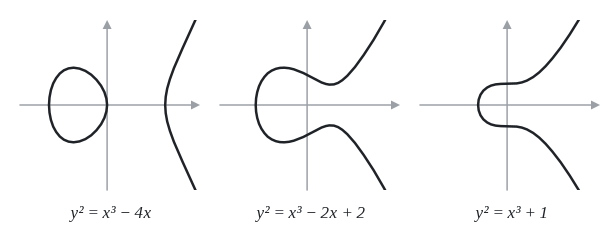
But where have the triangles gone? Each congruent number n belongs to the curve
From a right-angled triangle with shorter sides a, b, hypotenuse c and area n we make a point on this curve as follows:
The derivation takes a few lines of algebra from the equations a2 + b2 = c2 and
And the check on the curve y2 = x3 − 36x: on the left 362 = 1296, on the right 123 − 36 · 12 = 1728 − 432 = 1296. It fits.
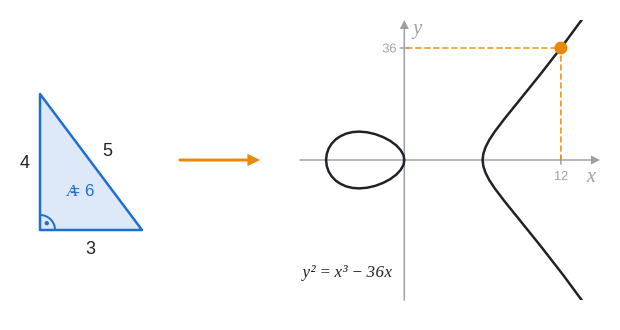
It also works the other way round: from a fraction point on the curve (as long as it doesn’t lie on the x-axis) a triangle can be calculated in a similar way. The triangle with area 5 gives the point
Adding points
Elliptic curves can do a little magic trick: from two fraction points we can make a third. We draw a line through both points. It meets the curve once more, at a point R. We then reflect that point in the x-axis, and the result is called the sum P + Q.
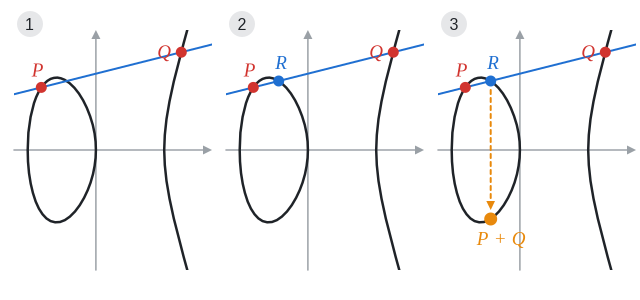
Why does the line have exactly three points in common with the curve, and why is the third one a fraction point again? When we substitute the equation of the line into the equation of the curve, we get a cubic equation in x, and that has at most three solutions. For the equation y2 = x3 + ax + b there is also a simple rule: the x-coordinates of all three intersections add up to the square of the slope of the line,
We know two of the points, and the slope k is calculated from them as the ratio of the differences of their coordinates. We get the third coordinate just by adding, subtracting and multiplying fractions, so it comes out as a fraction again. In the picture we have P(−4, 6) and
And what if the line is vertical, for example when it goes through the point P and its mirror image? Then it has no third intersection. So mathematicians add one more point to the curve, the point at infinity, which all vertical lines “point to”. It plays the role of zero: P plus the point at infinity is P again. And the mirror image of the point P is the opposite point −P, because P + (−P) gives zero.
Why call it a “sum”? Because it behaves like a sum: the order doesn’t matter (P + Q is the same as Q + P), we have a zero, and every point has an opposite point. And we can keep adding to the result. We can even add a point to itself. Instead of a line through two points we then take the tangent at the point P and get 2P. Then 3P = 2P + P and so on.
The curve y2 = x3 − 25x belonging to the area 5 has the fraction point P(−4, 6). Watch how further points grow out of it by adding, and how the fractions swell as they do:
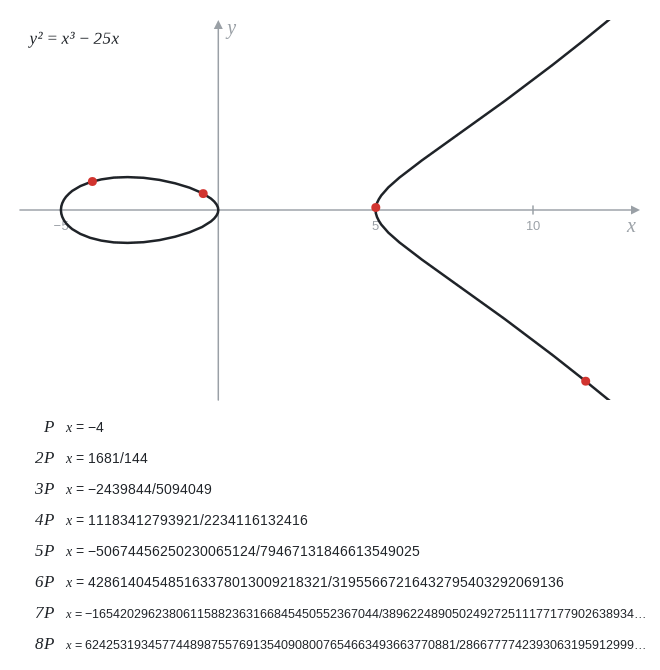
The number of digits grows roughly with the square: the numerator of the x-coordinate of the point 5P has 20 digits, that of 10P has 83 and that of 20P has 330. When we go twice as far, there are roughly four times as many digits, because 22 = 4. No wonder even the smallest triangle can have sides as monstrous as the one for 157.
At last we can explain what the rank of a curve is. It is the smallest number of starting points from which we get all the fraction points of the curve by adding (and subtracting). A few special points, with which adding only goes round in circles, don’t count towards the rank. As early as 1922 Louis Mordell proved that finitely many starting points are always enough.
- Rank 0: adding gets us no further than a few points that keep repeating. For the curve y2 = x3 − n2x these are only the points on the x-axis, which give no triangle.
- Rank 1: all the fraction points arise from a single starting point, as for our curve for the area 5 from the point (−4, 6). There are infinitely many points.
- Rank 2: we need two starting points that are independent of each other. And so on.
So the number n is congruent exactly when the curve y2 = x3 − n2x has rank at least 1. But how do we find the rank? The points can have enormous fractions, and a blind search may never end. This is exactly where the conjecture comes into play. First we will take a short detour into “clock arithmetic”. It looks like a digression, but it will leave us with footprints from which the rank can be estimated.
Clock arithmetic
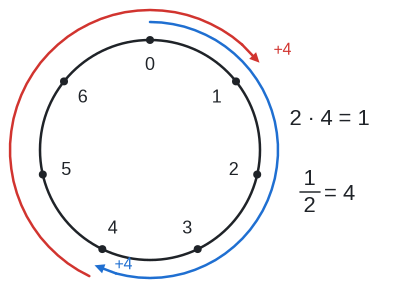
On a clock with hands, 10 + 5 = 3: ten o’clock plus five hours is three o’clock. A clock works only with remainders after division by twelve. Mathematicians calculate like this with any number of hours, and most of all with a prime number p. This is called calculating modulo p.
On a clock with a prime number of hours you can even divide. What is
An elliptic curve “on a clock” is then simply a list of pairs x, y from the numbers 0, 1, …, p − 1 that satisfy the equation of the curve up to multiples of p. There are only p · p pairs, so we can try them all and count the solutions.
It is exactly these curves on a clock, only with a huge prime number, that encrypt connections in web browsers, in online banking and in bitcoin (elliptic-curve cryptography was proposed independently by Neal Koblitz and Victor Miller in 1985). So people often ask whether a proof of the conjecture would threaten ciphers. It wouldn’t: ciphers rely on how hard it is to calculate on a single clock, while the conjecture is about fraction points.
Footprints in the snow
Let’s take our curve y2 = x3 − 25x and a clock with thirteen hours. We try all 13 · 13 = 169 pairs. For example x = 1: the right-hand side comes out as 1 − 25 = −24, and on a thirteen-hour clock that is 2 (because −24 + 26 = 2). Is two the square of some number on the clock? We go through 02, 12, …, 122 and find that it isn’t. So for x = 1 there is no solution. When we do this for every x, we find 19 solutions. The curve scatters into dots:
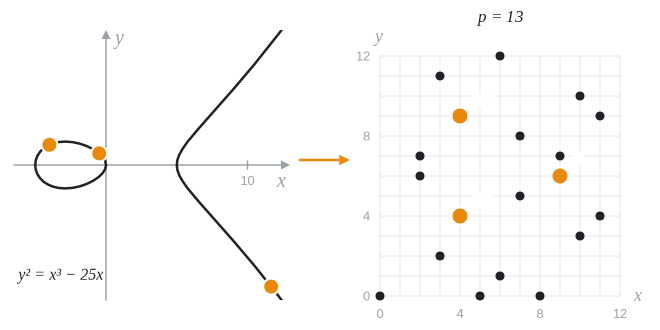
And now the main point: every fraction point of the curve leaves a dot on the clock. All we have to do is convert the fraction to the clock. On a clock with a prime number of hours you can divide, so a fraction is simply the numerator divided by the denominator, and we may convert each of them separately. The point P(−4, 6) is carried over to (9, 6), because −4 + 13 = 9. The point 2P has
So a curve with infinitely many fraction points leaves footprints on every clock, like an animal walking through snow. Birch and Swinnerton-Dyer came up with an idea: if a curve has lots of fraction points, it might have, on average, slightly more dots on the clocks than a curve that has none. The footprints would then give away how many fraction points the curve has.
How many dots can we expect? For each x there is some number on the right-hand side, and roughly half the numbers on a clock are squares. If it is a square, it gives two solutions, y and −y; if it isn’t, it gives none. So on average one solution for each x, around p dots in total. The actual number fluctuates around p, but never very far. Mathematicians always add the point at infinity, the zero of the addition, to the dots, and write the result as Np. For our curve N13 = 19 + 1 = 20, a little more than 13.
To be frank: a single dot on a clock proves nothing. The dots are there even without fraction points, and on any one clock a curve can have more or fewer dots just by chance. The footprints can only be read as an average over many prime numbers. And why they should be so precise that the rank can be read directly from them, nobody knows. That precision is exactly what the conjecture asserts.
What Birch and Swinnerton-Dyer calculated
Bryan Birch and Peter Swinnerton-Dyer were working in Cambridge in the early 1960s and had the EDSAC 2 computer at their disposal. At first it could store only 1,024 numbers, roughly five kilobytes altogether; a phone today has more than a million times as much memory. Even so, they used it to calculate Np for many curves and many prime numbers.
And how do you measure those footprints? For each prime number we write down the ratio
What does the rank have to do with this? Each starting point gives rise to its own infinite series of fraction points, and each of those series leaves its footprints on the clocks. With two starting points there are more footprints, the ratios are more often a little greater than one, and the product over thousands of primes grows more steeply. The small surpluses add up to a noticeable trend. Exactly how steeply is so far only an observation, and that is precisely what the conjecture claims.
We calculated it for three curves from our family y2 = x3 − n2x, for all prime numbers up to 100,000 (except two and the divisors of n):
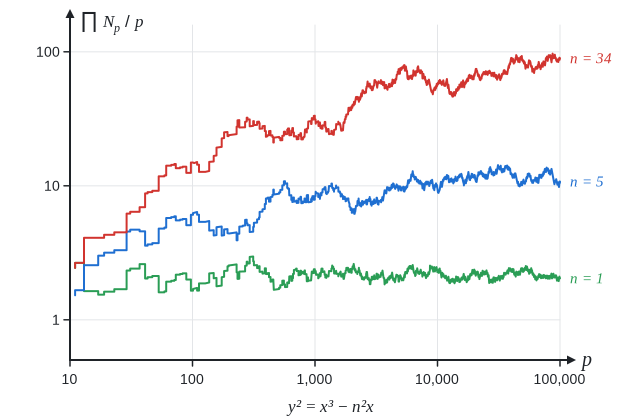
The horizontal axis shows up to which number we take the primes. Each division means numbers ten times larger, so the graph shows the primes up to a hundred just as well as those around a hundred thousand. The vertical axis shows the product, and there too each division means ten times more.
The green curve for n = 1 belongs to one, which is not congruent. The rank is 0 and the product stays around two. The blue one for n = 5 has rank 1 and rises slowly; by a hundred thousand it climbs to about 11. The red one for n = 34 has rank 2 (two independent starting points, for example (−2, 48) and (−16, 120)) and rises faster still, up to 90. That is exactly the kind of picture Birch and Swinnerton-Dyer saw in their graphs.
The rank is not read from the graph by the height of the line, but by how steeply it rises. The line for rank 0 stays put, the one for rank 1 rises slowly and the one for rank 2 faster. But a finite calculation can’t give us a sharp boundary: at the start the lines fluctuate a lot, and how steep they really are is decided only by infinitely many primes. That is another reason why it is only a conjecture, and why its precise version uses the L-function instead of a graph.
The conjecture in plain terms: how fast the product grows gives away the rank, that is, how many starting points the curve needs. Whoever proves it will receive a million dollars.
In technical terms (you can skip this): from the product one can build a function L(E, s), similar to the Riemann zeta function, and today’s statement of the conjecture says that the rank of the curve E is equal to the order of the zero of the function L(E, s) at the point s = 1. The conjecture also includes a precise formula for how the function behaves around this point, but the million is mainly about the rank.
How come nobody proved it long ago, when computers have gone through an enormous number of curves? Because there are infinitely many curves, and the graph shows only a hundred thousand primes out of infinitely many. The footprints are a hint, not a proof. It is similar to the Riemann hypothesis, which computers have verified for trillions of zeros, and yet it remains open.
What we already know
For curves where the footprints point to rank 0 or 1 (more precisely: where the L-function says so), the part of the conjecture about the rank has been proved. In 1986 Benedict Gross and Don Zagier showed how, for a curve where the L-function points to rank 1, to construct a fraction point with an infinite series of multiples. Victor Kolyvagin built on their work in the late 1980s and proved that the rank of such curves really is 1, and where the L-function points to rank 0, it really is 0. So for these curves we know that the prediction from the footprints is right. For the others we can’t prove it, but that doesn’t mean it doesn’t hold there. According to work by Manjul Bhargava, Christopher Skinner and Wei Zhang from 2014, the part about the rank holds for at least 66% of elliptic curves, almost two thirds. The precise formula from the conjecture hasn’t been proved in general even for them. The hard cases with rank 2 and above remain open, and that is exactly where one would need to be able to find or guarantee fraction points, even when they have hundreds of digits.
Elliptic curves are also behind the famous proof of Fermat’s Last Theorem. Andrew Wiles proved it in 1994 by proving, for a large group of curves, a deep connection between elliptic curves and other, well-studied functions, which had been predicted by Yutaka Taniyama and Goro Shimura. His successors completed the connection for all curves in 2001, and only thanks to that do we know that the L-function makes sense at the point s = 1 at all.
News
We are writing this section on 22 November 2026. On 6 October 2026 the company OpenAI published a total of 722 mathematical manuscripts, which it says were produced by its internal artificial intelligence model. Among them is a claimed partial result on the Birch and Swinnerton-Dyer conjecture for a further group of curves whose rank would come out as at most 1. Nobody has yet verified it independently, and the problem as a whole remains open.
Back to triangles
It is time to keep the promise from the introduction. In 1983 the mathematician Jerrold Tunnell found a test which, for odd n not divisible by the square of any number other than one, goes like this. Other numbers just need their square factors removed: if we enlarge a triangle three times, its area grows nine times, so 27 is congruent exactly when 3 is congruent. Count the integer solutions (including negative ones and zero) of the equations
If the number of solutions of equation A is not twice the number of solutions of equation B, the number n is definitely not congruent. If it is twice as many, the number n is congruent, but we can only guarantee this if the Birch and Swinnerton-Dyer conjecture holds. If it didn’t hold, the test could lie when it answers “yes”, and above all the bridge between the footprints on the clocks and the fraction points would collapse. For even n there is a similar pair of equations. Let’s try it out:
| n | solutions of A | solutions of B | A = 2B? | congruent? |
|---|---|---|---|---|
| 1 | 2 | 2 | no | no |
| 3 | 4 | 4 | no | no |
| 5 | 0 | 0 | yes | yes |
| 7 | 0 | 0 | yes | yes |
For n = 1 the equation 2x2 + y2 + 8z2 = 1 has only the solutions y = 1 and y = −1 (the others zero), just like the second equation. Two is not twice two, so one is not congruent, exactly as Fermat proved. For n = 3 there are four solutions
And the number 157? Neither equation has a single solution, so the test says “congruent”. You don’t need a supercomputer for this, a moment with a pencil is enough. And yet Zagier’s triangle has fractions with 48 digits. That is the whole beauty of it: Tunnell’s test is, in disguise, a calculation of the L-function at the point s = 1, the function built from the footprints on the clocks, and it settles something we would never find by trial and error.
You will find more Millennium Prize Problems in the category Famous problems.