
The Hodge conjecture
Of the seven Millennium Prize Problems, for each of which the Clay Mathematics Institute offered a million dollars in 2000, the Hodge conjecture has the reputation of being the most abstract. Even mathematicians say that it can’t really be stated properly without dozens of pages of preparation. We will try anyway, with a doughnut, a few equations and a sheet of wallpaper. I promise only this much: you will understand roughly what it is about and why it is so hard.
In one sentence, the conjecture can be put like this:
On shapes described by equations there are wrappings: loops, surfaces and their higher-dimensional counterparts that wrap around holes. Can every wrapping that passes a certain test be put together from pieces that are themselves described by equations?
There is one more small catch, which we will come to later.
Has it been solved? No. The conjecture has been open since 1950, and 2026 brought only a claimed partial result for one special family of shapes, which we will come to at the end.
Shapes from equations
The equation x2 + y2 = 1 describes a circle: all the points (x, y) that satisfy it lie on a circle of radius 1. If we add a third coordinate, the equation x2 + y2 + z2 = 1 describes a sphere, that is, the surface of a ball. And if we flip the sign of z2, we get x2 + y2 − z2 = 1, a surface shaped like an hourglass, which is called a hyperboloid.
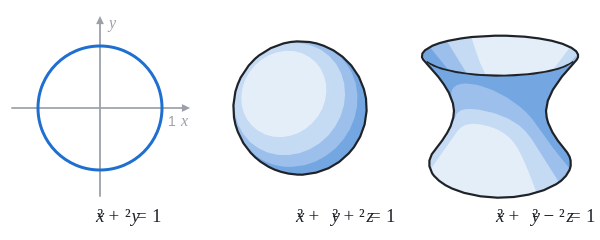
Shapes described by equations that involve only adding, subtracting and multiplying are studied in a field called algebraic geometry. That is where the Hodge conjecture is at home.
A piece described by equations
Whole straight lines lie on the hyperboloid. For example the one whose points satisfy the two equations
We can easily check this by substituting into the equation of the hyperboloid. We substitute one for x and z for y:
This gives 1 = 1, which holds for any z. So the whole line lies on the hyperboloid. If we rotate it around the vertical axis, it sweeps out the whole hyperboloid. We get a second family of lines in the same way, for example the line x = 1, y = −z.
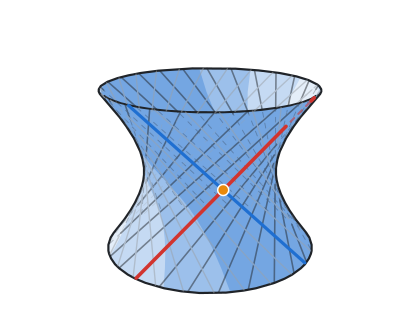
Thanks to this, a curved structure can be built from straight tubes or rods. The cooling towers of power stations, for example, have the shape of a hyperboloid.
What matters for what follows is this: a line is a piece of the shape that is itself described by equations. It lies on the hyperboloid, and it only needs one more equation added to the equation of the hyperboloid. We will call such pieces equation pieces. The Hodge conjecture asks what can be put together from them.
Loops on a doughnut can be added
From the article on the Poincaré conjecture we know the torus, the surface of a doughnut. A rubber band around the tube (red, let’s call it a) cannot be shrunk to a point on it, and neither can a rubber band around the hole (blue, b). It may slide around the torus and change shape, but it can’t be taken off.
The word hole is treacherous. A hole is nothing, an empty space in the middle of the doughnut. It can’t be put together from anything. What can be put together are the loops that wrap around the hole; those are made of rubber. Mathematicians call them cycles, and we will call them wrappings. A loop is the simplest kind, a one-dimensional one.
Loops can be added. Imagine a loop that winds around the tube twice during one trip around the hole. Such a loop counts as 2a + b. It is a genuine sum: two loops a and one loop b laid side by side can be slid and joined together until they form a single winding loop. And conversely, however we slide and deform the green loop on the torus, it always winds around the tube twice and around the hole once.
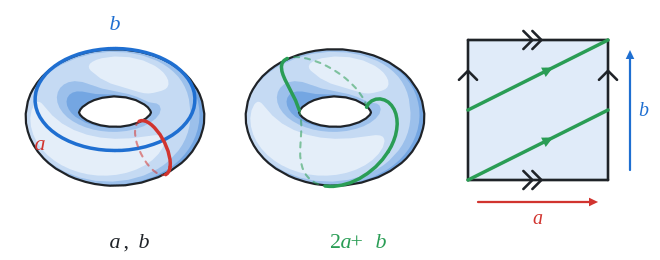
On the right is the same loop on a square whose opposite sides are glued together, just as we put the torus together in the article on the Poincaré conjecture. The green line goes out through the right side and comes back through the left, so it crosses the square horizontally twice and vertically once.
We can subtract loops too: −a is the loop a traversed the other way round. And it is not only loops that can wrap around something. The whole surface of the doughnut wraps around something as well, namely the cavity inside. It is a two-dimensional wrapping. On more complicated shapes there are wrappings of higher dimensions too. All of them can be added and subtracted just like loops.
Why complex numbers
Mathematicians don’t solve equations only in ordinary numbers, but in complex numbers too. That is where equations behave most nicely: the equation x2 = −1 has no solution among ordinary numbers, but among complex numbers it has two. In general, in complex numbers every equation in one unknown that involves only adding and multiplying has a solution, for example x5 + x + 1 = 0. So the Hodge conjecture is about shapes described by equations in complex numbers.
But where can we draw such a shape? One complex number is a point in a plane, the so-called Argand diagram, or complex plane. It has two components, a real one and an imaginary one. So a pair of complex numbers x and y is a quadruple of ordinary numbers. An equation in the unknowns x and y carves a shape out of four-dimensional space.
Now comes the crucial part: the shape has twice as many dimensions. The circle x2 + y2 = 1 is a curve in ordinary numbers, that is, one-dimensional. The same equation in complex numbers describes a surface, two-dimensional. Why? One complex equation is really two ordinary ones: the real parts of both sides must be equal, and so must the imaginary parts, each separately. Each ordinary equation removes one dimension, so out of four dimensions two are left. One complex direction is simply worth two ordinary ones. Mathematicians say that it has complex dimension one, that is, two ordinary dimensions. In the same way the line on the hyperboloid is doubled too: in complex numbers it becomes a surface.
An equation that is a torus
In the article on the Birch and Swinnerton-Dyer conjecture we met the elliptic curves y2 = x3 − n2 · x. Let’s take the simplest, for n = 1:
In ordinary numbers it has two pieces, an egg and an infinite branch. In complex numbers it is a surface in four-dimensional space. It can’t be drawn directly, but it can be unrolled into the plane like wallpaper.
That is because there is a formula that assigns to each point of the complex plane one complex solution of our equation. It was devised in the 19th century by Karl Weierstrass, and it is too complicated to fit in here, so you will have to take it on trust. But I will tell you what it does. The whole plane is covered with tiles (square ones for our equation, parallelograms for other elliptic curves), and the formula repeats in each tile like the pattern on a wallpaper: points that lie in the same position in two tiles give the same solution. And each solution appears exactly once in each tile.
So one tile is enough. Whatever goes out of its right edge comes back through the left one, and whatever goes out of the top comes back through the bottom. If we glue the opposite edges together, we get exactly the square with glued sides on which we drew the loop 2a + b, and so a torus. The complex solutions of the equation y2 = x3 − x form a torus. The point at infinity from the article on BSD is nothing special on this torus, it is just one of its points.
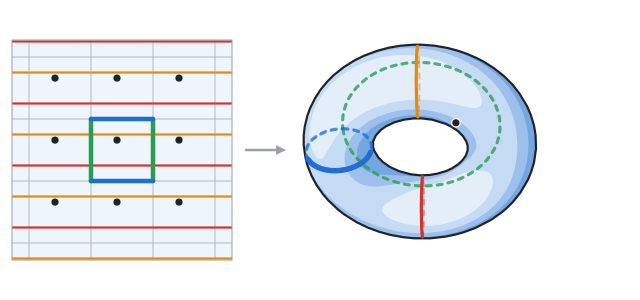
The picture also shows the ordinary solutions, those with real x and y. On the wallpaper they lie on horizontal lines: the infinite branch on the red ones, the egg on the orange ones. On the torus they become two circles around the tube. The branch closes up into a circle precisely through the point at infinity, which on the wallpaper lies on the red lines, once in each tile.
What may be put together
Now we have enough groundwork to say what the conjecture is actually about. We have a shape described by complex equations. It must be nice: closed, that is, finite, without an edge and completed with points at infinity, as with the torus, and without sharp spikes or places where it passes through itself. On it there are wrappings of different dimensions, which can be added and subtracted. And on it there are equation pieces.
Because of the doubling, equation pieces from complex equations always have an even dimension. A complex curve is a surface, a complex surface has four dimensions. That is why the conjecture asks only about wrappings of even dimension. The loops a and b are one-dimensional, so they can never be put together from equation pieces, and nobody expects them to be. They were just an exercise in adding.
On the torus itself it is still boring. The only two-dimensional wrapping is (up to multiples) the whole torus, and that is an equation piece in its own right. Things only get interesting on more complicated shapes.
The simplest such shape is made from two identical tori. Its points are pairs: one point on the first torus and one on the second. To pin down a position in it we need four numbers, two for each torus, so the shape is four-dimensional and we can’t draw it even as a wallpaper. There are lots of two-dimensional wrappings in it. If we keep the first point fixed and let the second run all over the second torus, we get an equation piece. But if the first point goes round the loop a and the second, independently, round the loop b, we also get a two-dimensional wrapping, but that one never passes the test, so it can’t be put together. Things only get interesting with combinations of such wrappings. For two tori, mathematicians can say exactly which of them pass the test, and they know that all of these can be put together, because the conjecture has been proved for such a shape. For more complicated shapes nobody knows.
The test
Which wrapping could be put together from equation pieces? In the 1930s the Scottish mathematician William Hodge came up with a tool that can at least give this away. Let’s call it the test. Hodge then presented his conjecture in 1950 at the International Congress of Mathematicians in Cambridge, Massachusetts.
To be honest, I have to admit that the test can’t be described precisely without university mathematics. But I can give you a rough idea. In a complex shape every direction has a twin: multiplying by i turns it through a right angle, just as it turns every number in the complex plane. At each of its points, an equation piece contains with every direction its twin as well, so in this sense it is balanced. The test checks whether a wrapping behaves as if it were balanced in the same way, even though it need not itself come from equations or look like it does.
In reality it is a calculation, not an analogy. Mathematicians calculate certain integrals over the given wrapping, that is, roughly speaking, sums of tiny contributions from the whole wrapping, and the test requires those of them that would give away an imbalance to come out as zero. What matters is that the test is precisely defined and can be carried out on any wrapping.
One thing, however, is easy. Every equation piece passes the test, because it is balanced, so the integrals on it come out as zero by themselves. It follows that every sum of such pieces passes too. That is the easy direction.
The conjecture
The Hodge conjecture claims that it also holds the other way round:
If a wrapping passes the test, then some multiple of it can be put together from equation pieces.
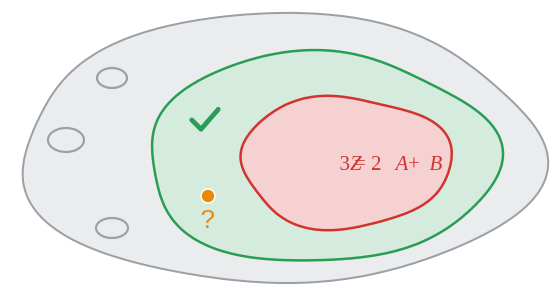
Put together means adding and subtracting equation pieces, even the same one several times, and then turning the result into our wrapping by sliding and deforming it. And multiple means the wrapping taken twice, three times or as many times as needed. So the conjecture doesn’t require the wrapping Z itself to be put together. It is enough if, say, 3Z = 2A + B, where A and B are equation pieces.
In technical language this is stated as: every Hodge class is a rational combination of algebraic cycles. Rational means that fractions are allowed when putting things together. But that is the same as a multiple: if
Why the multiple? Hodge himself originally stated the conjecture without it. Only later did it turn out that it doesn’t hold that way. The first example was found in the early 1960s by Michael Atiyah and Friedrich Hirzebruch: there are wrappings that pass the test and can’t be put together directly, even though a multiple of them can.
What would disprove the conjecture? A single wrapping that passes the test, but no multiple of which can be put together from equation pieces, neither twice it nor a million times it. In the picture, the orange dot. The conjecture talks about all wrappings on all nice shapes, so a single exception would be enough. Nobody has found one, but nobody has proved that none exists either. Searching for one is also hard for another reason: for a wrapping that passes the test, we would have to prove that no multiple of it can be put together from any equations at all. Nobody today has a tool for that, so even if a counterexample existed, we wouldn’t be able to prove it was one.
What we know and why it is hard
For simpler shapes we know that the conjecture holds. The groundwork was laid by the Russian-born American mathematician Solomon Lefschetz as early as 1924, before Hodge came up with his test. Today the conjecture has been proved for all shapes with at most three complex dimensions. That is because only two kinds of wrapping are interesting there: those two dimensions smaller than the whole shape, for which Lefschetz’s theorem holds, and the two-dimensional ones, which are paired with them and can be converted into them. From four complex dimensions upwards, wrappings “in the middle” appear, for example four-dimensional wrappings on an eight-dimensional shape, and no such trick works for them. So for more complicated shapes the conjecture is open, and it has been proved only for certain special families.
Why can’t it be done for more complicated shapes? There can be lots of wrappings that pass the test there, and they are four-dimensional and higher. To show that one of them is put together from equation pieces, we would have to find those pieces. And finding an equation piece means finding new equations that carve out exactly what we need on the shape. Nobody has any idea where to look. It is the same difficulty as with BSD: the test says that the pieces ought to exist, but it gives no instructions for constructing them.
Why it matters
The Hodge conjecture has no direct practical use, and nobody expects one. It is a central question of algebraic geometry, connecting two worlds. One is shape: loops, wrappings and holes, which don’t depend on equations, only on rubber. The other is equations and their solutions.
If the conjecture held, questions that are purely about equations could be decided by looking at the shape and calculating integrals. Today we only know that equation pieces pass the test. The conjecture claims that the test never lies. A grand plan of Alexander Grothendieck’s from the 1960s, the so-called theory of motives, which aims to unify the various ways of counting holes in shapes defined by equations, also depends on it. According to Pierre Deligne, who described the conjecture for the Clay Institute, this plan got stuck precisely because we don’t know how to construct interesting equation pieces. That is why the Clay Institute included it among the seven most important open questions in mathematics.
News
We are writing this section on 23 November 2026. In October 2026 the company OpenAI published hundreds of mathematical manuscripts at once, which it says were produced by its artificial intelligence model. Among them is a claimed proof of the Hodge conjecture for one special, highly symmetric family of shapes. Unlike the proof for Yang–Mills theory, according to available reports nobody has written it down in a form a computer can check, and nobody has yet verified it independently. Meanwhile OpenAI has withdrawn or corrected some of the manuscripts from the whole batch. Even if the result holds up, the general conjecture remains open.
What should you take away from all this? The Hodge conjecture claims that on nice shapes described by complex equations, every wrapping that passes Hodge’s test can, at least as some multiple, be put together from pieces that are themselves described by equations.
You will find more Millennium Prize Problems in the category Famous problems.