
The Riemann hypothesis
Prime numbers look as if someone had scattered them at random. After 2 and 3 come 5, 7, 11 and 13, then a gap, then 17… Nobody knows a formula that would tell you where the next prime lies. And yet, on a large scale, the primes follow a surprisingly precise rule. The Riemann hypothesis claims that they never stray far from that rule. It is probably the most famous unsolved problem in mathematics, and a prize of one million dollars has been offered for solving it.
First, a little riddle. Have a guess: how many primes are there below one million? A hundred thousand? Ten thousand? You will find the answer a bit further down.
How many primes are there?
We start by hand. The picture shows the numbers from 1 to 100, with the primes marked in red.
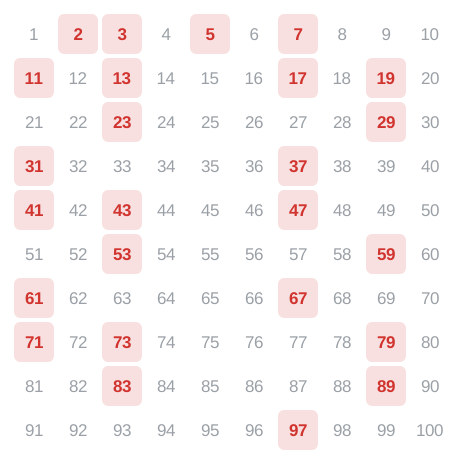
Up to 10 there are four primes: 2, 3, 5 and 7. Up to 100 we count 25. If we carry on, we find that up to 1,000 there are 168. So primes keep appearing, but at an ever slower rate. Among the first ten numbers four are prime, that is 40%, among the first hundred it is 25%, and among the first thousand only 17%.
The number of primes that are not greater than x is written π(x). Don’t be confused: here π is not the number 3.14, it is just the name of a function, taken from the word prime. So we have π(10) = 4, π(100) = 25 and π(1000) = 168. If we draw π(x) as a graph, we get a staircase: every time we meet a prime, the function jumps up by one.
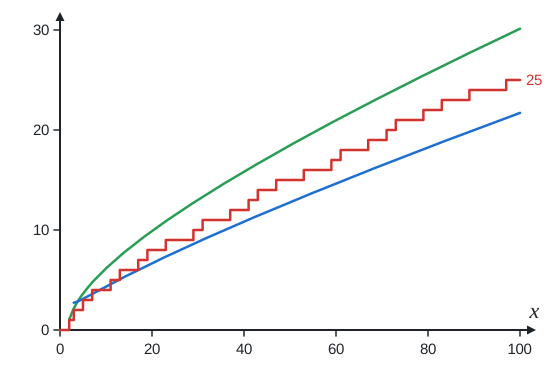
The steps look irregular, some are wide and others narrow. But from a distance they follow a fairly smooth curve. Which one?
The first to spot it was a fifteen-year-old Carl Friedrich Gauss, while going through tables of primes. He noticed that near a number x roughly every ln x-th number is prime, where ln is the natural logarithm. Let’s check this with an example: ln 1,000,000 is about 13.8, so near a million about every fourteenth number should be prime. Between 1,000,000 and 1,001,000 there should therefore be roughly
primes. In reality there are 75. For primes, which are so “disorderly”, that is a pretty good match.
If near x every ln x-th number is prime, then up to x there should be roughly
In the graph you see it as the blue curve. The fact that this estimate becomes more and more accurate is called the prime number theorem. It was proved only in 1896, independently by Jacques Hadamard and Charles de la Vallée Poussin, and both needed the zeta function, which we will get to shortly.
The graph does show, however, that the blue curve stays below the steps almost the whole time. We can do better. Gauss’s observation can also be read like this: a number t is prime with a “probability” of roughly
Mathematicians take an integral instead of the sum, that is, the area under the graph of the function
How far off is the estimate?
The table gives the actual number of primes π(x) and by how much the two estimates differ from it. The last column shows the square root of x for comparison.
| x | π(x) | error of |
error of li(x) | |
|---|---|---|---|---|
| 103 | 168 | 23 | 10 | 32 |
| 104 | 1229 | 143 | 17 | 100 |
| 105 | 9592 | 906 | 38 | 316 |
| 106 | 78,498 | 6116 | 130 | 1000 |
| 107 | 664,579 | 44,158 | 339 | 3162 |
| 108 | 5,761,455 | 332,774 | 754 | 10,000 |
| 109 | 50,847,534 | 2,592,592 | 1701 | 31,623 |
| 1010 | 455,052,511 | 20,758,029 | 3104 | 100,000 |
| 1011 | 4,118,054,813 | 169,923,159 | 11,588 | 316,228 |
| 1012 | 37,607,912,018 | 1,416,705,193 | 38,263 | 1,000,000 |
Here is the answer to the riddle: the number of primes below one million is 78,498. Was your guess at least roughly the right order of magnitude?
The estimate
And that is the heart of the Riemann hypothesis. In plain words:
The error of the estimate li(x) is at most roughly
More precisely: the Riemann hypothesis is true if and only if for every x from 2657 upwards
Here π in the fraction means the ordinary 3.14 again. This form with exact numbers was derived by Lowell Schoenfeld in 1976. The extra logarithm grows so slowly compared with
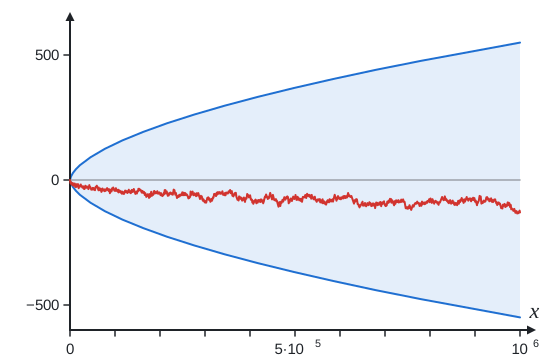
Up to a million we can see it with our own eyes, and computers have checked it much further. But there are infinitely many numbers, and nothing guarantees that something won’t go wrong somewhere very far away. In mathematics this has happened before: li(x) is greater than π(x) for every x in the table, so it always slightly overestimates the primes (the red line in the picture above is entirely below zero). But in 1914 John Littlewood proved that this will turn around one day, and even infinitely many times. Nobody has found a single such x yet, we only know that it is greater than 1019.
Why a square root? A simple experiment helps: toss a coin. After n tosses you expect roughly
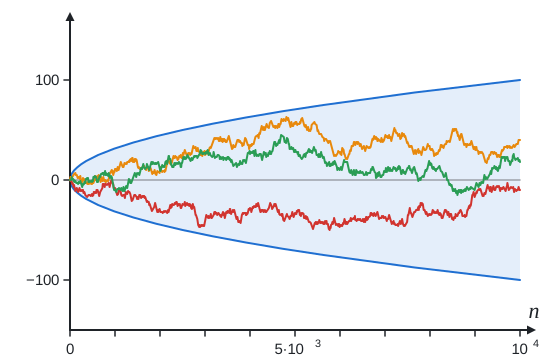
The similarity of the pictures is no coincidence. Primes are of course not random, every number either is prime or isn’t. But the Riemann hypothesis basically says that they behave as if they were random: they fluctuate around a smooth estimate, but no more than coin tosses would. There are no sneaky patterns in them that would pile them up or sweep them away somewhere far off.
The zeta function
And how did Riemann get into the story? In 1859 Bernhard Riemann wrote a short paper on how many primes there are below a given number. It was his only paper on number theory, and a whole branch of mathematics grew out of it. The main role in it is played by a sum that Leonhard Euler had studied before:
The Greek letter
Let’s start with s = 1:
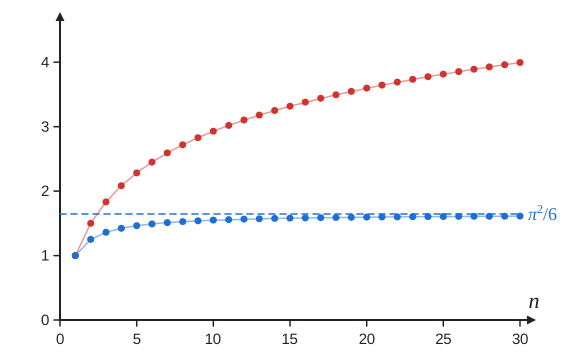
The terms get smaller and smaller, so it might seem that the sum settles down somewhere. It doesn’t. This so-called harmonic series grows beyond all bounds, only terribly slowly: for the sum to exceed ten, you have to add up 12,367 terms. In the picture, the red line shows what the sum of the first n terms comes to.
For s = 2 we add up the reciprocals of the squares:
Here the sum does settle down, shown in blue in the graph. What value it settles on puzzled mathematicians for over eighty years, and it was known as the Basel problem. Euler solved it in 1734 and nobody expected the result:
How the π from the circle got into the result would make a whole article on its own. For us, another discovery of Euler’s is more important, one that links the zeta function with the primes.
Euler’s product
Let’s take just the powers of two and add up their reciprocals:
This is an infinite geometric series with common ratio
We do the same with the powers of three and multiply the two sums. We expand the brackets, every term with every term:
For example
If we multiply by the bracket with the powers of five, the numbers built from twos, threes and fives appear. And when we multiply the brackets for all the primes, we get every positive integer. That is because each of them can be written as a product of primes, and in only one way. That is what the fundamental theorem of arithmetic says. That is why every
On the left is a sum over all the positive integers, on the right a product over all the primes. This formula is the bridge between the zeta function and the primes, and everything else relies on it.
What is more, it immediately implies that there are infinitely many primes. If there were only finitely many, then for s = 1 the right-hand side would be a product of finitely many ordinary numbers, that is, some definite number. But on the left would be the harmonic series, which grows beyond all bounds. That doesn’t add up. (You can find another, older proof in the article on proof by contradiction.)
Zeros and the critical line
Euler substituted only ordinary real numbers for s. Riemann took a bold step: he substituted a complex number for s, that is, a number of the form a + bi, where i is the imaginary unit, for which i2 = −1. We can picture complex numbers as points in a plane: the real part a says how far to the right the point is, and the imaginary part b how high up. That plane is called the Argand diagram.
There is one snag, though. The sum
The left-hand side makes sense only for x between −1 and 1, but the right-hand side has no such restriction. We can substitute, say, x = 2 and get −1. So the right-hand side “extends” the left. With the zeta function it is more complicated, but the idea is the same. Mathematicians call it analytic continuation.
What interests us, though, is where the zeta function equals zero. Such places are called zeros. Some are easy: the zeta function is zero at −2, −4, −6, −8 and onwards at all the negative even numbers. These are the so-called trivial zeros, shown in green in the picture. The others are called non-trivial, and we know that they all lie in a narrow strip where the real part is between zero and one. This strip is called the critical strip, shown in blue in the picture.
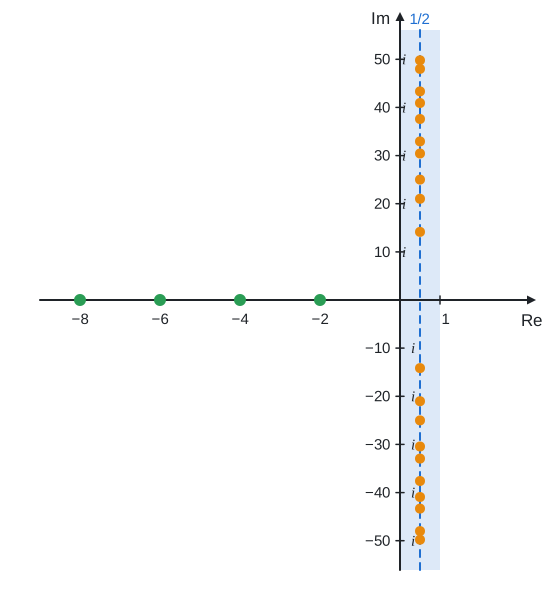
Right in the middle of the strip runs a line on which all the numbers have real part
All non-trivial zeros of the zeta function have real part equal to
In other words, all the orange points lie on the dashed line. Zeros come in pairs, symmetric about the real axis: if
On the critical line you can see how the function really does hit zero. In the graph, the red line shows the size (absolute value) of the number
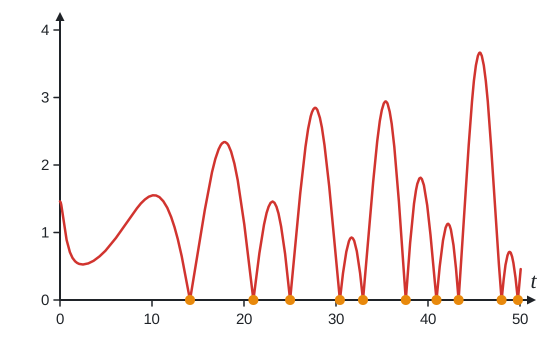
Riemann calculated the first few zeros by hand and wrote in his paper that it is “very probable” that they all lie on the line. But he put the proof aside, because he didn’t need it for his purpose. It has been awaited ever since. In 1914 Godfrey Hardy proved that infinitely many zeros lie on the critical line. But nobody has been able to prove that all of them lie there. Computers, on the other hand, have checked an enormous number of cases. In 2004 Xavier Gourdon verified that the first ten trillion (1013) zeros lie on the line. Not a single one strayed.
The music of the primes
How do zeros relate to counting primes? Right here lies the most beautiful part of Riemann’s paper. Riemann found a formula that builds the staircase of the primes exactly from a smooth curve and from waves, each wave belonging to one zero.
The cleanest form of that formula is for a slightly modified staircase. Instead of jumping up by one at every prime p, we jump by ln p. And we add small steps at the powers of primes too, so at four (22) we jump by ln 2, at nine (32) by ln 3 and so on. This staircase is called the Chebyshev function and is written
It looks frightening, and yet it says exactly what the beginning of this section said. At the start is the line x, at the end two tiny correction terms that hardly do anything. In the middle is a sum over all the non-trivial zeros. The letter ρ (read “rho”) is a zero, for example
Each pair of zeros
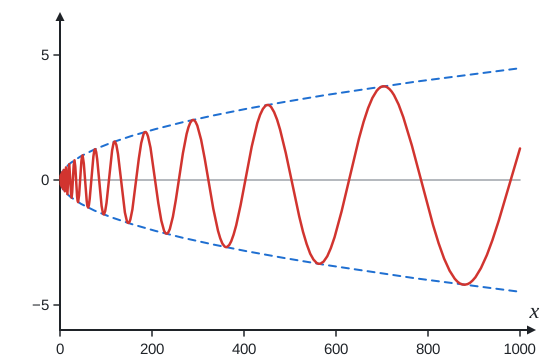
The wave oscillates and its height grows. Why? Let’s split the power xρ up:
The second factor xγ i is a complex number with absolute value one, which just keeps rotating as x grows. The rotation turns into oscillation. But the size of the wave is determined by the first factor,
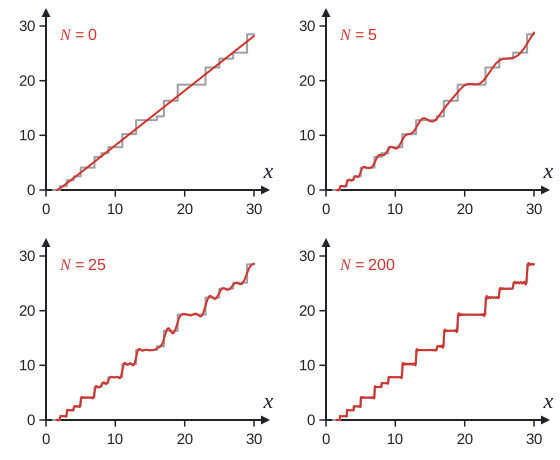
And now we put it all together. In the animation, the true function
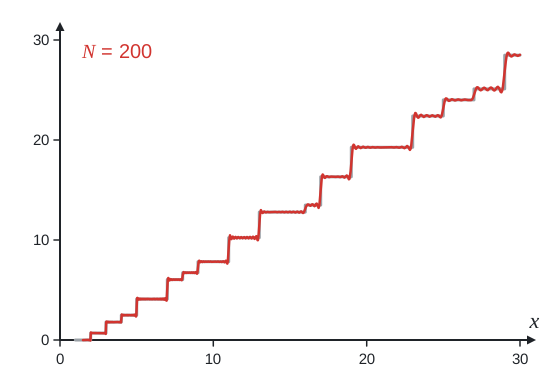
Without waves we get just a line. Each further wave adds a little oscillation, and the waves add up so that jumps gradually form at the primes while between them the oscillations cancel out. With two hundred pairs the red line can hardly be told apart from the grey staircase. If the animation doesn’t play for you, here are all four states side by side:
From here it is easy to see why the position of the zeros matters so much. The deviation of the staircase from the smooth line is the sum of all the waves. When all the zeros lie on the critical line, each wave grows like
But if some zero lay off the line, say with real part 0.8, its wave would grow like x0.8. And for large x that is far more than
The prime number theorem from the first section also rests on the zeros. In 1896 Hadamard and de la Vallée Poussin proved “only” that no zero lies on the edge of the critical strip, that is, that the real part is always less than one. That is enough for the waves to grow more slowly than x itself, so that the estimate fits better and better in percentage terms. The Riemann hypothesis wants much more: a real part of exactly
Why it matters
The Riemann hypothesis is an old and famous problem. In 1900 David Hilbert included it among the 23 problems that he thought should keep mathematics busy in the new century. It was the eighth of them. In 2000 the Clay Mathematics Institute included it among the seven Millennium Prize Problems. For solving each of them a prize of one million dollars has been offered, just as for the P versus NP problem. The prize is not paid out at once, though. The solution has to be published in a recognised journal and then survive for another two years before experts accept it.
Why are mathematicians so interested? Mainly because hundreds of other theorems rest on it. In research papers you often read “if the Riemann hypothesis holds, then…”. For example:
- The gaps between neighbouring primes near x are no greater than roughly
- The simple and fast Miller test would tell with certainty whether a number is prime. But it relies on the generalised Riemann hypothesis, a version for related functions similar to the zeta function.
- Precise estimates of how evenly the primes are shared among numbers ending in 1, 3, 7 and 9. Here too the generalised hypothesis is needed.
If someone proved the hypothesis (for the last two examples, the generalised one), all these theorems would suddenly hold. If someone disproved it, some of them would fall.
Now and then you hear that a proof of the Riemann hypothesis would break encryption and with it internet banking. That is not true. The widely used RSA cipher rests on the fact that we cannot quickly factorise a large number into a product of two primes. The Riemann hypothesis says nothing about factorising numbers, it only says how the primes are distributed among the other numbers. Most mathematicians also believe that the hypothesis is true, and it has long been relied upon. A proof would only confirm what is assumed. Only some new idea that came up during the proof could harm ciphers, but nobody can see any such idea.
Why people are talking about it now
Levent Alpöge, a mathematician at Anthropic, published a four-page note on his website on 20 November 2026. In it he writes that together with the AI model Claude he has found a proof of the Riemann hypothesis and that he has also proved the generalised Riemann hypothesis.
So far he has presented only a version of the proof written in the Lean language. It is a programming language in which mathematical proofs can be written so that a computer checks them mechanically, step by step. A conventional text that a mathematician could read does not exist yet. Alpöge himself admits that he does not yet understand all the mathematics of the proof and wants to write it up later.
There is no independent verification or review yet. The computer check in Lean is a powerful thing, but even it is not enough. Experts must check, among other things, that the statement itself is correctly written in Lean, that is, that the computer really verified the Riemann hypothesis and not some similar-looking statement. Brian Conrey, one of the leading experts on the Riemann hypothesis, called the announcement “a monumental moment in human history”. But he has not yet seen the manuscript. The announcement came the day after Anthropic went public.
There have already been many attempts to prove the Riemann hypothesis, including attempts by famous mathematicians, and all have failed so far. This one is different in that it comes as a proof in Lean, which a computer can check. Whether it holds up will be shown only by the work of experts, and that may take a long time. In any case, the Clay Institute’s million dollars cannot come until at least two years after publication. We are writing this paragraph on 21 November 2026.