
The Navier–Stokes equations
Turn the tap on just a little and a smooth, clear trickle of water will flow out. Turn it further and the stream becomes ragged, turns white and starts to bubble. The smoke from a candle that has just been blown out behaves the same way: at first it rises as a straight thread, and a little higher up it breaks into swirls.
Behind both lie the Navier–Stokes equations. We have known them since the 19th century, and weather forecasts, the airflow around aeroplanes and blood flow in our blood vessels are all calculated with them. Even so, nobody knows to this day whether they always make sense, or whether “something can break” in them. In 2000 the Clay Mathematics Institute included this question among the seven Millennium Prize Problems and offered a million dollars for the answer. The first of those seven to be solved was the Poincaré conjecture.
In September 2026 the company OpenAI announced that its artificial intelligence had solved the problem. But the solution has a catch, and mathematicians are arguing about it. To make clear what this is about, let’s first look at what the equations actually calculate.
A map of arrows
Take a river with a stone lying in it. At every point the water flows in some direction and at some speed. So at every point we can draw an arrow: where it points, the water flows, and the longer it is, the faster the water flows. Such a map of arrows is called a velocity field.
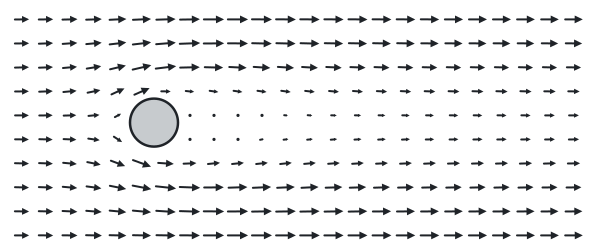
The arrows belong to places, not to the water. The water underneath them is constantly being replaced. Let’s drip some dye into the river and see how the field moves the drops along.
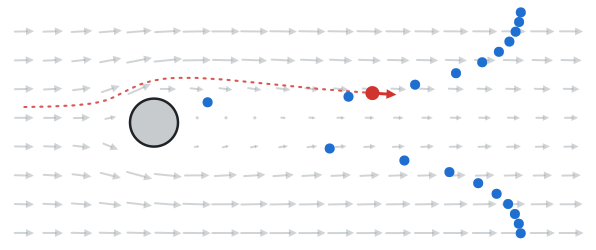
The map in the picture stays the same over time, and yet the drop speeds up and slows down. That is because it gets to places where the arrow is different. The acceleration of a drop has two causes. First, the arrow can change at the place where the drop happens to be, for example when the current gets stronger. Second, the drop moves on somewhere else, where the arrow is longer or points in another direction.
The second cause is tricky. Where the water moves to is determined by its velocity, and the velocity in turn determines where it moves next. So the water carries itself along. Mathematicians call this kind of behaviour non-linear: the effect grows faster than the cause. If the current speeds up to twice its speed everywhere, this effect becomes four times stronger. That is because velocity plays a part in it twice: the drop gets somewhere else twice as fast, and the differences in velocity between places are also doubled. Together that makes 2 · 2 = 4. So the problem can’t be chopped into pieces, each piece calculated separately and the results added up.
On top of that there is one more condition: water cannot be compressed. However much water flows into a place, the same amount must flow out.
The famous equation, piece by piece
All the equations do is write down Newton’s second law for each drop of water separately: mass times acceleration equals force. Here is the famous equation. You don’t need to decipher the symbols, just follow the colours:
The letter
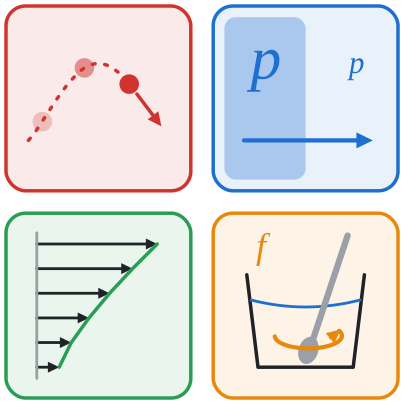
- Red – inertia, the only coloured piece on the left, part of the acceleration. Water that is moving tries to keep going and carries its velocity with it. This is the non-linear term that causes all the trouble.
- Blue – pressure. Water is pushed from where the pressure p is high to where it is low. Just squeeze a hose and the water squirts out.
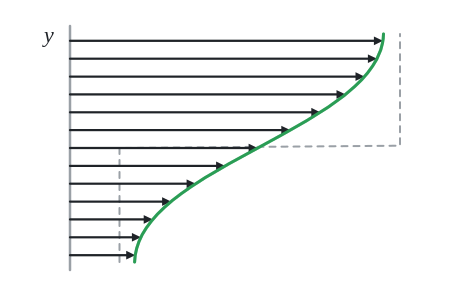
- Green – viscosity. It works much like friction, only inside the water. A faster layer of water drags a slower one along with it, and the slower one holds it back. The number ν says how strongly. The viscosity of honey is several thousand times greater than that of water, which is why it flows lazily and smoothly.
- Orange – external force
Below the equation there is also a short condition,
The next animation shows how friction wipes out differences. A fast layer of water moves above a slow one, and where they touch, they rub against each other. The difference gradually smears out and the speeds even out.
It was first written down by the French engineer Claude-Louis Navier in 1822, when he added exactly this internal friction to Euler’s older equations for a fluid without friction. The Irish physicist George Gabriel Stokes derived it again in 1845 in a different way, which is why it bears both their names.
Smooth and wild flow
Honey runs off a spoon smoothly, in orderly layers. This kind of flow is called laminar. A fast river, on the other hand, is wild and forms tangled eddies of all sizes; that is turbulent flow. Which of the two wins is decided by a contest between the red and the green terms of the equation, that is, inertia and friction.
The outcome of the contest is measured by a single number, the Reynolds number. It is calculated as speed times the size of the obstacle divided by viscosity. Water in a pipe starts to swirl from about 2,300, and a large ocean liner sails at a Reynolds number of around five billion. A bacterium, on the other hand, swims at a Reynolds number of around one ten-thousandth. The physicist Edward Purcell compared such a world to a swimming pool full of treacle, a thick syrup, in which you may move at most a centimetre a minute.
Our stone in the river shows this nicely. We calculated the flow around it on a computer, directly from the Navier–Stokes equations. To see where the water is swirling, we imagined dropping little paddle wheels into it. Where a wheel turns anticlockwise, the picture is red, and where it turns clockwise, it is blue. The deeper the colour, the faster the wheel spins. Mathematicians call this vorticity.
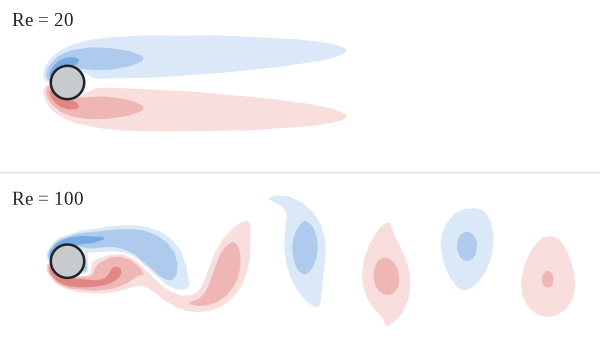
At a low Reynolds number, two calm eddies stay behind the stone. Above about forty they start to break away, once at the top, once at the bottom, and float off in a regular row. This is called a Kármán vortex street, after Theodore von Kármán, who described it in 1912. Clouds form the same pattern when the wind flows around a high island, such as Madeira or the Canary Islands. In NASA satellite images they look like giant spirals trailing across the sea.
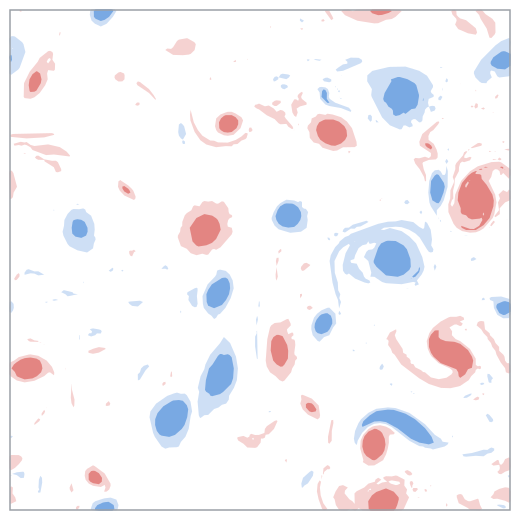
If we speed things up even more, the regularity breaks down and turbulence sets in. Large eddies break up into smaller ones, those into even smaller ones, and so the energy of motion flows from large eddies to smaller and smaller ones. At the very smallest, friction finally eats it up and turns it into heat.
Can the equation blow up?
At last we can ask the million-dollar question. We start from a reasonable flow. It is smooth, that is, without kinks or jumps, not even in how fast things change. In other words, the velocity and all its changes are finite everywhere, nothing blows up. And it has finite energy: in all the water put together there is only a finite amount of motion, no infinite supply. Will such a flow stay smooth for ever? Or can it happen that somewhere, in a finite time, the velocity climbs without limit?
Real water can’t flow infinitely fast. So why are we interested in a blow-up? Water is made of molecules and the equations know nothing about them; they assume that water is perfectly continuous, without any grains. Even so, they describe it superbly at all ordinary scales. If they could blow up, it would mean that the model, all by itself, starting from a perfectly smooth state, reaches a point where it stops being valid. And we wouldn’t know where we could still trust it. If they couldn’t blow up, forecasts and simulations would have a firm foundation. A weather forecast is approximate either way, but the question is about the equations, not about computers. Mathematicians call this a blow-up, or a singularity.
Let’s go back to turbulence. Energy flows to smaller and smaller eddies and friction stops it at the smallest ones. But what if the cascade runs so fast that within a finite time it reaches an “infinitely small eddy” before friction has time to put the brakes on?
A figure skater hints at why this could happen. When she pulls her arms in to her body during a spin, she spins faster. In the same way, an eddy that gets narrower spins faster. And in three-dimensional space eddies can get narrower: the surrounding flow takes an eddy like a little tube and stretches it like chewing gum. The amount of water in it stays the same, so a stretched eddy is thinner, just like the skater pulling her arms in. It is the same principle, and that is why a thinner eddy spins faster.
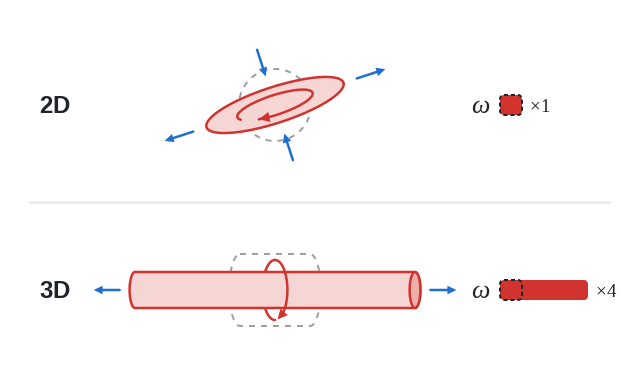
In a two-dimensional world, where everything takes place in the plane only, an eddy is a little disc. The flow can move it around and squeeze it into an ellipse, but in the plane every drop carries its rate of spin unchanged, and only friction slowly damps it. The shape of the eddy changes, the strength of its spin doesn’t. In 3D, stretching increases it. That is why mathematicians know the answer in the plane. In the late 1950s the Russian mathematician Olga Ladyzhenskaya proved that there the flow stays smooth for ever. But real water is always three-dimensional, and there the answer is still being sought.
A wave that breaks
We will show what such a blow-up looks like with a scaled-down model. Burgers’ equation describes a fluid with no pressure, only inertia and friction, and in only one direction at that. It is so simple that we can solve it exactly, and we can see the whole contest between steepening and friction in it:
Each drop moves at its own velocity u, so the faster ones catch up with the slower ones, like cars in a traffic jam or a wave breaking on the beach. The picture shows the velocities of the drops along a line. Where the curve is above the axis, the water moves to the right, where it is below, to the left, and in the middle they collide.
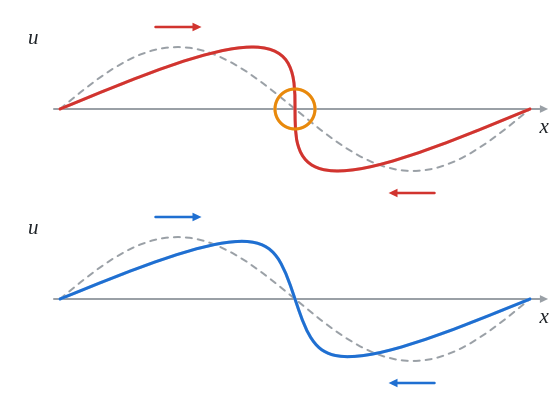
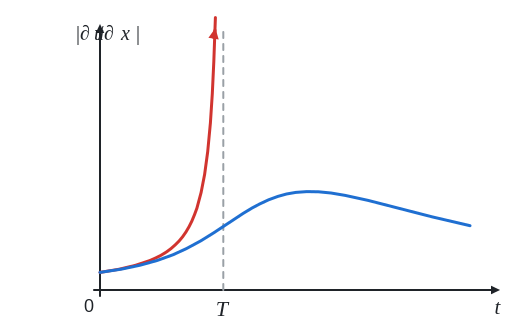
Without friction the front of the wave gets steeper and steeper until at time T it is vertical. At that moment the steepness is infinite, and if the wave carried on, the water would have to have two velocities at once at one point. Here the equation stops making sense. With friction the wave gets steeper too, but friction smears out the differences in velocity, and all that is left of the break is a steep, smooth step.
The graph shows the steepness of the wave at its steepest point. Without friction it shoots off to infinity at time T. That is exactly the kind of blow-up we have in mind: a quantity that grows without limit in a finite time. For the Navier–Stokes equations, the graph of the greatest velocity or vorticity would look the same.
For Burgers’ equation we know for certain that friction always wins, because we can solve it exactly. The Navier–Stokes equations also have pressure, which links all places at once, and a third dimension in which eddies get stretched. We can’t solve them exactly, and nobody knows how the contest between stretching and friction will turn out.
Why can’t a computer settle it? It calculates on a grid, as if on squared paper, and it sees nothing between the points of the grid. A blow-up would take place in a smaller and smaller region, which would eventually fit between two points of any grid. So a simulation can hint at which direction to look in, but it cannot settle “infinitely”. That takes a proof.
Two routes and a loophole
The Clay Institute did not take sides on the answer. Anyone who wants the million can choose between two routes. Either they prove that a smooth flow with finite energy stays smooth for ever, for absolutely every starting state. Or they find a single counterexample, a flow that blows up in a finite time. Until recently most experts expected the first to be true. The Spanish mathematician Diego Córdoba summed it up for Quanta Magazine in September 2026: “Ten years ago, nobody believed there was a singularity for Navier–Stokes.”
Now comes the loophole. The problem statement also allows an external force, the orange term of the equation, but only on the second route. A proof of smoothness only has to be given for water with no force. A counterexample may move the fluid with an external force, as long as the force itself is smooth and well behaved, with no hidden blow-up.
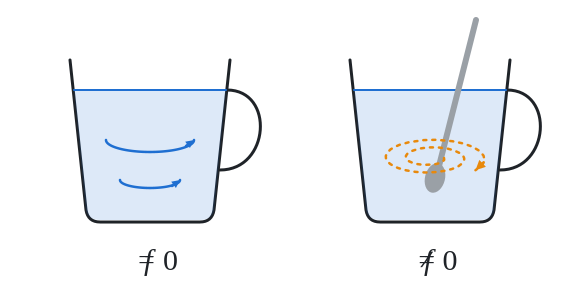
Real water is also driven by something, gravity or the wind. But such a force doesn’t “know” where the water should blow up. The force in a counterexample does know: it is planned like a puppeteer who leads the water exactly to where it should break. That is why the field regards the version without a force as the real question.
What happened in 2026
We are writing this section on 22 November 2026.
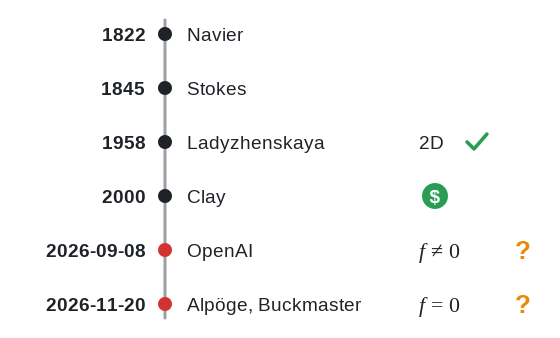
On 8 September 2026 OpenAI published a 166-page proof found by its internal model. About 10,000 agents, that is, copies of the program that run at the same time and confer with each other, worked on it for 88 hours. Then, over another 17 hours, the proof was rewritten in the Lean language, in which a computer can check every step (there is more about Lean in the article on the Riemann hypothesis).
According to the OpenAI paper, the fluid starts at rest and has finite energy the whole time, and yet its velocity shoots up without limit in a finite time. But only thanks to a smooth external force. The authors first chose how the flow should blow up, and then calculated the force that brings exactly that about. The main work was to make sure the force itself stayed smooth and didn’t hide a blow-up of its own, and that is a genuine mathematical achievement. If the proof is correct, they have formally completed the second route of the problem statement. On 11 September the Clay Institute wrote of the announcement that the Navier–Stokes problem had “apparently been settled”, and added that its assessment process is “deliberately unhurried”.
But many experts regard the result as exploiting a loophole. A force tailored to fit does a large part of the work, and the question the field considers the real one, namely whether water blows up on its own, without a force, remains open. A month after publication, according to Scientific American, nobody yet fully understood the proof. On top of that, in October three mathematicians pointed out that the proof checked in Lean does not match the proof in the text, so a successful check does not guarantee that the text is correct. That is because the proof has to be rewritten in the computer’s language, and the rewrite can drift away from the text. They do not claim that the proof is wrong.
The result also sparked a dispute over credit: the mathematicians Tristan Buckmaster and Levent Alpöge published a similar blow-up with an external force for a fluid without friction the day before OpenAI, and they claim that information about their approach reached OpenAI and could have influenced its result. OpenAI says it could not have.
On 20 November 2026 Alpöge and Buckmaster published a 79-page paper that claims a blow-up without an external force. That would be the real question. But the proof rests on a so-called certificate. That is a huge computer calculation with controlled rounding, which confirms that an approximate solution computed on a computer lies close enough to a true one. The authors have not published it yet, and until they do, nobody can check the proof. Buckmaster himself admitted that the text was written in a hurry and with a lot of help from language models. The mathematician Terence Tao writes that the strategy is clear in broad outline, but that more work is needed before it becomes a properly written-up proof.
So has it been solved? Formally, perhaps yes: if OpenAI’s proof is correct, it meets the problem statement, even if only through the loophole of an external force. The real question without a force has been claimed, but not verified. The Clay Institute has not yet awarded anything to anyone. It decides on the prize itself, under its rules no earlier than two years after publication in a peer-reviewed journal. OpenAI announced in advance that it would not apply for the million.
Why it matters
The weather, airflow around a wing, blood in the arteries, combustion in an engine: all of these are calculated from the Navier–Stokes equations. People rely on them making sense. If they could blow up on their own, it would mean that at the very smallest scales a smooth description of water is not enough. And understanding whether the cascade of eddies can run all the way down to infinitely small sizes means understanding turbulence, which physics still cannot describe from first principles.
The Navier–Stokes equations are not the only Millennium Prize Problem on which things are moving this year. Levent Alpöge, for instance, is also the author of the announced proof of the Riemann hypothesis. You will find more problems in the category Famous problems.