
The Poincaré conjecture
In 2000 the Clay Mathematics Institute picked out the seven hardest open problems in mathematics and offered a prize of one million dollars for solving each of them. Today, in 2026, only one of them has been solved: the Poincaré conjecture. It was proved by the Russian mathematician Grigori Perelman from St Petersburg. He did not take the million dollars, just as he had earlier turned down the most prestigious award in mathematics, the Fields Medal.
So what does the conjecture actually say? It can be put in a single sentence:
Is every closed shape on which every loop can be shrunk to a point really a sphere?
We will use pictures to show what closed, loop and sphere mean. By the time you finish reading, you will understand that sentence, and you will also see why its proof took a whole century.
Before we go any further, let’s agree on our words. In everyday speech a ball is a solid object, say a lead pellet. For almost the whole article we will only be interested in its surface, a thin skin like that of a blown-up balloon or a football. Mathematicians call it a sphere. Whenever we mean the solid object, we will always say solid ball. The same goes for all the shapes in this article: the closed shape in the question above is a surface, not a solid. A mug, a doughnut and a cube will all be just thin rubber skins for us, hollow inside.
Topology: rubber-sheet geometry
The Poincaré conjecture belongs to topology. This is geometry in which lengths, angles and curvature don’t matter. You can imagine every shape as perfectly pliable rubber. A topologist may stretch it, squash it, bend it and inflate it as much as they like. Only two things are forbidden: tearing and gluing. If two shapes can be turned into each other in this way, a topologist considers them the same.
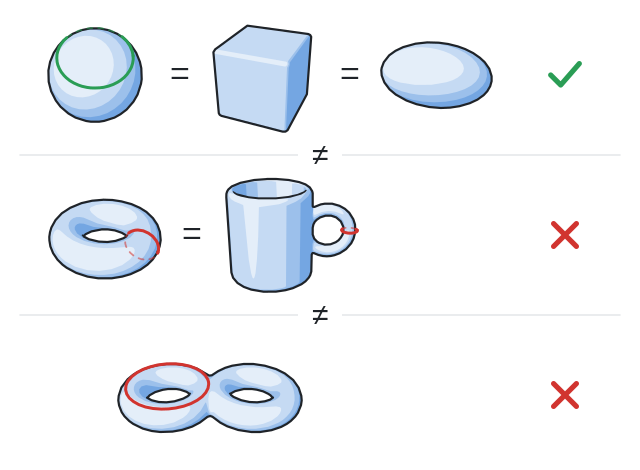
The most famous example is the mug and the doughnut. You can knead a rubber mug into a doughnut: the bottom is pushed up, the body of the mug shrinks into the handle and the handle swells into a doughnut. All the while, the hole in the handle stays put.
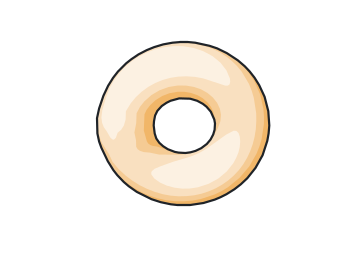
In the same way, to a topologist a sphere, the surface of a cube and the surface of a rugby ball are all the same. But a doughnut is not a sphere. However you squash a sphere, no hole through it will appear unless you pierce it. And that is tearing. Mathematicians call the doughnut a torus. Once again it is only a surface, the skin of an inflated bicycle inner tube.
Loops that cannot be shrunk
So how can we recognise a sphere if we are allowed to squash it any way we like? A rubber band helps. Put it anywhere on the sphere and let it contract. It must not leave the sphere, it may only slide along the surface and get smaller. On a sphere it always shrinks to a single point.
On a torus this is not the case. A rubber band around the tube (red) or around the hole (blue) won’t shrink. It can slide around the torus, but to shrink it would have to leave the tube or break.
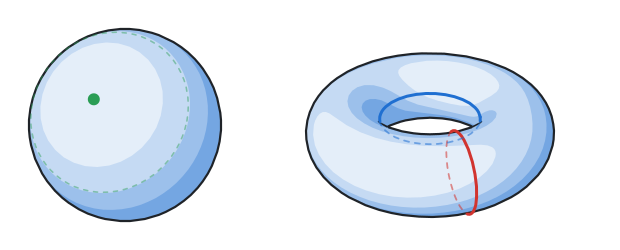
The loop test doesn’t need to see the shape from outside or measure it. It is enough to walk around on it with a piece of string. If every loop can be shrunk to a point, mathematicians say that the shape is simply connected. In the next picture, shapes in the same row are the same to a topologist, while shapes in different rows are not.
The ant that doesn’t know what it lives on
Try to imagine you are an ant living on a huge sphere or a huge torus. It knows nothing of “up”: for the ant there is only the surface it crawls on. And it can only see a small patch around itself, which looks flat to it, on a sphere just as on a torus.
Mathematicians say that the sphere and the torus are two-dimensional. Not that they are flat, but the ant only needs two numbers to say where it is, just as latitude and longitude are enough for us on Earth. Dimension is counted from the inside, by how many directions are available to a creature living there.
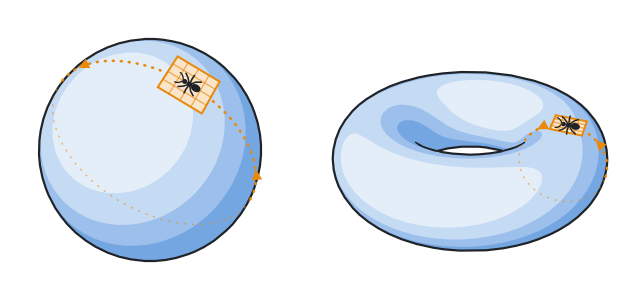
The Earth also looks flat under our feet, and its shape was only tested the ant’s way in 1522. That year an expedition led by Ferdinand Magellan (who did not live to see the return himself) came back to Spain: if you keep sailing west, you arrive back from the east.
If the ant keeps going straight on and comes back, it at least knows that its world is not an infinite plane. But it can do that on a sphere just as well as on a torus, so only the string can settle it. The ant walks a loop with the string and pulls it in towards itself, always along the surface. If it comes across a loop that cannot be shrunk, it knows it is not on a sphere.
For surfaces, mathematicians can settle this question completely, provided they are closed, that is, finite and without an edge. The sphere and the torus are closed: the ant can crawl over them for ever and never fall off anywhere. The plane is infinite. A disc and a cylinder without lids are finite, but they have an edge the ant could fall off.
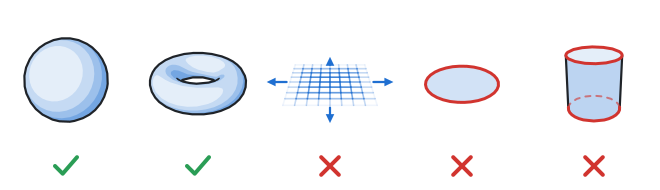
Mathematicians had already drawn up a complete list of closed surfaces in the 19th century: the sphere, the torus, the double doughnut, the triple doughnut and so on, plus a number of stranger surfaces that cannot be built in our space without intersecting themselves. On all of them except the sphere, some rubber band gets stuck. So the result is: a closed surface on which every loop can be shrunk is a sphere. A piece of string is all the ant needs.
One dimension up
But we are not ants, we live in three-dimensional space. What if space as a whole were also closed, finite and without an edge, just one dimension up? What would that look like?
The series of spheres S1, S2, S3 helps here, where the number gives the dimension, that is, how many numbers a creature living there needs to say where it is.
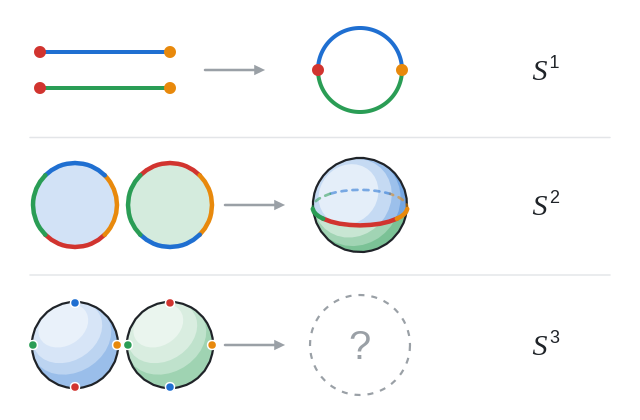
The circle S1 is one-dimensional, a creature on it can only walk back and forth. We get it from two line segments glued at their ends.
The sphere S2 is our ant’s world. We get it from two discs that we glue together along their whole edge, each point of the edge of one disc to the matching point of the other (glued points have the same colour). When it is inflated, one disc is the upper half, the other the lower half and the glued edge is the equator.
The ant knows nothing about any gluing. When it crosses the red edge of the first disc, it is on the red edge of the second and carries on crawling. On the sphere it would simply cross the equator. We only draw the discs side by side because we have no choice, otherwise it couldn’t be drawn. In reality there is no gap between them.
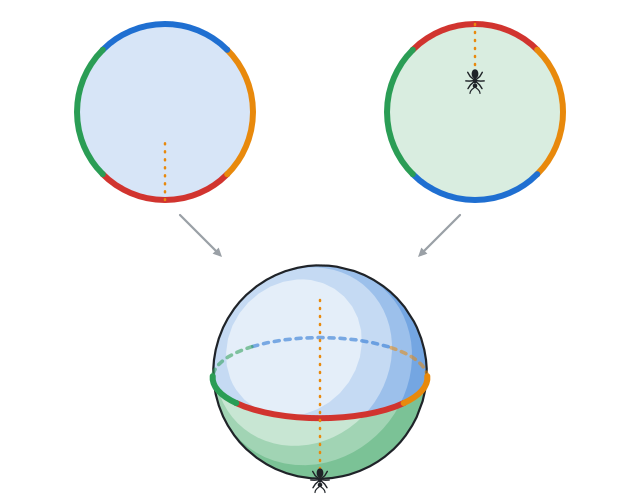
The second disc is drawn upside down. With rubber that doesn’t matter, all that matters is which points are glued together. It is flipped for the ant’s sake: it leaves through the bottom edge of the first disc, arrives through the top edge of the second and keeps crawling in the same direction. A bit like a character in an old computer game: it disappears off the bottom of the screen and pops up at the top.
An ant from the plane could not glue a sphere together from the discs, it would have to bend them into the third dimension. But it can live on it, as long as it knows which points are glued together.
Now we add another dimension. The boundary of a solid ball is a sphere. We take two solid balls and glue them together along their whole boundary, each point on the surface of the first ball to the matching point on the surface of the second. The result is called the three-dimensional sphere S3, or the three-sphere.
It cannot be built in our space, for the same reason that an ant in the plane cannot put together a sphere. But you can live in it. You are sitting in a rocket in the centre of the first ball and flying straight on. At the surface, say at the red point, you are suddenly at the red point on the surface of the second ball and you fly on, into it. No wall, no seam. And the second ball is not “somewhere else”, it is only next to the first because otherwise it couldn’t be drawn, and it is flipped for the same reason as the second disc. If you kept flying, you would come out through the blue point back into the first ball and in the end return to where you set off from.
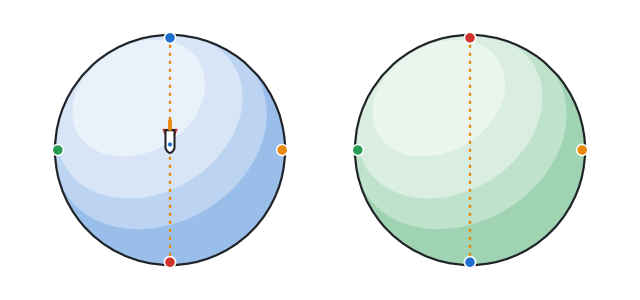
You may have come across the claim that the three-sphere is the surface of a four-dimensional ball. There is no contradiction in that: the surface of a ball is two hemispheres, each of which can be squashed flat into a disc, and the surface of a four-dimensional ball is made up in the same way of two solid three-dimensional balls. The fourth dimension is only an aid for drawing the three-sphere from the outside. Anyone living in it doesn’t need a fourth dimension, just as the ant doesn’t need “up”.
A doughnut one dimension up
In the three-sphere, a rubber band floating in space can always be shrunk to a point. But there are other closed three-dimensional spaces too, “doughnuts one dimension up”, as it were. Once again we build the simplest of them by gluing.
We start with the ant. We glue together the left and right sides of a rubber square (green) and we get a tube. We glue the two ends of the tube together too (blue circles), and we have a doughnut. An ant that crawls out through the right side of the square appears on the left. On the torus it has simply gone round the tube.
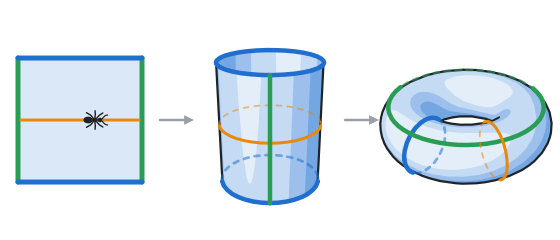
One dimension up, we take a cube and glue together each pair of opposite faces: left with right, front with back and top with bottom. Anyone who flies out through the right face of such a space comes back through the left one and never meets a wall. Mathematicians call it the three-dimensional torus, or the 3-torus.
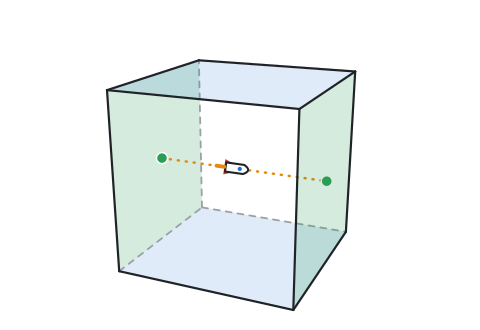
The rocket’s path from the centre through the right face and back through the left face to the centre is a closed loop that cannot be shrunk. However we slide and bend it, it will always pass through the green face. It is the same as the rubber band around the tube of a torus: you can slide it, but you can’t take it off.
What shape is the universe?
Could our universe be like this? The three-sphere, the 3-torus and a number of other spaces are all candidates.
Don’t mix these up: curvature and the shape of the whole are two different things. Curvature can be detected from the inside. On a sphere, the angles of a triangle add up to more than 180°. Join the North Pole and two points on the equator a quarter of the circumference apart with two meridians and a piece of the equator. All three angles are right angles, and they add up to 270°.
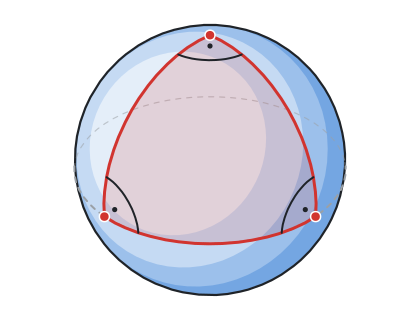
Where the sum is exactly 180°, as in school geometry, space is flat, that is, not bent. Cosmologists measure this on a grand scale, from the spots in the microwave radiation left over from shortly after the Big Bang. According to the Planck satellite, the universe is flat to within the precision of the measurements.
But flat does not yet mean infinite. A cube with glued faces is flat too, a triangle in it has 180°, and yet it is closed. If the universe were a torus like this and not too large, we would see some parts of it more than once, from different sides. Astronomers have searched for such repeated images in the microwave radiation, but have not found them. So if the universe is closed, it is most likely larger than the part we can see, and what shape it has as a whole we don’t yet know.
What the conjecture is about
In 1904 the French mathematician Henri Poincaré asked a question: does the same hold for three-dimensional spaces as for surfaces? The three-sphere and the 3-torus are easy to tell apart with a rubber band. But there are infinitely many closed three-dimensional spaces, and at the time nobody knew how to list them. Is every closed three-dimensional space in which every loop can be shrunk a three-sphere? Is a piece of string enough for an ant one dimension up?
In technical terms the conjecture reads like this (feel free to skip this paragraph): every closed simply connected three-dimensional manifold is homeomorphic to the three-sphere. A manifold is a space that looks like ordinary space near each of its points, and homeomorphic means “the same to a topologist”, that is, convertible by squashing without tearing or gluing.
It is hard because we cannot look at three-dimensional space from the outside. We are inside it like the ant on its surface, and we have to make do with what we can find out from within.
A hundred years of failed attempts
Mathematicians extended the conjecture to higher dimensions too, but there the condition has to be strengthened. Not only every rubber band must be shrinkable to a point, but also every inflated balloon, that is, every skin we place in the space (and in higher dimensions their higher-dimensional relatives as well). Rubber bands alone would not be enough: in four or more dimensions there are shapes on which every rubber band can be shrunk, and yet they are not spheres. With the stronger condition, the conjecture does hold.
The first surprise came straight away: in higher dimensions it was easier. More dimensions mean more room, and things have space to get out of each other’s way.
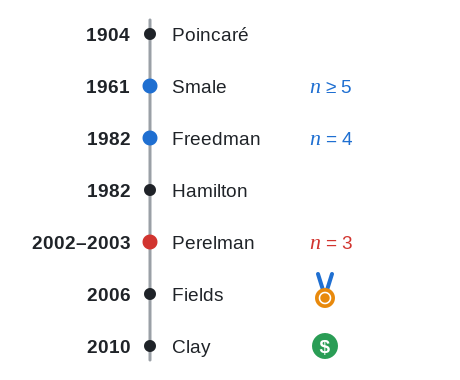
In 1961 the American Stephen Smale proved the conjecture for all dimensions from five upwards. In 1982 Michael Freedman proved it for dimension four. Both received the Fields Medal for it. Poincaré’s original dimension three still remained. A number of mathematicians, including very highly respected ones, announced proofs in which a mistake was later found. But in that same year, 1982, Richard Hamilton came up with the idea that finally cracked the conjecture, it just took another twenty years.
How Perelman proved it: Ricci flow
Hamilton didn’t say “let’s examine the shape”, but “let’s let the shape smooth itself out”. He worked out how to make a space flow smoothly so that its curvature evens out, like the temperature in a metal rod, and a bumpy shape turns into a round sphere.
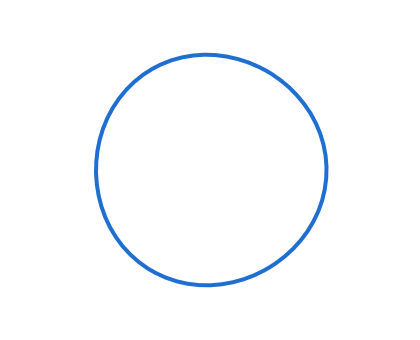
It is easiest to see with a curve. Where it is sharply bent, the curvature is large, and where it is almost straight, it is small. And the rule of the flow is: where the curve is bent more, it straightens out faster. Bulges are pulled in and hollows filled out, until the curve becomes a circle. The real flow would also shrink the curve at the same time, until it shrivelled to a point. In the animation we therefore keep inflating it so that the area inside stays the same and you can clearly see how the shape changes.
Hamilton’s Ricci flow does the same thing with a whole three-dimensional space. The curvature of space can be detected from the inside, as with the ant, by triangles with more than 180°. So Ricci flow doesn’t move anything anywhere. It changes the measurement, that is, how far apart points are and what angles the paths between them make. It is like a rubber balloon that shrinks fastest where it is most curved, so it gets closer and closer to a round sphere. For anyone who wants to see the equation, here it is:
On the left is how the measurement of distances in space (g) changes over time, on the right is its curvature (Ric, after the Italian mathematician Gregorio Ricci-Curbastro). The minus sign means that where space is curved like a sphere, distances get shorter, and the greater the curvature, the faster they do so.
Hamilton’s plan: take any closed space in which every loop can be shrunk and let it flow. If a round sphere comes out of it, it was a sphere at the start too, because the flow only squashes smoothly and never tears anything.
But the flow can get stuck. Take a dumbbell: two bulbs joined by a thin neck. The neck is strongly curved, it is wrapped by a small circle, bent much more sharply than the large bulbs. And a more curved place shrinks faster. So the neck narrows faster than the bulbs have time to round off.
In the end the neck pinches down to a point and the curvature there grows without limit. But the rule of the flow needs to know the curvature at every point, and where the curvature is “infinite”, it stops making sense, rather like how you can’t divide by zero. Mathematicians call such a place a singularity.
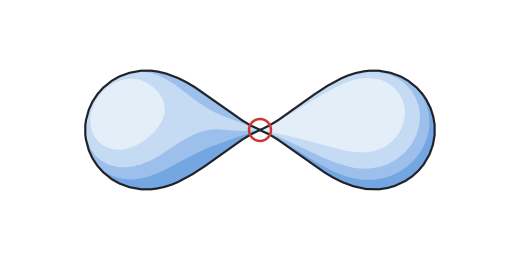
This is where Hamilton’s programme got stuck for almost twenty years. The neck of a dumbbell is the simplest case. What if something far wilder can pinch off in a three-dimensional space?
Perelman’s breakthrough
In November 2002 Grigori Perelman posted the first of three papers on the internet archive arXiv, and the other two followed in 2003. He didn’t send them to any journal. In them he showed exactly what was missing.
First: Perelman learnt to look at the places where curvature grows without limit through a magnifying glass. He zooms in on them so that the curvature looks ordinary again, and he proved that under the magnifying glass they always look like one of a few known shapes: a long thin neck that looks like a cylinder close up, such a neck ending in a cap, or a whole small piece that is shrivelling up and meanwhile looks almost like a sphere. Nothing wilder can happen, and that is exactly where the breakthrough lies.
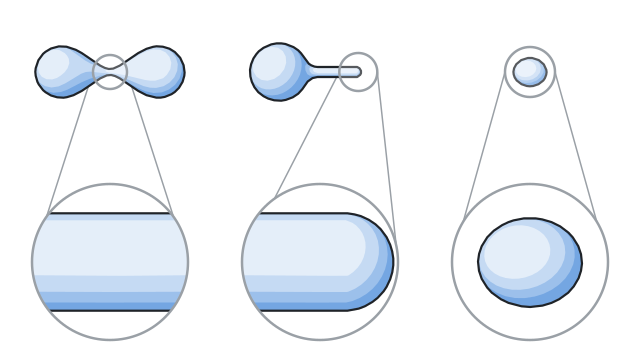
In three-dimensional space the “cylinder” from the picture is one dimension higher, its cross-section is not a circle but a sphere.
Second: we can deal with the necks. Hamilton proposed a procedure called surgery and Perelman completed it. Just before the neck pinches off, it is cut, both holes are sealed with caps and both pieces are left to flow on. For the dumbbell, which is only a surface, the cap is a piece of a sphere and the neck is pinched by mean curvature flow, whereas Ricci flow does this only in three-dimensional space. There the boundary of the hole is a sphere and the cap is a solid ball.
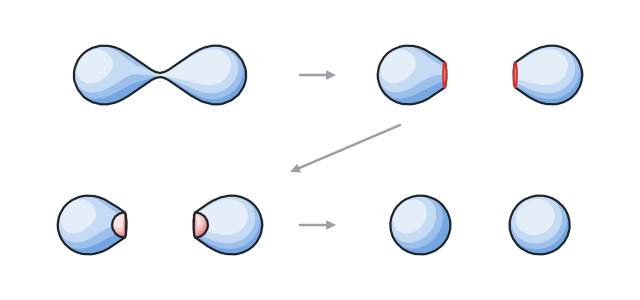
Third: there are only finitely many cuts, at least in any finite time. If we kept cutting for ever, we would never finish. Moreover, for spaces in which every loop can be shrunk, Perelman showed that after a finite time nothing is left: all the pieces shrivel up and vanish. Just before it vanished, each piece was a three-sphere, and we remember those spheres.
All that remains is to go through the whole procedure backwards. The flow itself doesn’t change the shape as far as a topologist is concerned, only the cuts did. So we glue the remembered spheres back together with necks, exactly where we cut. Two spheres joined by a neck are still one sphere, like two balloons joined by a tube.
But one thing could wreck the whole procedure. If a neck led from a sphere back into the same sphere, it would form a handle like that of a mug, and a loop that goes through the handle and comes back would not shrink. But that cannot happen in our space, because every loop in it can be shrunk. So every neck joins two different spheres, gluing always gives a sphere again, and so the original space was a sphere too.
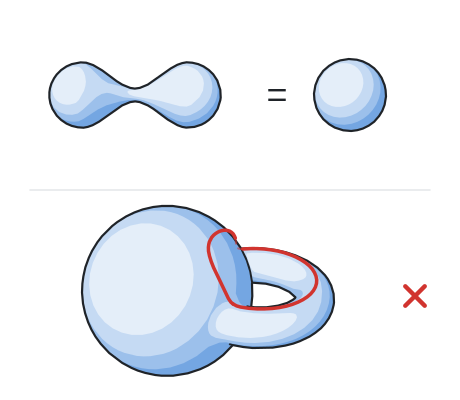
So the proof doesn’t go through infinitely many shapes one by one. It shows that this procedure works for every space that satisfies the conditions of the conjecture.
The million nobody wanted
Perelman’s papers were extremely terse. Over several years, three teams of mathematicians checked them independently and filled in the missing details (Bruce Kleiner and John Lott, John Morgan and Gang Tian, Huai-Dong Cao and Xi-Ping Zhu). They found no significant error. The journal Science named the proof the Breakthrough of the Year for 2006.
In August 2006 the International Mathematical Union awarded Perelman the Fields Medal. He was the first in history to turn it down. He did not travel to the ceremony in Madrid. At the time he told journalists from The New Yorker: “It was completely irrelevant for me. Everybody understood that if the proof is correct then no other recognition is needed.”
In March 2010 the Clay Institute awarded him the Millennium Prize for solving the problem, one million dollars. Perelman turned it down in July 2010. According to the Russian agency Interfax, he said that his contribution to the proof was no greater than that of Richard Hamilton, whose idea of Ricci flow had been its foundation. And he added: “To put it short, the main reason is my disagreement with the organised mathematical community. I don’t like their decisions, I consider them unjust.”
He had already left the Steklov Institute of Mathematics in St Petersburg in December 2005 and has published nothing since. He lives in seclusion and does not talk to journalists.
Why it matters
The Poincaré conjecture is the first step towards listing all the possible shapes of the space we could live in, just as such a list has been complete for surfaces since the 19th century. And Perelman proved even more. He confirmed William Thurston’s whole geometrisation conjecture, a map of all closed three-dimensional spaces in which the Poincaré conjecture is just one square.
The shape of the universe will be decided by measurements, not by mathematics. But we do know this much for certain: if the universe were closed and every loop in it could be shrunk, it would be a three-sphere.
What is more, Ricci flow has found uses outside mathematics too. Its version for surfaces, computed on a computer, helps for example in studying the brain. The surface of the brain is wrinkled and different in every person. After it has been cut along a few prominent grooves, Ricci flow can spread it out flat without changing the angles, and such “brain maps” can then be compared with each other. This method was described in 2012 by researchers in a scientific journal on medical imaging.
The Poincaré conjecture is so far the only one of the seven Millennium Prize Problems to have fallen. The remaining six are still waiting, among them the P versus NP problem from computer science and the Riemann hypothesis about prime numbers. Something new is happening with the latter right now: on 20 November 2026 a proof of it was announced, which nobody has yet independently verified. You can find the details in the article on the Riemann hypothesis. You will find more articles in the category Famous problems.