
Yang–Mills theory and the mass gap
Every proton in your body is made of three smaller particles, quarks. But nobody has ever seen a quark on its own. If you try to pull one out of a proton, you don’t get a quark, you get a new pair of particles. It is like a magnet: break it in half and you have two smaller magnets, each with a north and a south pole. You will never get a north pole on its own.
Physicists understand this. They have a theory that describes it, they run calculations with it on supercomputers, and the results agree with experiments. But mathematicians have not managed to prove that the theory even exists as a precise mathematical object. Nor have they managed to prove the most important conclusion physicists draw from it: that it has a mass gap. That is why in 2000 the Clay Mathematics Institute included Yang–Mills theory and the mass gap among the seven Millennium Prize Problems and offered a million dollars for a solution.
Has it been solved? Perhaps half of it. In October 2026 the company OpenAI announced a computer-checked proof that the theory exists. The gap, the harder half, is still open. You will find the details at the end of the article. But first we need to explain what this is actually about.
Four forces
Everything that happens in the universe is governed by four fundamental forces. Gravity keeps the Moon in its orbit and us on the ground. The electromagnetic force is behind electricity, magnets, light and, in fact, everything you feel with your hand when you touch something. The weak force causes some kinds of radioactivity. And the strong force holds quarks together in protons, and protons together in atomic nuclei.
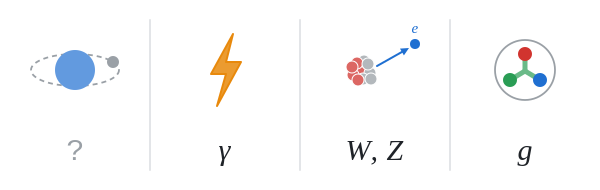
According to particle physics, forces are carried by particles that we will call messengers. Two charges act on each other by exchanging messengers. The messenger of the electromagnetic force is the photon, the particle of light, written γ. The messenger of the strong force is called the gluon, from the word glue. It is written g and it is the main character of this article.
A force that gets weaker
Two electric charges act on each other with a force that quickly gets weaker as the distance grows. At twice the distance it is four times weaker, at three times the distance nine times weaker. Physicists write this by saying that the force is proportional to
Field lines show why this is so. They are lines that start at a positive charge and end at a negative one. Where they are dense, the field is strong. When we move the charges apart, the field lines spread out into the whole of space and few of them are left between the charges. You will see this in the top half of the animation a little further on. We calculated the field lines in it exactly according to the laws of electricity.
The photon itself has no electric charge. So photons hardly affect each other at all. Two beams from torches can cross and pass through each other as if the other one weren’t there. With gluons it will be exactly the other way round.
Three colours
Electric charge comes in two kinds, positive and negative. The strong force has three kinds of charge instead. Physicists call them colours: red, green and blue. They have nothing to do with real colours, it is just a handy name. Every quark carries one of the three colours.
Why colours, of all things? On a screen, red, green and blue together make white. It is similar with quarks: a proton is made of three quarks of three different colours, so from the outside it is “white”, that is, without any colour charge. Besides quarks there are also antiquarks, which carry an “anticolour”. A quark and an antiquark of the same colour also combine to make white. Such a pair is called a meson. The rule “three colours make white” is figurative, but it captures exactly how colour charges combine: they cancel each other out, much like positive and negative electric charge.
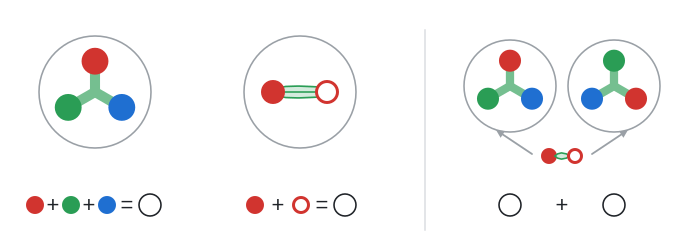
Now comes the crucial part: gluons themselves carry colour. The photon has no electric charge, but the gluon does have a colour charge. That is why gluons are attracted not only to quarks but also to each other.
A rubber band that never lets go
How does this show up in the field lines? Between two quarks the field lines don’t spread out into space, because the gluons attract each other. They are pulled together into a thin tube, much as strands of hair are gathered into a plait. Physicists call it a string or a flux tube.
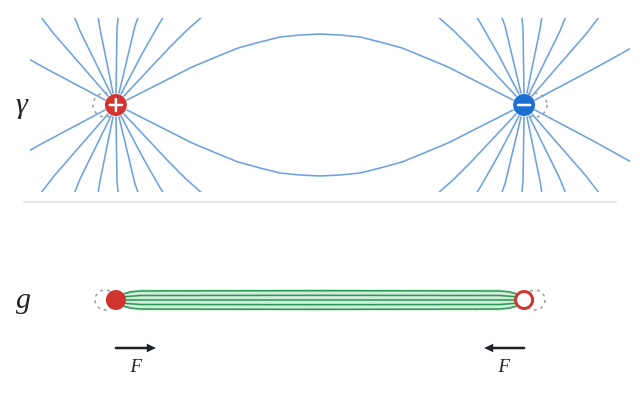
The tube keeps the same width whether it is long or short. And because every bit of it is the same, it pulls just as hard whether it is twice or ten times as long. The force between quarks does not get weaker. It behaves like a rubber band, with one difference: a rubber band pulls harder the more you stretch it, while the tube always pulls the same.
And it pulls really hard. Experiments and calculations give a force of around 160,000 newtons. That is roughly the weight of sixteen tonnes, acting between two particles that would fit inside a proton.
The longer the tube, the more energy it contains, because every bit of it carries the same amount. If you wanted to pull quarks a metre apart, you would need an enormous amount of energy. But the tube snaps much sooner, at about the length of a proton’s diameter. That happens as soon as more energy is stored in it than it costs to make two new particles, a quark and an antiquark. The energy of the tube turns into their mass according to Einstein’s famous equation
It says that energy E and mass m are two forms of the same thing, and c is the speed of light. The new quark and antiquark become the new ends of the two pieces of the tube. Instead of one free quark you have two mesons, just like with the broken magnet. That is why nobody has ever seen a quark on its own. Physicists call this quark confinement. You can’t free a quark by pulling harder either. More energy put in just means more new pairs, and so more mesons, never a free quark.
Why the strong force doesn’t reach far
But something doesn’t add up here. At school you learn that the strong force has a very short range and doesn’t act at all beyond the edge of an atomic nucleus. How does that fit with a rubber band that pulls equally hard at any distance?
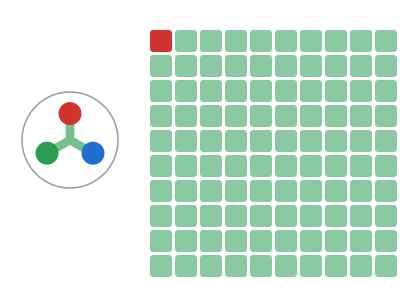
The rubber band holds the quarks inside a proton. But from the outside a proton is white, so another proton doesn’t feel its colour charge. In the same way an atom is electrically neutral from the outside, which is why two atoms stick to each other only weakly, even though they are full of charges inside. Between the protons in a nucleus only what is left over of the strong force acts, and it is much weaker than the force between quarks. It is carried by mesons that hop from one proton to the other, as on the right of the picture with the colours.
But mesons are not massless like the photon, they have mass. And a messenger with mass doesn’t get far. The lightest mesons, pions, weigh about a seventh of a proton, and what is left of the strong force reaches only about one or two proton diameters. Beyond that it almost vanishes. So the short range of the nuclear force is set by pions.
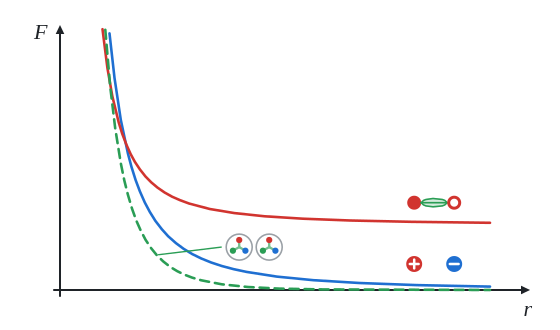
So the rubber band inside and the short range outside don’t contradict each other. They describe two different things: the force between coloured quarks and the force between white protons.
What Yang–Mills theory is
In 1954 the physicists Chen Ning Yang and Robert Mills wrote down the equations of a new kind of theory. It is built in the same way as the theory of electromagnetism, with one crucial difference: the messengers themselves carry charge. Twenty years later it turned out that this is exactly how the strong force works. The theory of the strong force is called quantum chromodynamics (from the Greek chróma, colour), and it is Yang–Mills theory with gluons, to which quarks are added.
The Clay problem asks about pure Yang–Mills theory, that is, about a world containing only gluons and no quarks. Why does it make sense to ask about such a world? It is the simplest version in which the essential point can be seen: something with mass arises out of massless gluons. With quarks the problem is even harder. Mathematicians start with the simpler one, much as we started with a circle for the Birch and Swinnerton-Dyer conjecture.
But even a world of gluons alone is surprisingly complicated. Gluons attract each other, so they affect themselves. Mathematicians call such equations non-linear. It is the same difficulty as with the Navier–Stokes equations: there water carries itself along, here gluons attract themselves. So the problem can’t be split into simple pieces, each calculated separately and the results added up.
The mass gap
Yang–Mills theory is a quantum theory, and in the quantum world energy is added in packets. Each packet is some particle that the theory can produce. How small the smallest packet can be depends on the theory.
The lowest possible energy belongs to the vacuum, that is, empty space without a single particle. We count its energy as zero. The mass gap is the smallest packet by which empty space can be “enriched”. By the equation E = m · c2 the smallest packet of energy corresponds to the lightest particle, which is why the gap is called a mass gap: it is the mass of the lightest particle the theory can produce, multiplied by c2. It is written with the Greek letter Δ (delta).
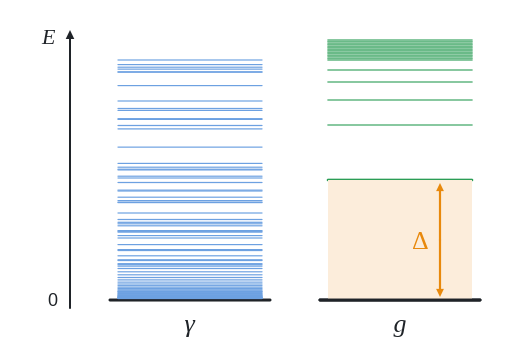
Electromagnetism has no gap. A photon with a long wavelength carries very little energy, and the longer the wavelength, the less. So the energies above the vacuum start straight above zero, with no gap.
In a world of gluons alone it could look the same according to the equations, because gluons have no mass in the equations, just like the photon. But physicists are convinced that this is not the case. Gluons stick together and form glueballs. A gluon on its own, like a quark, never gets free, so the lightest thing a world of gluons can produce is a glueball. And that does have mass. Calculations predict it would weigh almost twice as much as a proton.
That would also explain why no long-range force, like the one you know from electric charges, acts between white glueballs. If the world of gluons could produce a massless particle that gets free, the force between white objects would reach far. The gap says that no such particle exists. In the real world with quarks, though, the range of the nuclear force is set by pions, not by the gap of the pure world of gluons.
The Clay problem asks for a proof that Δ is a positive number, that is, that the gap really exists. It doesn’t need to know how big it is.
Has anyone observed glueballs yet? Not unambiguously so far. In the real world there are quarks too, and in experiments glueballs mix with mesons, so they are hard to tell apart. In 2024 the BESIII experiment in China measured the properties of a particle that match the prediction for one of the heavier glueballs. But that is not certain.
How massless gluons give rise to mass
This is where the story gets strangest. How can something with mass arise out of particles without mass?
The answer is once again E = m · c2. Mass and energy are the same thing, and energy confined to a small space behaves like mass from the outside. Imagine a box with perfect mirrors on the inside, and inside it trapped light that bounces back and forth. Photons themselves have no mass, and yet a box with light in it is heavier than an empty one. By exactly the energy of the light divided by c2.
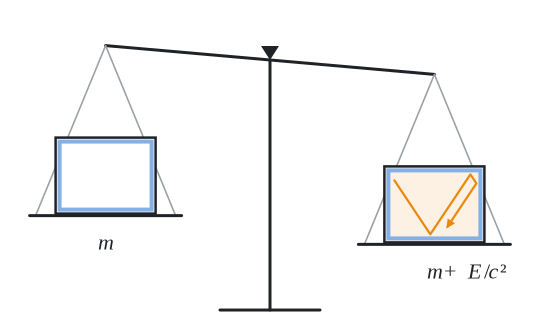
A glueball is a box like this, only without walls. It doesn’t need walls, because the gluons attract each other themselves: a glueball is like a rubber band curled up into a ring. The energy of the gluons shows up from the outside as mass.
It is similar with the proton. The three quarks it is made of do have their own mass, but together only about one per cent of the proton’s mass. The rest is the energy of the gluon field and of the motion of the quarks trapped inside the proton. Nobody supplies this energy, the proton has carried it inside itself since it came into being, just as the box carries its light. Because your body is made mainly of protons and neutrons (and it is the same with neutrons), this applies to you too. Most of what your scales show is the energy of the strong force.
It works, and yet it doesn’t exist?
Now to the heart of the matter. How can a theory give numbers that agree with experiments while mathematicians don’t know whether it even exists?
Physicists have two main recipes for getting numbers out of the theory. The first works only for collisions at enormous energies, when the quarks are very close together. There the rubber band hardly pulls at all and the quarks behave almost like free particles. This is called asymptotic freedom. The calculations can then be done approximately, step by step. The effect was discovered in 1973 by three physicists, who received the 2004 Nobel Prize for it. One of them was David Gross, whom we will meet again. But this recipe can’t calculate the rubber band or the gap, because they concern large distances.
The second recipe chops space and time up into tiny cubes, like a grid on squared paper, only in four dimensions. On the grid you can calculate on a supercomputer. Then the grid is made finer and finer and you watch how the result changes. That is how physicists calculated the mass of the proton and of glueballs.
The catch lies in what happens as the grid is refined. It is not enough just to make the grid finer. With each refinement you also have to adjust the strength with which the gluons act, exactly so that the results stay the same. In practice this works superbly. But until this year nobody had proved mathematically that such a procedure leads anywhere.
An illustrative example helps. Let’s try to build a circle out of the squares of a grid. We count the squares whose centre lies inside the circle and add up their areas. The smaller the squares, the closer the sum gets to the true area of the circle.
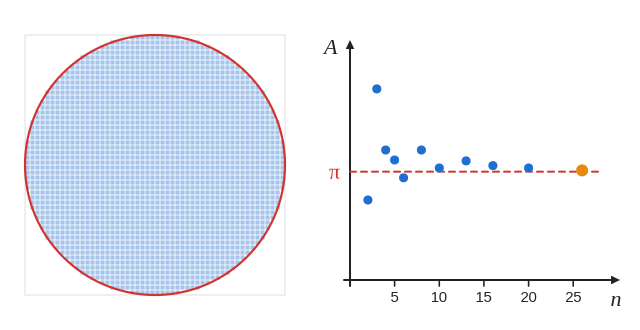
With a circle we know in advance that there is a perfect shape the squares are approaching. It is the circle. You can also compare it to a photograph: the more pixels, the sharper the picture. But a thousand photos at ever finer resolution still don’t prove that a perfect picture without pixels exists. It could happen that the picture blurs as it is refined, or that in the end something boring comes out of it, say an empty world in which nothing happens.
For Yang–Mills theory, physicists long had only the photos. A mathematician wants to prove that there is a real picture behind them, that is, a theory on continuous space and time without a grid, which obeys the precise rules a quantum theory is supposed to follow. And they want to prove that the picture has a gap. Until this is proved, we can’t be sure that what physicists calculate are properties of a real theory and not just properties of their method.
The official problem statement of the Clay Institute was written by the physicist Edward Witten and the mathematician Arthur Jaffe. In plain terms it asks for two things. First, a proof that the picture exists: a pure quantum Yang–Mills theory in four-dimensional spacetime (three dimensions of space plus time) that obeys strict rules. And second, that it has a mass gap. Moreover, both not just for three colours but for a whole family of similar theories. In simpler worlds with two or three dimensions, mathematicians have been able to construct similar theories since the 1970s, but our world has four dimensions.
What happened in 2026
We are writing this section on 23 November 2026.
On 26 October 2026 the company OpenAI announced that its artificial intelligence model had proved the existence of pure quantum Yang–Mills theory. The proof is written in the Lean language, in which a computer can check every step (there is more about Lean in the article on the Riemann hypothesis). OpenAI does not claim to have proved the mass gap.
Why not? The gap is a different kind of statement. Existence says “only” that the photos come together into a picture. The gap says what the picture looks like at large distances, which is exactly where the theory is at its wildest and where the physicists’ first recipe doesn’t work.
The proof is being assessed by a panel of five physicists and mathematicians, chaired by David Gross, with Arthur Jaffe, co-author of the problem statement, among its members. Gross was chosen as chair by OpenAI itself. On 9 November the panel announced that, in its assessment, the code proves the existence of pure Yang–Mills theory according to the problem statement, which is standard in both physics and mathematics. The next day it published the full code and its assessment, in which it admits that it does not claim to fully understand the proof yet.
How can the panel trust a proof it doesn’t understand? The computer went through every step and found no error. So people don’t need to check whether the proof is correct. But they do need to check whether the computer really proved what the problem statement asks for, and not some similar-looking statement. That is exactly what the panel checked: that the rules the theory must obey according to the problem statement are written correctly in Lean.
The way the proof proceeds is interesting. It builds the theory exactly as physicists do on supercomputers: from a four-dimensional grid that is made finer and finer. It proves that the photos really do come together into a picture, and for the whole family of theories in the problem statement. But it leaves two things open: it does not establish whether the same theory always comes out as space is enlarged to infinity, nor whether the theory has a single vacuum. According to the problem statement, such a result would not be enough on its own. But the panel takes the view that the proof established enough other properties of the theory to make up for this, and that this is enough for existence by the standard the panel chose.
Some mathematicians criticise the fact that the proof was assessed behind closed doors and that for almost two weeks only the panel had access to the code. Independent verification by people who would understand and explain the proof is still missing.
So who is right? For the existence of the theory there is strong evidence: the computer went through every step and respected experts confirmed that the statement matches the problem statement. But human understanding is still missing. Nothing has happened with the mass gap, it is as open as it was before. And because the Clay Institute awards the million for the whole problem, and in any case no earlier than two years after publication, nobody has won anything yet.
Why it matters
No direct technological application is expected from a solution. It is about understanding. A proof of the gap would confirm mathematically that mass can arise from massless gluons, the very same phenomenon to which most of the mass of the matter around us owes its existence. And the theory on which particle physics rests would for the first time stand on a firm mathematical foundation as a whole, gap included. If OpenAI’s proof holds up, the first half is done.
Quarks, gluons and the mass gap are not the only Millennium Prize Problem on which something is moving this year. You will find the others in the category Famous problems.