
Integers
Integers are numbers with no fractional part. They contain the positive integers, their additive inverses (the negative numbers) and zero.
Properties
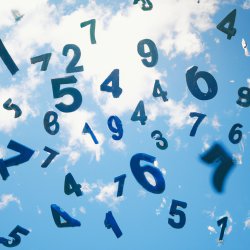
The integers form a set containing the numbers …, -3, -2, -1, 0, 1, 2, 3, … We usually write this set with the letter Z with a double diagonal stroke: ℤ, from the German “Zahlen” (numbers). The integers form an infinite and countable set.
Integers have, for example, these properties:
- They are closed under addition and multiplication, just like the positive integers. This means that if we add two integers, we get an integer again.
- Unlike the positive integers, the integers are also closed under subtraction. The positive integers were not, because the difference of two of them could be negative. That does not bother us for the integers, because they include the negative numbers.
- Like the positive integers, they are not closed under division. We can still get a non-integer after dividing.
- For every integer c there is an additive inverse −c. If we have the number 10, its additive inverse is −10. For 55 it is −55. The same holds for negative numbers: for −13 the inverse is 13. If we have an integer c and its additive inverse −c, their sum is zero: c + (−c) = 0. So the additive inverse of zero is zero again.
Even and odd numbers
Integers can be split into even and odd numbers. Even numbers are those divisible by 2, for example 2, −4, −8, 40, 124 and so on. Odd numbers leave a remainder of 1 when divided by 2, so they are the numbers −1, 1, 5, 19, −41 and so on. Notice that we really do distinguish even and odd numbers among the negative numbers too (so −5 is odd), and that zero is an even number.
Properties with respect to addition: if you add two even numbers, you get an even number again. The following table shows the other cases:
A similar table for multiplication:
Division with remainders
On the set of integers we can define division with remainders in much the same way as for the positive integers, but we have to deal with negative numbers. So this time the basic definition looks like this:
In this expression we divide
What would such a division look like? Let’s try
The quotient is −6 and the remainder is 3. It may surprise you that the quotient differs from the one we get when all the numbers are positive:
Here the quotient would be 5 and the remainder 1. The difference comes from the negative numbers. With positive numbers, in the first step we look for the largest integer that is not greater than 21 and is exactly divisible by 4. That is 20. So we work out
With negative numbers we proceed in the same way. We look for the largest number that is not greater than −21 and is exactly divisible by 4. But −20 is greater than −21. So the largest number that is not greater than −21 and is exactly divisible by 4 is −24. Again we get the remainder as the difference −21 − (−24) = −21 + 24 = 3.
Related articles
- Divisibility by 2
- Divisibility by 3
- Divisibility by 4
- Divisibility by 5
- Divisibility by 6
- Divisibility by 7
- Divisibility by 8
- Divisibility by 9
- Divisibility by 10
- Divisibility by 11
