
Exponential growth
An old legend tells of the inventor of chess, who asked the king for a modest reward: one grain of rice on the first square of the chessboard, two on the second, four on the third and on every following square twice as many as on the one before. The king is said to have laughed at how little the wise man wanted, and ordered a sack of rice to be brought. But he laughed too soon.
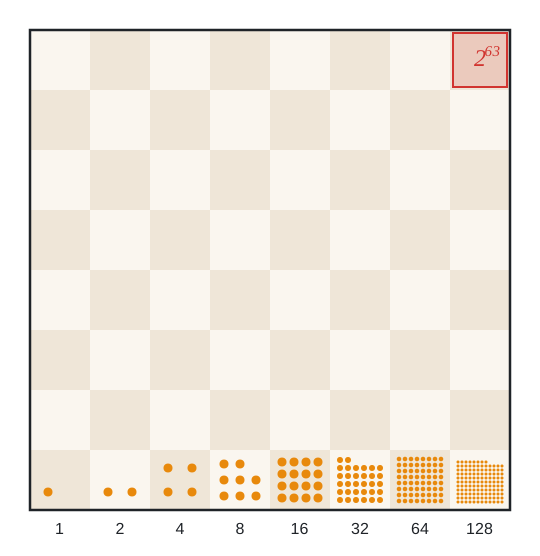
On the first square there is 1 grain, that is 20. On the second there are 21 = 2, on the third 22 = 4, on the fourth 23 = 8. The exponent is one less than the number of the square, so on the last square, the 64th, there lie
grains. That is more than nine quintillion. But that is only the last square, and we are interested in the whole chessboard. If we add up all the squares, we get
which is exactly 18,446,744,073,709,551,615 grains.
Why exactly 264 − 1? Check it on the first few squares: 1 + 2 = 3, 1 + 2 + 4 = 7, 1 + 2 + 4 + 8 = 15. Each time the sum is one less than the number of grains on the next square.
A single grain of milled rice weighs roughly 20 milligrams, so a thousand grains weigh about 20 grams. Let’s work out how much the whole chessboard would weigh:
The whole chessboard would weigh about 369 billion tonnes of rice. The whole world, on the other hand, grows roughly 540 million tonnes of milled rice a year. How many years of the world’s harvest would that last? The quotient of the two numbers:
The king would have had to hand over all the rice that humanity harvests in more than six hundred years. The most striking thing is how long it all looks innocent: the whole first half of the chessboard, 32 squares, adds up to 232 − 1, which is about 4.3 billion grains. That is around 86 tonnes, a few lorries’ worth. The rest is only poured on to the second half of the board.
Adding versus multiplying
If something grows in such a way that the same number is added to it at every step, we speak of linear growth. If, on the other hand, it is multiplied by the same number at every step, it is exponential growth. On the chessboard it was multiplication by two.
Oliver’s parents offer him two ways of increasing his pocket money. He now gets £300 a month, and they will either raise it by £100 every month or by 10%. A hundred pounds, or just ten per cent of three hundred, which is thirty? The choice seems clear.
In the first month that really is right. With addition Oliver gets 300 + 100 = 400 pounds, with multiplication 300 · 1.1 = 330 pounds. After half a year addition gives £900 and multiplication roughly £531. But ten per cent is worked out from an ever larger amount, so the increases keep growing, while a hundred stays a hundred. In the 23rd month multiplication overtakes addition, and from then on it only pulls further away: after three years Oliver would get £3,900 with addition and over £9,200 with multiplication. And after four years £5,100 against roughly £29,100 a month.
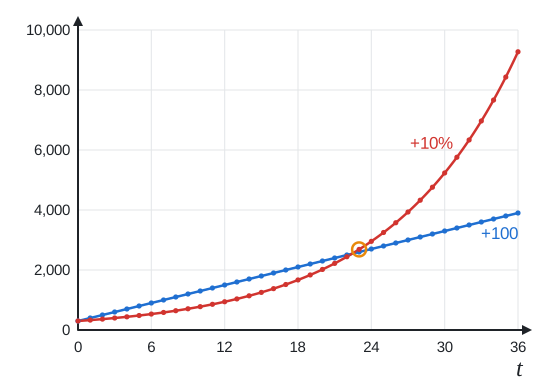
The blue line leads for a while, but the red curve climbs ever more steeply. This is true in general: exponential growth sooner or later overtakes any linear growth, and the only question is when.
Exponential growth fits into a single formula
where N0 is the starting value, q is the number by which we multiply in one period, and t is the number of periods that have passed. For Oliver, N0 = 300 and q = 1.1, because adding 10% means multiplying by 1.1. After 36 months we get
On the chessboard, N0 = 1 and q = 2. The variable t is in the exponent, so this is an exponential function. You will also find bacteria splitting in two there.
How long does it take to double?
With exponential growth it is handy to ask how long it takes for the value to double. This doubling time does not change, whenever we start. If something doubles in ten years, it doubles again in the next ten years, and after twenty years it is four times as much.
A simple rule of thumb helps with an estimate, the rule of 70: if something grows by p per cent per period, it doubles in approximately
periods. If prices in the shops rise by 7% every year, they double in roughly
Why exactly seventy? We find the exact doubling time using a logarithm. We are looking for the t that solves the exponential equation
We take logarithms of both sides, which brings the exponent down in front of the logarithm:
Now all that is left is to divide:
So prices would double in just under ten and a quarter years, and the rule of 70 hit the mark almost exactly. The 70 comes from the fact that the quotient of two logarithms is the same whichever base we take the logarithm to. With the natural logarithm ln and general growth of p per cent we get
because for small percentages
Water lilies on a pond
Before you read on, try to crack this puzzle yourself. Water lilies grow on a pond, and every day there are twice as many of them as the day before. In 30 days they cover the whole pond. On which day was half of the pond covered?
The answer that suggests itself is the fifteenth day, since fifteen is half of thirty. But the number of water lilies doubles every day, so if the whole pond is covered on day 30, then the day before it must have been half covered. Half of the pond was under water lilies on day 29.
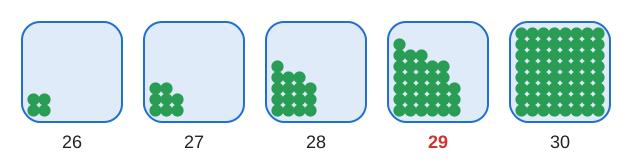
If we go still further back in time: on day 28 a quarter was covered, on day 27 an eighth, on day 26 a sixteenth and on day 25 only about 3% of the surface. Anyone who went to look at the pond on day 25 would see almost clear water and conclude that there was plenty of time. And in just five more days the pond is completely overgrown.
That is exactly what makes exponential growth treacherous. For most of the time it looks innocent, and by the time it can be seen with the naked eye, only a few doublings remain.
Epidemics
A disease can spread at the same rate. Let’s say that there are 100 infected people in a town today and the number of cases doubles every three days. In 30 days it therefore doubles ten times:
From a hundred ill people there are over a hundred thousand in a month. That is why epidemiologists push for measures when the numbers are still small and it seems to people that nothing is happening. We are on the pond on day 25.
How fast a disease spreads is described by the reproduction number R. Put simply, it is how many other people one ill person infects on average. If R = 2, everyone infects two others, those two infect four, and each “generation” of ill people is twice as large. If one generation lasts roughly three days, we are back at exactly the example above. If we manage to push R below one, for example to 0.8, the number of ill people is multiplied in each generation by a number less than one and the epidemic fades. Of 100 infected people, in the tenth generation only about
people are infected.
The difference between R = 0.8 and R = 2 seems small. But after ten generations it becomes a gulf between eleven and a hundred and two thousand ill people.
Fold a piece of paper 42 times
Take a sheet of paper about a tenth of a millimetre thick. Fold it in half and you have two layers, so two tenths of a millimetre. Fold it again and you have four layers. Each fold doubles the thickness. How thick would the paper be after 42 folds?
The Moon is on average roughly 384,000 km from the Earth. A piece of paper folded 42 times would reach it and stick out a bit further.
You don’t need to try it, because you can’t fold a sheet of paper by hand more than seven times anyway. After seven folds it has 128 layers and is just under 1.3 cm thick, and it is also getting smaller and stiffer. The record is thirteen folds, and it took a strip of toilet paper about 16 km long.
Why does this number strike us as absurd? Our intuition copes with addition. When we imagine 42 steps, we imagine 42 identical steps side by side. Here, though, each step adds as much as the whole sheet is thick so far. After ten folds the paper is about 10 cm thick, after twenty over 100 m and after thirty it already reaches 107 km high. And the last twelve folds, which take the paper to the Moon, are simply another twelve doublings.
It can’t last for ever
If the water lilies went on multiplying at the same rate, on day 31 they would cover two ponds, and on day 40 a thousand ponds. Of course it doesn’t work like that. A pond has only a limited area, bacteria have a limited amount of food, and a disease has nobody to infect once most people have already had it. In nature, exponential growth lasts only until space or resources start to run out.
Then growth slows and the value approaches a ceiling that the environment can support. The graph of such growth looks like a stretched-out letter S, which is why it is called an S-curve, or in technical terms logistic growth.
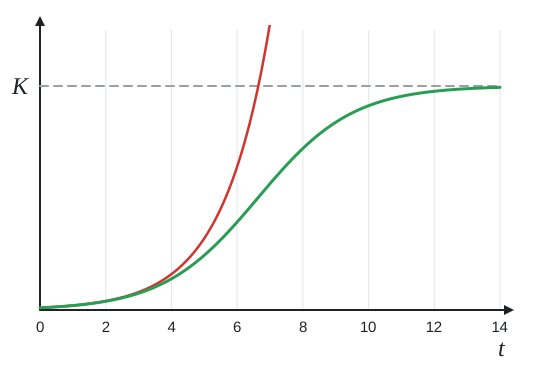
At first the two curves are hardly different. There are plenty of resources, so nothing holds growth back and the S-curve grows exponentially. Even before the halfway point it begins to bend away from the exponential, at halfway to the ceiling K it grows fastest, and then it bends over and only slowly approaches the ceiling. The trouble is that from the opening part of the graph you can’t tell whether you are looking at an exponential or an S-curve. That only becomes clear later.
By the same pattern, a value can also decrease. All it takes is for the value to be multiplied in each period by a number less than one, as with the epidemic with R = 0.8. The textbook example is radioactive decay. Instead of doubling time we speak here of the half-life, the time in which half of the substance decays. Radioactive caesium-137 has a half-life of roughly 30 years. After 30 years half of it is left, after 60 years a quarter, after 90 years an eighth. Mathematically speaking, it just keeps being halved and never falls to zero. But the substance is made of atoms, so after roughly two thousand years even the last atom from a gram of caesium will have decayed.
