
Force
You kick a ball on the grass and the ball flies off. The goalkeeper catches it and the ball stops. You squeeze a rubber ball in your palm and it gets squashed. In each of these cases something exerts a force on a body. A force is what changes the motion of a body or its shape: it sets it moving, stops it, speeds it up, slows it down, turns it in another direction, or squashes, stretches or bends it.
A force is always the action of one body on another. A foot acts on a ball, a hand on a rubber ball, and the seat on your back when a car pulls away sharply. The bodies don’t even have to touch. A magnet attracts a nail from a distance, and the Earth attracts everything around it, even a ball flying through the air. The force with which the Earth attracts bodies is called weight and is denoted W. We will look at it in more detail later; for now, let’s see how large a force actually is.
How much one newton is
A force is denoted F (for force) and its unit is the newton N, named after Isaac Newton. Written out in base units it is
You will find out why it is exactly a kilogram times a metre per second squared when we get to Newton’s laws.
How can you picture it? Put a 100 g bar of chocolate on your palm. It presses on your hand with a force of about 1 N; more precisely, the Earth attracts it with a force of 0.98 N. A litre of milk, which is a kilogram, presses on your palm with a force of roughly 10 N, a bag with five kilograms of potatoes with 50 N, and an adult with a mass of 70 kg presses on the floor with a force of around 700 N. The newton is a small unit, so the kilonewton is often used, 1 kN = 1,000 N.
The newton meter
We measure force with a newton meter. Inside is a spring ending in a hook. The harder we pull on the hook, the more the spring stretches. Twice the force stretches it twice as much, so it is enough to draw a scale in newtons next to the spring.
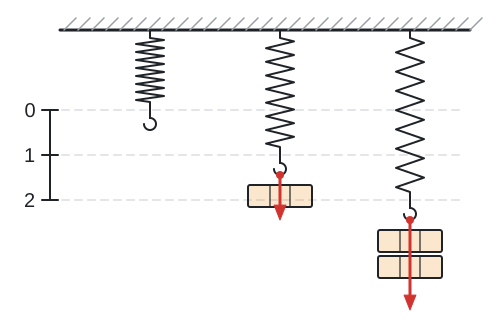
The first newton meter is empty, a bar of chocolate hangs from the second and two bars from the third. The red arrow is the force with which the chocolate pulls on the hook. Two bars pull with twice the force and the spring stretches twice as far, from zero up to two. Hanging luggage scales work on the same principle, except that their scale is marked in kilograms.
Force as a vector
Saying “I’m pushing with a force of 50 N” is not enough. It matters where, too: a trolley that you push forwards goes somewhere different from one that you pull backwards. A force is a vector, it has both magnitude and direction, and it is written with an arrow,
For a force, though, even magnitude and direction are not enough. Put a book on a table and poke it with your finger in the middle of the spine, so that the force points through the centre of the book. The book moves straight ahead. Then poke it just as hard and in the same direction, but near a corner. The book moves and also turns. It matters where the force acts on the body. We call this place the point of application. So a force has three properties:
- point of application, the point at which the force acts on the body,
- direction, where the force points,
- magnitude, how many newtons it has.
We therefore always draw the arrow of a force from its point of application. It points in the direction of the force and its length corresponds, to scale, to the magnitude.
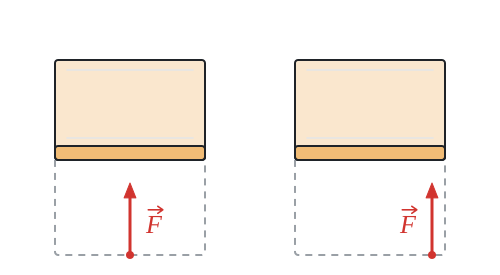
We see both books from above, with the spine at the bottom. The red arrows are equally long and point the same way; they differ only in the point of application. We draw them at the starting position of the books, shown by the grey dashed outline, because the force acts only at the moment of the poke. After that the books just slide across the table until friction stops them. The left book, where the force points through its centre, moves straight ahead; the right one moves and turns. We can slide the arrow of an ordinary vector anywhere we like on paper, but by sliding the arrow of a force we may change what the force does to the body. If, however, the body does not rotate and it is enough to treat it as a point particle, all the forces act at one point and we need not worry about the point of application. That is how we will do it in the following examples.
Adding forces
A boat is rocking lazily a little way from the jetty. Ethan pulls it towards the jetty to the north with a rope, with a force of 40 N, and George pulls with a second rope from the bank to the east, with a force of 30 N. Both ropes are tied to the bow. Where do the two of them together pull it, and how hard?
Forces that act on a body at one point can be replaced by a single force with the same effect. It is called the resultant force and it is the vector sum of all the forces:
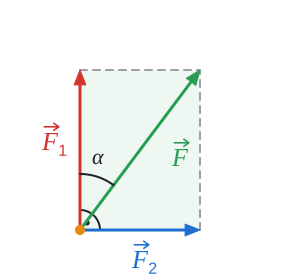
We draw the arrows from the bow and complete the parallelogram. The forces are perpendicular, so this parallelogram is a rectangle. The resultant force is its green diagonal. Together with the red arrow and the upper side of the rectangle, which is as long as the blue arrow, it forms a right-angled triangle, so we find its magnitude using Pythagoras’ theorem:
Substituting:
We square and add:
And take the square root:
Together they pull the boat with a force of 50 N, not 70 N. It would be tempting to simply add the magnitudes, but each of them pulls in a different direction. The resultant comes out longer than either of the forces on its own, but shorter than their sum.
We still have to find the direction. Let α be the angle between the resultant and Ethan’s rope. Opposite it lies the side of the rectangle as long as George’s force, so
The sin−1 button on a calculator gives α ≈ 37°. The resultant points north, turned 37° towards the east.
If Ethan and George pulled in the same direction, their magnitudes would add up to 70 N. If they pulled exactly against each other, they would subtract and the resultant of 10 N would point towards Ethan. At any other angle between the ropes the resultant lies somewhere between 10 N and 70 N, and the smaller the angle between the ropes, the larger it is.
Balanced forces
What if the resultant comes out as zero? Then the forces cancel each other out and the body behaves as if no force were acting on it. We say that the forces are balanced.
A lamp hangs from the ceiling on a cord and is at rest. The Earth pulls it down with its weight and the cord pulls it up with an equal force, so the resultant is zero. Balance does not mean that nothing acts on the lamp. Two forces act on it, only their effects cancel. How balanced forces show up in the motion of a body is described by Newton’s first law.
A lamp on a cable
A cable is stretched across a street between two houses, and a lamp hangs from the middle of it. Its weight is 50 N. The cable sags under the lamp and each half of it makes an angle α = 30° with the horizontal. How large is the force in the cable?
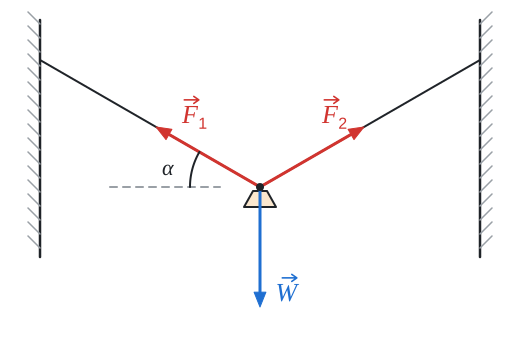
Three forces act on the lamp: the blue weight
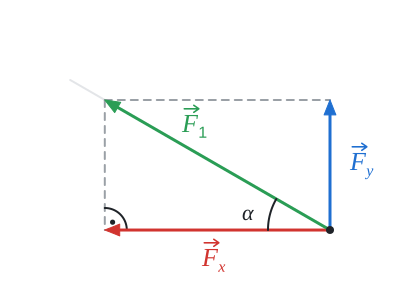
The horizontal components of the two forces are equal in magnitude and point against each other, so they cancel. The vertical components both point upwards and together they must balance the whole weight of the lamp, so each takes half. From the right-angled triangle in the picture the vertical component is Fy = F · sin α, and therefore
We divide both sides by the sine:
Substituting, sin 30° = 0.5:
Let’s check that the forces really hold the lamp in balance. The vertical component of each of them is Fy = 50 N · 0.5 = 25 N, and the two together give 50 N, exactly the weight of the lamp. The horizontal component is Fx = F · cos α ≈ 50 N · 0.866 ≈ 43 N and it cancels with an equal component from the other half of the cable.
Each half of the cable pulls with 50 N, the same as if the lamp hung from a single vertical cable. Two halves of the cable, and yet they have not shared the load. Sneaky. Each half of the cable pulls mostly sideways, against the half from the other house, and only its vertical component of 25 N points upwards.
Why a cable can never be pulled straight
A sagging cable looks ugly, so the installer pulls it tighter. The angle α gets smaller. What happens to the force in the cable? In the formula the sine is in the denominator, and the sine of a small angle is a small number. For 10° we have sin 10° ≈ 0.174:
The cable is now pulled with almost three times the force, even though the lamp is just as heavy.
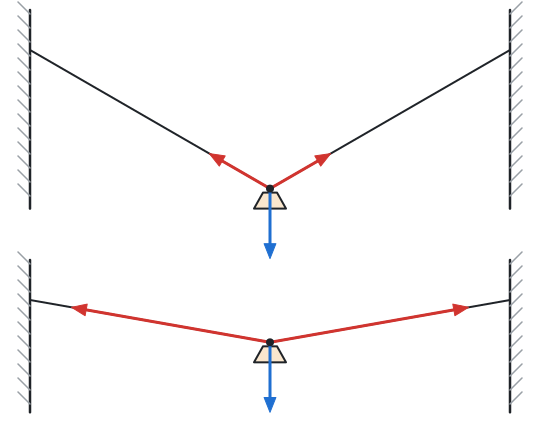
The picture shows the same lamp with a large and a small sag. The blue weight is equally long in both cases, while the red forces from the cable are much longer for the small sag. A calculator gives further values:
| angle α | force in the cable |
|---|---|
| 30° | 50 N |
| 10° | 144 N |
| 5° | 287 N |
| 2° | 716 N |
| 1° | 1,432 N |
With a sag of a single degree each half pulls with over 1,400 N, as if two adults were hanging from it. And all that for a lamp with a mass of roughly five kilograms. Almost all of that extra force points horizontally and pulls the houses towards each other.
Nobody can pull a cable perfectly straight. At an angle α = 0° both forces would point horizontally, their vertical components would be zero and nothing at all would hold the lamp up. However hard the cable pulled, the lamp would always make it sag at least a little. That is why a washing line or a wire with a curtain on it also sags, and anyone who tried to stretch it as tight as a guitar string would more likely snap it.
The lamp hangs at rest because the forces acting on it cancel. But a body with zero resultant force does not have to simply stand still. Why a puck keeps sliding across the ice, and why you are thrown forwards when a bus brakes, is explained in the next article, Newton’s first law.
