
Conservation of momentum
Momentum does not appear out of nothing, and it does not vanish without trace either. It can only be passed from one object to another. Whether two trolleys collide or two people push each other apart, one gains momentum and the other loses exactly the same amount. The sum of the two momenta stays what it was. This is called the law of conservation of momentum, and it is one of the most useful laws in all of physics. It lets us work out what happens after a collision without knowing the forces that acted during it, or how long they lasted.
An isolated system
For the law to apply, we first have to say which objects we are talking about. We choose a few objects that interest us, say two wagons, and call them a system. The forces that the objects of the system exert on one another are internal forces. The forces exerted on them by something from outside, such as the Earth or the rails, are external forces.
A system is isolated when no external forces act on it, or when the external forces cancel and their resultant is zero. A perfectly isolated system does not exist on Earth, but we can often come very close to one. The Earth pulls a skater on ice downwards and the ice holds them up from below with a force of the same size, so these two forces cancel. The friction of the skates is small and we ignore it.
A stone falling from a cliff, on the other hand, is not an isolated system. The Earth pulls it, which is an external force, and so its momentum increases. But if we include the Earth in the system as well, the force between the stone and the Earth becomes internal. The stone pulls the Earth towards itself with a force as large as the one with which the Earth pulls the stone, and the Earth gains momentum of the same size in the opposite direction, but because its mass is so enormous, its velocity is tiny. It is similar with a tennis ball bouncing off a wall. The momentum of 2.4 kg·m/s that the ball lost was taken over by the wall and with it the whole Earth, which, because of its mass, started moving imperceptibly slowly.
The total momentum of a system is the vector sum of the momenta of all its objects. For two objects:
When the objects move along one straight line, we choose a positive direction and add the momenta as signed numbers. An object moving against the positive direction has a negative momentum.
Why the total momentum does not change
Take two objects of an isolated system that act on each other for a while, whether they collide or push each other apart. No other forces act on them, or they cancel, so the momentum of each is changed only by the force from the other. Object 2 acts on object 1 with a force
Both forces appear at the same instant and vanish at the same instant, so they act for the same time Δt. The impulse is equal to the change of momentum, so the momenta of the two objects change by
The changes of momentum are equal and opposite. We add them:
The total momentum has not changed. What one object gained, the other lost. The force in a collision is not constant, but that does not matter. We split the whole collision into very short moments; in each of them the two forces are equal and opposite, so the total momentum does not change in any of them.
Inside a system, objects can collide, push and repel as they please. Internal forces always come in action–reaction pairs, so they cannot change the total momentum. Only an external force can change it. The same holds for more objects: each pair merely exchanges momentum. Baron Munchausen, who supposedly pulled himself out of a swamp by his own hair, therefore made it up. The hand pulls on the hair, the hair on the hand, and both forces stay inside the baron and do not change his total momentum. With that we have derived the law:
The total momentum of an isolated system does not change. The momenta before the event (unprimed) and after it (primed) have the same sum:
Note that only the sum is constant. The momenta of the individual objects can change, and usually do.
The recoil of a rifle
A hunter fires a rifle of mass 4 kg. A bullet of mass 10 g leaves it at 800 m/s. How fast does the rifle move backwards? We ignore the hunter’s hands and shoulder for now, and the rifle simply hangs freely in the air.
We choose the direction of the bullet’s flight as positive. Before the shot the rifle and the bullet are at rest, and the total momentum is zero. It must be zero after the shot too:
We subtract the momentum of the bullet and divide by the mass of the rifle:
We substitute:
The rifle moves off at 2 m/s and the minus sign says that it moves backwards, against the flight of the bullet. The bullet and the rifle have momenta of the same size, 8 kg·m/s, only in opposite directions. But the rifle has four hundred times the mass, so it is four hundred times slower. We have ignored the momentum of the gases that leave the barrel together with the bullet.
Two metres per second is over seven kilometres per hour. Anyone who holds the rifle only loosely will get a hefty blow to the shoulder from the butt. That is why the butt is pressed firmly against the shoulder. The rifle then moves off together with the shooter, and the momentum of 8 kg·m/s is spread over a much greater mass. With a shooter of mass 80 kg it is
The shooter is only slightly nudged, and if they brace themselves firmly against the ground, not even that.
Two skaters
The skaters Lily and Sophie stand facing each other on the ice. They put their palms against each other’s and push apart. Lily has a mass of 50 kg, Sophie 60 kg. Sophie glides away at 1 m/s. How fast does Lily glide away?
We choose the direction in which Sophie moves away as positive and label Lily with the index 1. Before they push apart, both are at rest, so the total momentum is zero afterwards too:
We express Lily’s velocity and substitute:
Lily glides away at 1.2 m/s in the opposite direction. We check that the momenta really do add up to zero:
Each of them received a momentum of 60 kg·m/s, each in a different direction.
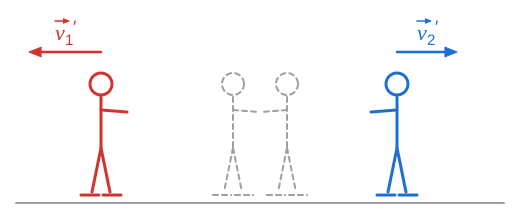
The speeds of the skaters are in the ratio 1.2:1, that is 6:5, which is the inverse of the ratio of their masses, 50:60. The lighter skater glides away faster. How hard they pushed does not matter. If they had pushed against each other for the same time with twice the force, both would have glided away twice as fast, but the ratio would stay 6:5.
Nor does it matter which of them was pushing. It is tempting to think that if only Lily pushes and Sophie holds her hands firm, mainly Sophie will glide away. But the forces in a pair are equal whoever pushes, and the lighter Lily again glides away faster.
Jumping from a small boat onto the bank rests on the same principle. The jumper pushes off the boat and the boat pushes off the jumper, so while the jumper flies forwards, the boat drifts backwards. If it is light, it drifts a good distance away, and instead of reaching the bank the jumper lands in the water.
Colliding wagons
In a marshalling yard, a wagon of mass 20 t travels at 2 m/s and runs into a stationary wagon of the same mass. The automatic couplings snap shut on impact and the wagons continue together. How fast?
A collision after which the objects stay joined together and move on as one is called an inelastic collision. We choose the direction of travel of the first wagon as positive.
After the collision both wagons have the same velocity v', so their momentum is that of a single object of mass m1 + m2. The law of conservation of momentum:
Before the collision only the first wagon has momentum:
After the collision the two wagons together must have the same momentum. We divide it by their total mass:
The coupled wagons travel at 1 m/s, half of the original velocity. The mass has doubled and the momentum has stayed the same, so the velocity had to drop to a half. If the wagon hit a stationary pair of coupled wagons, the same momentum would be shared among three times the mass, 60,000 kg, and all three would travel at a third of the velocity, about 0.67 m/s.
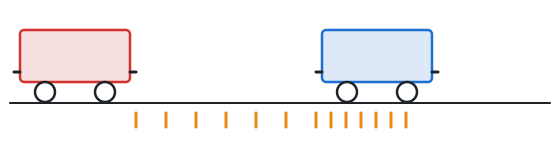
The orange marks show where the front of the red wagon was after equal intervals of time. While the red wagon travels alone, they are equally far apart. After it couples with the blue wagon, the gaps are still equal, only half as large.
Now comes a trickier case. The second wagon is not stationary but travels towards the first at 1 m/s. That is against the positive direction, so v2 = −1 m/s. It would be a mistake to add the momenta of the two wagons regardless of direction; the coupled wagons would then come out at 1.5 m/s. We therefore substitute the velocity of the second wagon with its minus sign:
The coupled wagons will move at 0.5 m/s in the direction in which the first wagon was travelling. If they had been travelling towards each other at the same speed, they would have stopped on the spot.
The wagons are not quite an isolated system, of course, as the wheels rub against the rails. But these external forces are small and the collision lasts only a fraction of a second, so in that time they change the momentum of the wagons negligibly. The forces between the colliding wagons are many times greater. That is why we can use the law of conservation of momentum for collisions even though the system is not completely isolated.
The rocket
A rocket stands in space far from any planets and its total momentum, with its fuel, is zero. The engine burns fuel and expels hot gases backwards through the nozzle at enormous speed. The gases thus gain momentum backwards, and for the total momentum of the rocket and the gases to remain zero, the rocket must gain momentum of the same size forwards. A rocket is really a rifle that fires an enormous number of tiny “bullets” backwards every second and each time speeds up a little forwards itself.
Nothing needs to act on the system of rocket and gases from outside, the rocket needs no ground or air and accelerates in a vacuum too. It pushes off the gases that it carries with it and expels itself. The more gas it throws out per second and the faster, the more momentum it gives the gas and the more it accelerates itself.
In a collision, momentum merely flows from one object to another. The force that really takes motion away, and in the end stops almost everything that slides along the ground, is friction. The next article is about it: Friction.
