
Momentum and impulse
A lorry reverses across a depot yard at 10 km/h, roughly the pace of a casual jogger. On a shooting range, a bullet leaves the barrel at 800 m/s. Which of the two is harder to stop? The bullet wins on speed, the lorry on mass. Physics has a quantity for this contest that combines mass and velocity. It is called momentum and it is the product of mass and velocity:
Put informally, momentum tells us how much motion there is in an object. Its unit is the kilogram metre per second, kg·m/s. This unit has not been given a name of its own, as the newton has.
An object with twice the mass has twice the momentum at the same speed, and an object moving twice as fast with the same mass does too. This matches experience. A medicine ball is harder to catch than a football thrown at the same speed, and a ball struck on the volley is harder to catch than one someone just hands you.
A lorry or a bullet?
The lorry has a mass of 40 t = 40,000 kg. We convert the speed to metres per second, 10 km/h ≈ 2.78 m/s, and substitute:
The bullet has a mass of 10 g = 0.01 kg:
The momentum of the slow lorry is almost fourteen thousand times greater than that of the fast bullet. The bullet is moving roughly three hundred times faster, but the lorry is four million times more massive. A sandbag will stop the bullet, but the lorry will simply push it aside. In a moment we will see why it is momentum that decides how hard an object is to stop.
Velocity is a vector, and so momentum is a vector too:
Mass is a positive number, so momentum always points in the same direction as velocity. Two identical lorries travelling towards each other at the same speed have momenta of the same magnitude but opposite directions. On a straight line we choose a positive direction, and a momentum pointing against it gets a minus sign, just like velocity.
How to change momentum
The momentum of an object changes only when its velocity changes, and that takes a force. We start from Newton’s second law F = m · a and for the acceleration we substitute the change of velocity over time,
The mass does not change, so mass times the change of velocity is the change of momentum. At the start the object had velocity v0 and momentum p0 = m · v0, at the end velocity v and momentum p = m · v:
Substituting into the second law, we get Newton’s second law written in terms of momentum:
Force is the change of momentum per unit time, just as acceleration is the change of velocity per unit time. In vectors,
Impulse
We multiply the formula by the time Δt:
The product of a force and the time for which it acts is called impulse, J = F · Δt. Its unit is the newton second, which is the same as the unit of momentum:
The impulse is equal to the change of momentum. An important consequence follows: when an object has to lose a certain amount of momentum, for example to stop, the impulse is fixed. A large force can do it in a short time, a small force in a long time. Twice the time means half the force, ten times the time means a tenth of the force.
Now we know why a sandbag stops a bullet but not a lorry. The bullet stops in the sand in about a thousandth of a second, so the sandbag slows it with an average force of
That is not small, but sand can withstand it. If the same force had to stop the lorry, it would have to brake it for
The bullet is brought to a halt over a distance of about 400 m/s · 0.001 s = 0.4 m (average speed times time). In fourteen seconds, at an average speed of 1.39 m/s, the lorry would travel almost 20 m. The sandbag would have to be twenty metres long, and so the lorry simply pushes it aside and drives on.
Impulse also works the other way round, when an object is speeding up. A footballer kicks a stationary ball of mass 0.45 kg and the ball flies off at 30 m/s. The ball has gained a momentum of 0.45 kg · 30 m/s = 13.5 kg·m/s. The contact with the foot lasts about a hundredth of a second, so the foot acts on the ball with an average force of
If you want to kick harder, you have to act on the ball with either a greater force or for longer. That is why a shot-putter does not throw the shot with just the wrist, but pushes it along the whole long path of the arm.
The force in an impact is not constant, it rises quickly and falls again. From the change of momentum we calculate its average, and that will be enough for us.
The airbag
Imagine a car travelling at 50 km/h that hits a wall. A passenger of mass 70 kg is wearing a seat belt and an airbag inflates in front of them. The belt and airbag stop them in roughly 0.1 s. How large is the force acting on them?
The positive direction is the direction of travel. The passenger loses all the momentum they had:
The change of momentum is Δp = 0 kg·m/s − 973 kg·m/s = −973 kg·m/s. The minus sign only says that the force points against the direction of travel. The magnitude of the force:
When we divide a kilogram metre per second by a second, we get kg·m/s2, that is a newton. A force of about 9,700 N acts on the passenger. Their weight is 70 kg · 9.81 m/s2 ≈ 690 N, so the belt and airbag slow them with a force about fourteen times greater. That is a lot, but it is survivable.
Without a belt or an airbag, the passenger would hit the steering wheel and dashboard and stop in about 0.01 s. They lose the same momentum, just in a tenth of the time:
That is about 97,000 N, ten times more and about a hundred and forty times their weight. An airbag does not reduce the momentum that the passenger loses, which is determined by their mass and velocity. It only takes it away over a longer time, and therefore with a smaller force. The crumple zone of a car does the same: it is gradually squashed in a collision and lengthens the time taken to stop.
A soft landing
Freya, a gymnast with a mass of 40 kg, jumps down from the beam and lands at 4 m/s. Just before landing she has a momentum of
On a hard floor, even with her knees bent, she stops in about 0.05 s, and on a crash mat that gives way under her, in about 0.25 s. The resultant force that slows her is:
On the mat the force is five times smaller, because the landing lasts five times longer. In both cases Freya loses all of her momentum. The mat does not change how much momentum disappears, it just takes it away more slowly.
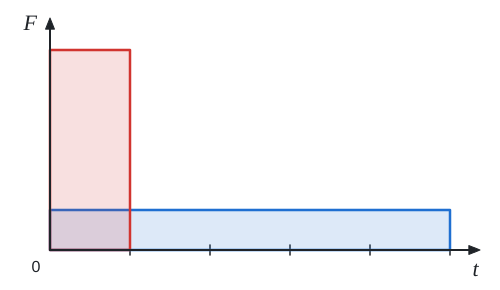
The red rectangle is the landing on the floor, the blue one on the mat. The height of a rectangle is the average force and the width is the duration of the landing, so the area of the rectangle is force times time, that is the impulse. The red rectangle is five times taller and five times narrower than the blue one and both have the same area of 160 N·s, because both landings took the same momentum from Freya. The real force in a landing jumps up quickly and falls again. The impulse is then the area under its curve, and the average force is the height of a rectangle with the same area.
The floor and the mat must push harder still, by Freya’s weight of about 390 N, because the Earth pulls her down during the landing too. The resultant force is the difference between the force with which the surface pushes upwards and the weight.
The same principle is used by the sand in a long jump pit, the mats in the pole vault, or bending your knees when you jump down from a wall.
Why you draw your hands back when catching
When you catch a ball thrown hard, your hands move back towards your body with it by themselves. This slows the ball over a longer time and with a smaller force, and your palms do not hurt. If you hold your hands stiff, you stop the ball in a very short time with a large force, and the ball often bounces off. Anyone who has ever tried to catch a raw egg knows this best.
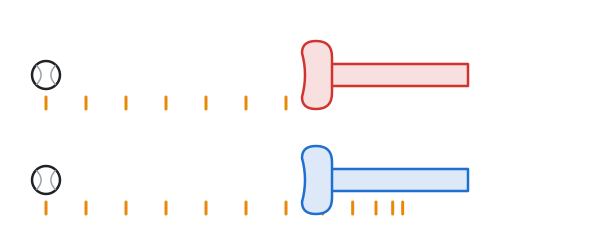
The orange marks record where the ball was after equal intervals of time. At the top, the ball stops against the stiff red hand almost instantly. At the bottom the blue hand moves back with it and the ball slows gradually, the marks getting closer together. The grey outline shows where the hand started. The stopping at the bottom takes much longer, so the hand slows the ball with a much smaller force.
A handball of mass 0.4 kg flies at 15 m/s and has a momentum of 6 kg·m/s. Stiff hands stop it in about 0.01 s with a force of 600 N, relaxed ones in 0.1 s with a force of only 60 N.
A bounce is worse than a stop
You throw a ball of plasticine with a mass of 0.06 kg at a wall at 20 m/s. We choose the direction towards the wall as positive. The ball sticks, so its momentum changes from 1.2 kg·m/s to zero:
Now take a tennis ball with the same mass and speed. In the ideal case it bounces and flies back at the same speed of 20 m/s, that is against the positive direction, and its momentum is −1.2 kg·m/s:
The change of momentum is twice as great. The wall has to stop the tennis ball first and then send it back again. With a contact of the same duration, the wall therefore pushes on the tennis ball with twice the force that it exerts on the plasticine. It would be a mistake to say that the momentum has not changed because the tennis ball is still flying at the same speed. The velocity has the same magnitude but the opposite direction, and momentum is a vector. That is also why a ball that bounces off your stiff hands hurts more than one that stays in your palms.
But where did the momentum that the tennis ball lost in the bounce go? And what if, instead of hitting a wall, it hits another object that is free to move?
How to calculate this, why a rifle kicks the shooter in the shoulder when fired, and how fast coupled railway wagons travel, is shown in the next article, Conservation of momentum.
