
Speed and velocity
In 2009 at the World Championships in Berlin, Usain Bolt ran 100 m in 9.58 s. How fast was that run? If he had kept the same pace all the way, every second would have covered
which is over ten metres every second. And how much is that in kilometres per hour?
On a street where traffic is limited to 50 km/h, Bolt could keep up with the cars for a while. At least over a hundred metres, as he could not hold that pace for longer.
The formula for speed
If you are only looking for the formula, you calculate the speed v by dividing the distance s by the time t in which the body covered it:
Speed tells you how much distance a body covers per unit of time, for example per second or per hour. The greater the distance in the same time, the greater the speed. And when we take longer to cover the same distance, the speed falls, since time is in the denominator.
We get the unit by dividing the unit of distance by the unit of time. Distance in metres and time in seconds give metres per second, m/s. Distance in kilometres and time in hours give kilometres per hour, km/h. To convert between the two units, we use the number 3.6: from m/s to km/h we multiply, the other way round we divide.
Average speed
The journey from London to Nottingham along the M1 is about 205 km. The Smiths took 2.5 h to get there, including a stop at a petrol station. So how fast were they going?
Let’s try to calculate it:
But the speedometer in the car hardly ever showed 82 km/h. At times it showed around 130 km/h, in the traffic jam near Northampton 20 km/h and at the petrol station zero. The number 82 km/h is the average speed: the speed at which the car would have had to travel all the time without stopping to reach Nottingham in the same time. We denote it
The total time includes everything, even stops. If the Smiths had sat at the petrol station an hour longer, they would have covered the same 205 km in 3.5 h and the average speed would have dropped to
Bolt’s speed of 10.44 m/s from the introduction was also an average. Bolt came out of the blocks from zero and was still accelerating over the first metres, so he ran more slowly at the start and faster towards the end. In the Berlin measurements he covered the section between the 60 m and 80 m marks, that is 20 m, in 1.61 s:
So over a short section in the second half of the race he was considerably faster than the average over the whole hundred metres.
Out at 60, back at 40
This problem is set in tests and entrance exams because almost everybody gets it wrong the first time. Mr Taylor drives to a holiday cottage 120 km away at 60 km/h. On the way back the road is jammed, so he drives at only 40 km/h. What was his average speed for the whole journey there and back?
It is tempting to add the two speeds and divide by two:
But that is wrong. Average speed is not the average of the speeds, but the total distance divided by the total time. So first we find how long he drove in each direction. On the way there he covered 120 km at 60 km/h. From the formula
The journey there took
and the journey back
In total he covered 240 km in 5 h. The average speed is
Mr Taylor’s average speed was 48 km/h, not 50 km/h. Where did the two kilometres per hour go? The picture shows the answer.
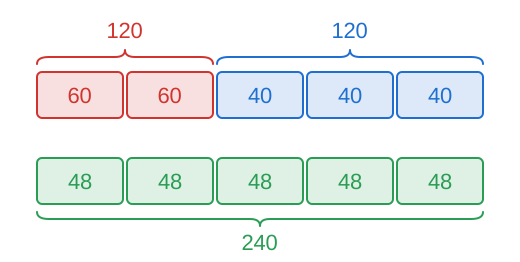
Each rectangle represents an hour of driving and the number in it tells how many kilometres Mr Taylor covered in it. The journey there, in red, took him two hours, the journey back, in blue, three. Both journeys are equally long, 120 km, but he drove at the slow speed for longer. When we take the average over five hours, the forty gets three votes and the sixty only two:
The green row shows that five hours at 48 km/h give the same 240 km. An average of 50 km/h would come out only if Mr Taylor had driven at both speeds for the same length of time, say an hour at sixty and an hour at forty. Here he drove the same distance, not for the same time, and so the average leaned towards the slower speed.
The same problem the other way round is even trickier. Mr Taylor again drove there at 60 km/h and would like an average of 80 km/h for the whole journey. How fast must he drive back? The answer 100 km/h suggests itself, but we already know that speeds cannot be averaged like this. He would cover the whole journey of 240 km at an average speed of 80 km/h in
But he has already used two hours on the way there. For the return 120 km he has only one hour left, so he must drive at 120 km/h. And what if he wanted an average of 120 km/h? He would have to cover the whole journey in two hours, and he has already used them up. He would have to arrive back in zero time, so it is impossible, however fast he drives.
Instantaneous speed
The speedometer in a car does not show the average speed over the whole journey. It shows how fast the car is going right now. We call this instantaneous speed. But how do we calculate it when the formula requires some distance and some time, and yet an instant lasts no time at all?
We will make use of the average speed over a shorter and shorter section. A car sets off from a set of traffic lights and 100 m further on there is a lamp post. We are interested in how fast the car is going right at the lamp post. At the lamp post we put a light gate, of the kind used for timing in athletics, and a second one 100 m, 10 m and 1 m beyond the lamp post in turn. The gates measure how long the car took over each section, and from that we calculate the average speed:
| section | time | average speed |
|---|---|---|
| 100 m | 4.142 s | 24.14 m/s |
| 10 m | 0.4881 s | 20.49 m/s |
| 1 m | 0.04988 s | 20.05 m/s |
Over the hundred-metre section the average speed came out at 24.14 m/s. But the car was accelerating all the way through the hundred metres, so at the end of the section it was going much faster than at the lamp post, and the average came out higher. Over ten metres the car has less time to accelerate, and over one metre hardly any. The shorter the section, the less the speed changes during it and the closer the average speed gets to the speed at the lamp post. The results settle at around 20 m/s. Over a section of 10 cm we would get 20.005 m/s, and over a millimetre a little less still. The instantaneous speed of the car at the lamp post is therefore 20 m/s, that is, 20 · 3.6 km/h = 72 km/h. That is exactly what the speedometer would show at that moment.
So we get the instantaneous speed as the average speed over a very short section. We write the piece of distance that the body covers as Δs and the time in which it covers it as Δt. The Greek Δ means a change. Then
where the time Δt must be so short that the speed does not change noticeably during it. How short is short enough depends on the motion. A car travelling along a motorway with cruise control changes speed only slightly in a second. A car hitting a wall stops in a tenth of a second.
Uniform motion is motion in which a body covers equal distances in equal intervals of time. Now we can also describe it differently: it is motion in which the magnitude of the instantaneous speed does not change. The speedometer keeps showing the same number and the average speed over any section is the same as the instantaneous speed. In non-uniform motion the instantaneous speed changes and the average speed is just a number between the smallest and the largest instantaneous speed.
For the curious: derivatives
Anyone who already knows limits and derivatives will recognise what we did in the table. We kept shortening the time Δt and watched what the quotient
The car from the table covered the distance s = 1 m/s2 · t2 from the traffic lights in time t, and it reached the lamp post after ten seconds. The derivative of t2 is 2t, so
and this is exactly the value that the table was approaching. Otherwise we can do without derivatives in this whole category.
Velocity as a vector
A car is going round a roundabout and the speedometer shows the same 30 km/h all the time. Is the velocity of the car changing or not?
Velocity is a vector. It is not enough to know how fast the car is going, where it is going matters too. Speed is the magnitude of the velocity, and the arrow of the velocity we denote
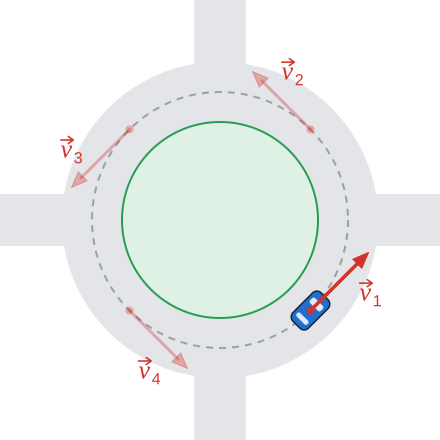
In the picture the car goes anticlockwise along the grey dashed circle, as on roundabouts in countries that drive on the right. The red arrow shows its velocity. The lighter arrows
Now we move all four arrows to a single point. We can move arrows as long as we do not turn them or change their length, so they are still the same vectors.
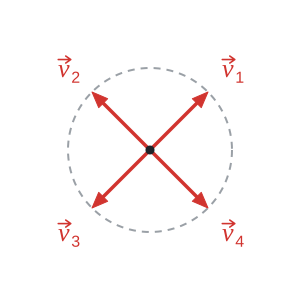
All four arrows end on the same dashed circle, so they have the same magnitude,
We recognised uniform motion by distances, and distance has no direction. That is why we consider motion uniform when the magnitude of the velocity does not change. So the car on the roundabout moves uniformly, and yet its velocity as a vector is changing. You can tell for yourself in a car that this is an important difference: on a bend you have to brace yourself, even though the driver is touching neither the accelerator nor the brake. We will explain why that is later, when we come to acceleration.
It remains to explain why the arrow points along the tangent, that is, along the line that just touches the path at the given place. We return to average velocity, that is, average speed taken as a vector. In time Δt the car moves from point A to some further point on the path. Its displacement is the arrow
Careful: the magnitude of this vector is in general not the same as the distance divided by the time. Displacement is usually shorter than the distance, and it coincides with it only over a very short section.
Dividing a vector by a number means the same as multiplying it by the number
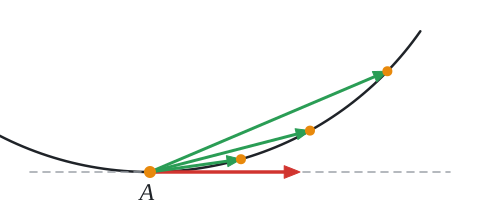
The picture shows a black path along which the car goes from left to right. The green arrows are displacements from point A over shorter and shorter times, to points lying closer and closer to A. The long displacement points slantwise upwards, the shorter ones less so, and the shorter the time, the more closely the arrow hugs the grey dashed tangent. The instantaneous velocity is the average velocity over a very short section, and so it points along the tangent, in the picture in the direction of the red arrow.
You can even see a tangent to a path. Sparks from a grinder fly off the disc along the tangent, in the direction in which the bit of metal was moving at the moment it broke away from the disc. Drops flying off a spinning umbrella behave in the same way. If the car on the roundabout hit black ice and the wheels stopped gripping, it would carry on roughly straight in the direction of its velocity arrow, not along the circle.
How fast things move
To give you an idea, here are a few typical speeds, rounded:
| what is moving | km/h | m/s |
|---|---|---|
| pedestrian | 5 | 1.4 |
| cyclist | 20 | 5.6 |
| Bolt over 100 m | 37.6 | 10.4 |
| car on a motorway abroad | 130 | 36 |
| airliner | 900 | 250 |
| sound in air | 1,235 | 343 |
| Earth around the Sun | 107,000 | 29,800 |
| light | 1.08 · 109 | 3 · 108 |
The speed of sound in the table is for air at a temperature of 20 °C. Sound is slow compared with light, and that is why you see lightning before you hear thunder: light reaches you practically instantly, sound covers a kilometre in about three seconds. If you count nine seconds between the lightning and the thunder, the storm is roughly three kilometres away. Light is the fastest of all. From the Moon it reaches us in just over a second and from the Sun in about eight minutes.
Calculator
Enter the distance and the time and the calculator will work out the average speed. The pre-filled values come from the Smiths’ journey to Nottingham.
The simplest motion is one in which the velocity does not change at all, neither in magnitude nor in direction. Such motion is uniform and in a straight line, and the next article is devoted to it, Uniform motion in a straight line.
