
Equation of a circle
A circle is made up of all the points in the plane that are the same distance r from the centre S. The equation of a circle is that same sentence written with coordinates: the point X(x, y) lies on the circle if and only if it is exactly r away from the centre S(m, n). And the distance between two points can be worked out with Pythagoras’ theorem.
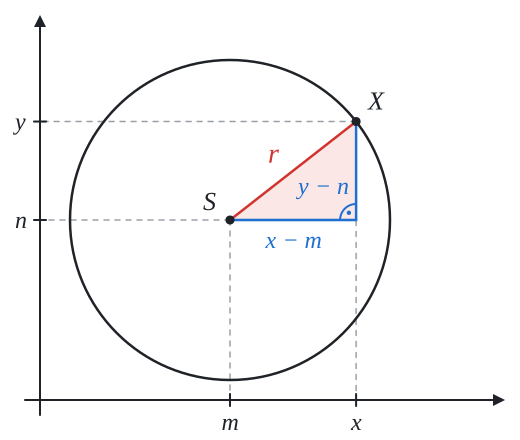
We join the centre S to the point X and draw in the horizontal and vertical sides, which gives a right-angled triangle. The horizontal side has length x − m, the vertical side has length y − n, and the hypotenuse is the radius r. By Pythagoras’ theorem we therefore have
If the point X lay to the left of or below the centre, the difference x − m or y − n would come out negative. That does not matter, because a square is never negative. If you know the magnitude of a vector, you will recognise the same formula here: the left-hand side is the square of the magnitude of the vector
The coordinates of every point on the circle satisfy this equation, and only those points do. A point inside the circle is closer to the centre than r, so its left-hand side comes out smaller than r2. For a point outside, it is the other way round.
Centre-radius form
The equation
is called the centre-radius form of the equation of a circle. It is the most convenient form, because from it we can see the centre S(m, n) and the radius r straight away.
Let’s write the equation of the circle with centre S(2, −1) and radius r = 3. We substitute m = 2, n = −1 and r = 3:
Minus minus one is plus one, and three squared is nine:
This is exactly where most mistakes are made. The centre S(2, −1) appears in the equation with the signs reversed: the two turns up as −2 and the minus one as +1. Anyone who writes (x + 2)2 + (y − 1)2 = 9 gets a circle with centre (−2, 1), which is somewhere else entirely. The same trap lies in wait when reading an equation: from (x + 5)2 + (y − 3)2 = 16 we read off the centre S(−5, 3), not (5, −3). And a third catch: on the right is r2, not r. This circle has radius
The simplest circle is the one with its centre at the origin (0, 0). Both brackets simplify and we are left with the equation x2 + y2 = r2.
A circle given by its diameter
Often the question does not give us the centre or the radius directly. For example, we may have to find the circle whose diameter is the line segment AB, where A(−1, 2) and B(5, −6).
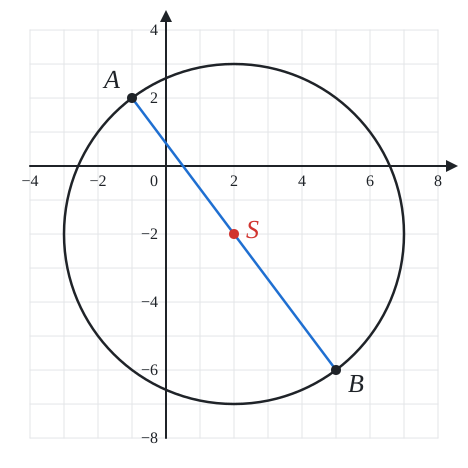
The centre of the circle lies exactly in the middle of the diameter, so it is also the midpoint of the line segment AB. We get its coordinates as the means of the coordinates of the points A and B:
The radius is half the diameter, so we first work out the length of the line segment AB. The differences of the coordinates are 5 − (−1) = 6 and −6 − 2 = −8. Then we use Pythagoras’ theorem:
The diameter is ten, so the radius is r = 5. It would be a mistake to use the whole length |AB| as the radius, as the circle would then be twice as big. We substitute into the centre-radius form:
We check by substituting the point A: (−1 − 2)2 + (2 + 2)2 = 9 + 16 = 25. It works, so the point A lies on the circle.
General form
If we expand the brackets in the centre-radius form, we get the general form of the equation of a circle. We start from the first circle, (x − 2)2 + (y + 1)2 = 9, and expand both brackets using the formulae (a − b)2 = a2 − 2ab + b2 and (a + b)2 = a2 + 2ab + b2:
We put the terms in order and move the nine to the left so that zero is left on the right:
We add up the numbers:
It is still the same circle, just written differently. The general form is written as x2 + y2 + ax + by + c = 0. Notice that x2 and y2 have the same coefficient and there is no x · y term. That is how we can usually recognise a circle, but certainty comes only from converting back to the centre-radius form. The equation x2 + 4y2 = 4 no longer describes a circle; it is an ellipse.
From the general form we cannot read off the centre or the radius at a glance, so we need to be able to convert it back.
Back from the general form
We have the equation x2 + y2 + 6x − 8y = 0 and want to find out where its centre is and what its radius is. We use completing the square, separately for x and for y. First we group the terms by variable:
Half of six is three, but (x + 3)2 = x2 + 6x + 9, so we have added an extra nine and must subtract it again. Hence x2 + 6x = (x + 3)2 − 9. Half of minus eight is minus four, so y2 − 8y = (y − 4)2 − 16. We substitute:
We move the numbers to the right-hand side:
Done, this is the centre-radius form. Watch the signs: the centre is S(−3, 4) and the radius is
If completing the square gave a negative number on the right, it would not be a circle, because the sum of two squares cannot be negative. With zero, the equation would be satisfied only by the centre itself.
Is the point on the circle?
We substitute the coordinates of the point into the left-hand side of the centre-radius form and compare the result with r2. Take the point A(1, 2) and the first circle (x − 2)2 + (y + 1)2 = 9:
We got 10, which is more than 9. So the point A is further from the centre than the radius, and lies outside the circle. At exactly 9 it would lie on the circle, and at a smaller number, inside it.
Chapters: Equation of a circle, Position of a line relative to a circle
