
Newton’s second law
Two supermarket trolleys stand side by side. One is empty and has a mass of 10 kg, the other is loaded with water and tins and has a mass of 25 kg. You push both with the same force, 50 N. The empty trolley shoots off, while the full one only lazily starts to move. Newton’s second law tells us exactly how much each one speeds up. We will ignore the friction of the wheels to keep things simple.
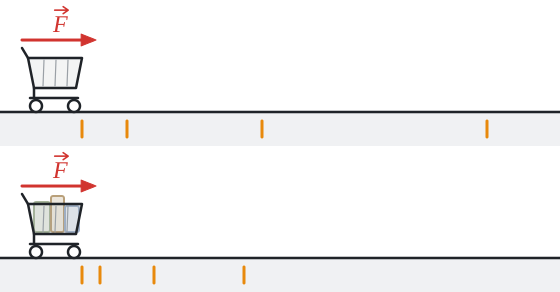
Both trolleys start from rest, and the orange marks show the position of their front at regular intervals of time. For both, the gaps get longer, so both are accelerating. But in the same time the empty trolley travels two and a half times the distance of the full one, because its acceleration is two and a half times greater. The force arrows are the same length for both trolleys. The only difference is the load.
The law of force
Isaac Newton wrote it down in 1687 in roughly this form:
The alteration of motion is ever proportional to the motive force impressed; and is made in the direction of the right line in which that force is impressed.
Mass seems to be missing here, but only seems to. By “motion” Newton meant the product of mass and velocity (the quantity of motion, i.e. momentum), so mass is hidden inside it.
In today’s language: the greater the force acting on an object, the greater its acceleration, and the greater its mass, the smaller its acceleration:
If we double the force, the acceleration doubles too. If we double the mass, the acceleration halves. More often the law is written multiplied by the mass:
Both force and acceleration are vectors, so the full form is
Be careful about one thing:
Let’s go back to the trolleys and work out their accelerations. We start with the empty one:
And the full one:
We will explain in a moment why the result came out in metres per second squared. An acceleration of 5 m/s2 means that the speed of the empty trolley increases by 5 m/s every second, while that of the full one increases by only 2 m/s. The full trolley has two and a half times the mass, so its acceleration is two and a half times smaller. If you pushed the empty trolley twice as hard, with a force of 100 N, its acceleration would be twice as large, 10 m/s2.
But nobody pushes a trolley for long. If you push for half a second, the empty trolley speeds up to 5 m/s2 · 0.5 s = 2.5 m/s, and the full one only to 2 m/s2 · 0.5 s = 1 m/s.
Mass as a measure of inertia
An object keeps moving at the same velocity until a force makes it change. This is called inertia. The second law adds a number to it: the greater the mass, the more the object resists a change in velocity. Mass is a measure of inertia.
That is why you can get an empty trolley moving with one finger, but stopping a full one that is already rolling is hard work. It is also why a lorry pulls away from the traffic lights more slowly than a car, even though it has a much more powerful engine.
A bigger object is not necessarily more massive. A beach volleyball is bigger than a bowling ball, but you would not want to kick the bowling ball. The ball is far more massive, so an equally hard kick moves it only slightly and your foot comes to a stop against it.
We cannot get rid of inertia even where things weigh nothing. An astronaut on a space station lifts a hundred-kilogram crate with one hand, because the crate and the station are falling around the Earth together, and the crate floats in weightlessness. But as soon as the astronaut wants to set it moving or stop it, they have to put in the same effort as on Earth. The crate still has a mass of 100 kg and the same inertia.
Where the newton comes from
The unit of force is the newton, N = kg·m/s2. The second law explains why it is this unit, because the newton is defined by it: one newton is the force that gives an object of mass 1 kg an acceleration of 1 m/s2. We substitute into F = m · a:
This also gives us the unit of acceleration used for the trolleys. We divide the newton by the kilogram:
The kilograms cancel and metres per second squared are left.
How big is one newton? About the force you feel holding a small apple in your hand. Put a one-litre bottle of water, with a mass of about 1 kg, on perfectly smooth ice and pull it with a constant force of 1 N. The bottle accelerates the whole time: after a second it is moving at 1 m/s, after two seconds at 2 m/s. A constant force does not keep the velocity constant, it keeps changing it.
What force makes a car accelerate
A family car with a mass of 1,200 kg accelerates from zero to 100 km/h in ten seconds, which is an acceleration of about 2.8 m/s2. How big must the resultant force on the car be?
The formula is already in the right form, so we substitute straight away:
The units work out: a kilogram times a metre per second squared is a newton. A resultant force of about 3,360 N, that is more than three kilonewtons, must act on the car. Notice the word resultant. Air resistance and the rolling resistance of the tyres also act against the motion, so the road has to push the car through the wheels a little harder still.
Several forces at once
Usually several forces act on an object, and then you always proceed in the same way:
- draw the forces acting on the object and choose a positive direction,
- add them up to get the resultant force,
- divide it by the mass to get the acceleration.
Draw only the forces acting on the object you are interested in. The force with which the car pushes on the road does not belong in the calculation of the car’s acceleration, because it acts on the road. All of dynamics rests on this procedure, and the later articles only add new kinds of forces to it.
Our car from the previous example is now driving along a country road and the driver presses the accelerator. The road pushes it forwards through the wheels with a force F1 = 3,000 N, while air resistance and rolling resistance slow it down with a force F2 = 600 N.
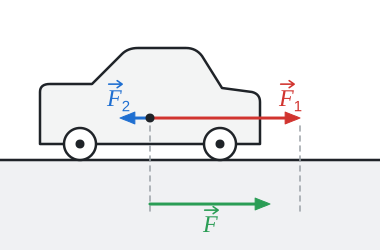
The red arrow is the driving force, the blue one the resistance and the green one the resultant, all to the same scale. Vertically, the car is also acted on by the weight downwards, and the road pushes it upwards with a force of the same size. They cancel each other out, which is why we do not draw them in the picture.
We choose the direction of travel as positive. The forces point in opposite directions, so their magnitudes are subtracted:
We divide by the mass:
The car has an acceleration of 2 m/s2. A common mistake is to divide only the driving force by the mass. You would get 2.5 m/s2, which is too much, because the air resistance would get lost in such a calculation.
The same method works in other situations. On a motorway a car travels at a constant speed, the resistance is roughly 600 N and the driving force is just as large, so the resultant force is zero and so is the acceleration. When the driver lifts off the accelerator, the driving force disappears and only the resistance is left, which points against the positive direction (we ignore engine braking):
A negative acceleration means that the car is slowing down.
The method also works the other way round, from acceleration back to force. How big a driving force does the car need to have an acceleration of 2.8 m/s2, even with a resistance of 600 N? The resultant force must be F = m · a = 3,360 N, as we calculated above. From the relationship for the resultant force we express the driving force:
We substitute:
So the driving force must reach almost four kilonewtons. Anyone who forgot about the resistance would find that their car accelerates more slowly than the calculation predicted.
Why heavy and light objects fall at the same rate
In free fall, all objects at one place have the same acceleration g ≈ 9.81 m/s2, a stone and a bunch of keys alike. It is tempting to think that the heavier stone must fall faster, because the Earth pulls it with a greater force. It does pull harder, but the heavier stone also has a greater mass, so it resists a change in velocity more.
A newton meter shows how much a kilogram weighs: the Earth pulls every kilogram with a force of about 9.81 N. So the weight (the gravitational force on the object) is directly proportional to the mass:
The number g appears here as a force per kilogram, N/kg, and that is the same thing as m/s2. A ball of mass 0.5 kg is pulled by the Earth with a force of about 4.9 N, a bowling ball of mass 5 kg with a force ten times greater, about 49 N. But the bowling ball also has ten times the mass:
Ten times the force, ten times the mass, the same acceleration. In general
Mass plays a double role: it determines how strongly the Earth pulls on an object, and at the same time how much the object resists a change in velocity. It is not self-evident that the same number appears in both roles; this is checked by measurement and it holds with enormous precision. That is why a hammer falls just like a nail.
In air there is also air resistance, which points upwards, and the resultant force is the weight reduced by the resistance. For a stone the resistance is negligible compared with the weight, but for a feather, which weighs almost nothing, it takes away almost all of the weight. That is why a feather drifts down on Earth and a stone drops. Air resistance depends on the shape and speed of an object, not on its mass. Air slows steel and polystyrene balls of the same size equally at the same speed. But the greater the mass, the less the resistance takes away from the acceleration, so it removes only a tiny part of the acceleration of the steel ball, while it noticeably slows the polystyrene one.
Why the seat pushes us in the back
When a car sets off sharply, you feel the seat back pushing into your back. That is the force that gives you the same acceleration as the car, and now we can calculate it. A passenger has a mass of 60 kg. In a family car with an acceleration of 2.8 m/s2, the seat back pushes on her with a force of
In a sports car with an acceleration of 9.3 m/s2 it is already
For comparison, the seat supports her from below with a force equal to her weight, 60 kg · 9.81 m/s2 ≈ 589 N. So the seat back pushes on her almost as hard as the seat does from below, which is why we speak of a g-force of almost 1g in the horizontal direction. The ratio of the two forces is the same as the ratio of the accelerations,
So the second law tells us what a force does to an object. What remains is the question of where forces come from and what they act on. When you push a trolley, you feel the trolley pushing back on your hand. That is the subject of Newton’s third law.
How forces work in pairs is shown in the next article, Newton’s third law.
