
Acceleration
Car makers like to boast about how many seconds their car takes to accelerate from 0 to 100 km/h. For an ordinary family car it is roughly ten seconds. What does that number actually tell us? First we convert a hundred kilometres per hour to metres per second:
So in ten seconds the car gains 27.8 m/s. If it gained speed evenly, it would go faster by a tenth of that every second, by 2.78 m/s, or 2.8 m/s rounded. After the first second it would be travelling at 2.8 m/s, after the second at 5.6 m/s, after the third at 8.4 m/s, and after the tenth at those 27.8 m/s. The quantity that tells us how much the speed changes in a second is called acceleration.
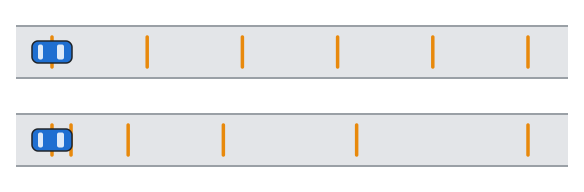
The picture shows two roads one above the other. Both cars leave an orange marker behind them every whole second. The top car keeps the same pace the whole time, 7 m/s, so its markers are the same distance apart. The bottom car pulls away from rest and accelerates by exactly 2.8 m/s every second. In the first second it covers only a little, barely a metre and a half, but then more with every second, because it travels faster and faster. Its markers are therefore further and further apart, and we will work out by how much in a moment. After five seconds both cars are in the same place, 35 m from the start. The bottom car lagged behind at first, but in the end it was faster and caught up with the top car exactly at the finish.
The formula for acceleration
If you are looking only for the formula, you calculate the acceleration a by dividing the change in velocity Δv by the time Δt in which the velocity changed:
The Greek Δ stands for a change. The change in velocity is the difference between the velocity at the end and at the start. We denote the initial velocity v0 and the final velocity v:
For the car from the introduction we write down the data:
Substituting:
A family car has an acceleration of about 2.8 m/s2. In reality a car does not accelerate equally the whole time: in a higher gear it gains less speed. The number we calculated is therefore the average acceleration over the whole ten seconds. We get the instantaneous acceleration by the same trick as the instantaneous speed: we measure the change in velocity over such a short time Δt that the acceleration does not change noticeably during it. If you know derivatives, you will recognise the derivative of velocity with respect to time, a = v'(t).
Why metres per second squared
We get the unit of acceleration by dividing the unit of velocity by the unit of time. Dividing by a number is the same as multiplying by its reciprocal:
Two seconds in the denominator look odd, but each is there for a different reason. The first belongs to the velocity (how many metres per second the car travels), the second says how long it took for that velocity to change. So read 2.8 m/s2 as “2.8 m/s faster every second”.
If you prefer to work in kilometres per hour, you can put it that way too: a car that accelerates from 0 to 100 km/h in ten seconds gains 10 km/h every second. The result of 10 km/h per second is a perfectly good acceleration, just in a unit nobody uses, because it mixes hours with seconds.
Watch out for a common mix-up: a large acceleration does not mean a high speed. A car on a motorway abroad with cruise control set to 130 km/h has zero acceleration, because its speed does not change. A car pulling away when the lights turn green starts with almost zero speed, and yet it has a considerable acceleration. Acceleration does not tell us how fast an object is moving, but how fast its velocity is changing.
Why the markers spread out
Let’s look at the bottom car in the picture again. Its acceleration is 2.8 m/s2, so in the first second it speeds up from zero to 2.8 m/s. The speed grows evenly, so during the first second the car travels at an average of half of that, 1.4 m/s, and covers 1.4 m. In the second second it speeds up from 2.8 m/s to 5.6 m/s, travels at an average of 4.2 m/s and covers 4.2 m, three times as much as in the first. In the third second it travels at an average of 7 m/s, like the top car, and covers the same 7 m.
Every second the average speed increases by 2.8 m/s, and so the stretch of road covered increases by 2.8 m. The gaps between the markers are 1.4 m, 4.2 m, 7 m, 9.8 m and 12.6 m in turn, in the ratio 1:3:5:7:9, and together they add up to 35 m. The top car travels at 7 m/s the whole time and also covers 35 m in five seconds. The fact that the average speed lies exactly halfway between the speed at the start and at the end of the second holds only when the speed grows uniformly. We will explain why in the article on uniformly accelerated motion.
Braking
A car is travelling at 72 km/h, that is 20 m/s, the driver brakes and the car stops in 4 s. The final velocity is zero, the initial velocity 20 m/s:
The acceleration came out negative. The car’s speed does not increase, on the contrary it decreases, by 5 m/s every second. In everyday speech we would just say the car is slowing down, but a physicist says that it decelerates with an acceleration of −5 m/s2, or with a deceleration of 5 m/s2. Both mean the same thing.
But what does the minus sign really mean? Velocity is a vector and so is acceleration. The acceleration arrow
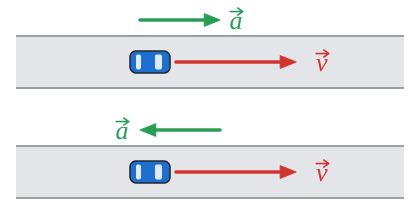
Both cars travel to the right, so the red velocity arrow
Acceleration in a bend
A car goes round a roundabout and the speedometer shows 54 km/h the whole time. Yet its velocity, as a vector, is changing, because the velocity arrow keeps turning. And where velocity changes, there is acceleration. Acceleration as a vector is the change in the velocity vector per unit of time:
We subtract two vectors by moving both arrows to the same point. The difference
Example: A car covers a quarter of a roundabout at a constant speed of 54 km/h = 15 m/s in 3 s. At the start it is heading east, at the end north. How large is its average acceleration and which way does it point? We write down the data:
The arrow
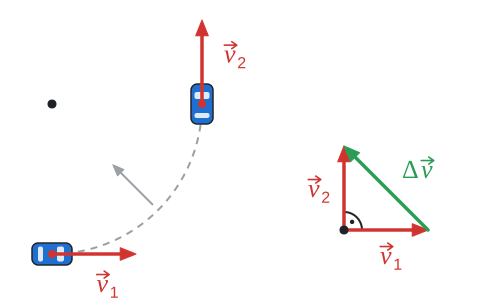
On the right both arrows have been moved to one point and they form a right angle. The green difference
The difference points diagonally to the upper left, to the north-west, just like the grey arrow on the left, which leads from the middle of the quarter to the centre of the roundabout. We get the acceleration by dividing the change in velocity by the time. Dividing by a number only shortens the arrow, so the acceleration also points to the centre of the roundabout. Substituting:
The car has an average acceleration of about 7.1 m/s2 towards the centre of the roundabout. That is almost as much as in hard braking on a dry road, around 7 m/s2, and yet the speedometer still shows 54 km/h. This is why you have to brace yourself in a bend even though the driver is neither accelerating nor braking. What we found is the average acceleration over the whole quarter of the roundabout. We will work out the instantaneous acceleration at every point of the bend exactly in the article on centripetal acceleration.
G-force
We feel the acceleration of a car on our own body: a sports car pushes you into the seat as it pulls away. How strongly is compared with the acceleration due to gravity g ≈ 9.81 m/s2. This is the acceleration with which a stone you let go of falls, as long as air does not slow it down. A sports car can go from 0 to 100 km/h in three seconds, so its acceleration is
almost the same as that of a falling stone.
G-force tells you how many times more strongly the seat, the floor or the backrest pushes on you than when you are sitting calmly. If you are sitting on a chair now, the g-force is 1g, even though you are not accelerating. G-force is therefore not the same as acceleration. At 4g the seat would push on you four times as hard, as if you weighed four times as much.
In a sports car at full throttle the backrest pushes on your back almost as hard as the seat pushes from below, because the car accelerates almost like a falling stone. On a roller coaster, at the lowest point of a dip or a loop, a g-force of 3 to 4g presses you into the seat. The carriage rapidly changes direction there from going down to going up, and that is a large acceleration pointing upwards.
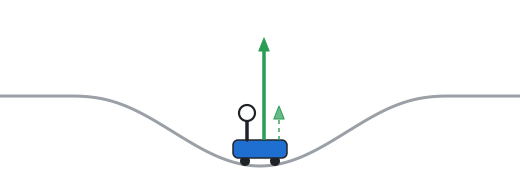
On the way down the seat pushes more weakly than when you are sitting, and at the lowest point of the dip about three times as strongly.
A fighter pilot in a tight turn can withstand up to 9g, but only in a special suit that stops the blood draining from the head to the legs. An untrained person would faint within a few seconds at such a g-force. Interestingly, in free fall we feel nothing even though we are accelerating: nothing pushes on us, the g-force is zero and the body is weightless. Why we feel acceleration as pressure from the seat will only be explained by dynamics, the part of physics about forces.
The simplest motion is one in which the acceleration does not change at all, like that of the bottom car in the first picture. The velocity then grows by the same amount every second, and we can work out the distance and the velocity at any moment with simple formulas. The next article, Uniformly accelerated motion, is devoted to this kind of motion.
