
Friction
Give a mug on the table a little push. It slides a short way and stops. A shoe that slips on a paving slab also travels only a short distance before it comes to rest. According to the law of inertia, a body with no resultant force on it would keep going at the same speed for ever. So something must be slowing it down, and that something is friction: the force that two surfaces exert on each other when they slide over one another, or at least try to.
Friction is not only a nuisance, though. Without it, your foot would slip backwards on the ground and car tyres would just spin on the spot, so we could not take a single step and the car would stay where it was.
Static friction
Lucy is moving house and needs to shift a wooden wardrobe of mass 60 kg across a wooden floor. She pushes carefully, but the wardrobe does not budge. The horizontal force of Lucy’s hands
Lucy pushes harder. The wardrobe still doesn’t move, so the static friction has grown along with her push. It is always exactly large enough to keep the wardrobe in place, not a newton more. If Lucy stopped pushing, the static friction would vanish too. After all, the wardrobe will not set off against her on its own.
This cannot go on for ever, though. Static friction has a maximum, and as soon as Lucy overcomes it, the wardrobe moves.
Kinetic friction
Once the wardrobe is sliding, it is still held back by the kinetic (sliding) frictional force
Why? Even surfaces that look smooth are full of tiny bumps and hollows under a microscope. At rest, the bumps on the bottom of the wardrobe and on the floor settle into each other, and the materials stick together a little where they touch. To get the wardrobe moving, you have to break all these bonds at once. When it is sliding, the bumps do not have time to settle in so deeply and mostly skip over one another.
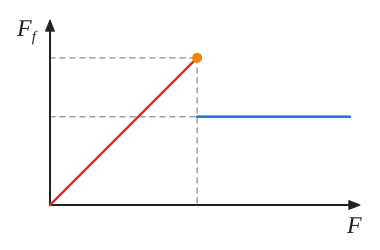
While the wardrobe stays at rest, the frictional force equals the pull, and the graph is the red sloping line. At the orange point the pull reaches the maximum static friction, the wardrobe breaks free and the frictional force drops to the lower value of kinetic friction. It stays there however hard Lucy pushes, and it is shown by the blue horizontal line.
How large is friction?
The harder the surfaces are pressed together, the deeper the bumps settle into each other and the greater the friction. An empty wardrobe is easier to move than one full of books. The pressing is measured by the normal (contact) force
where μ is the coefficient of kinetic friction. It is a ratio of two forces, the newtons cancel, and so the coefficient has no unit. It depends only on which two surfaces rub against each other and is found by measurement. The size of the contact area hardly matters: a wardrobe lying on its side is just as hard to slide as one standing upright.
The maximum static friction is calculated with the same formula, only with a larger coefficient of static friction μs. Approximate values of the coefficient of kinetic friction:
| surfaces | μ |
|---|---|
| rubber on dry tarmac | 0.7 |
| rubber on wet tarmac | 0.5 |
| rubber on snow | 0.3 |
| rubber on ice | 0.1 |
| wood on wood | 0.3 |
| steel on ice | 0.02 |
Real values vary with the tyres, the temperature and how worn the surface is. Rubber on dry tarmac slips least, and a steel skate on ice slips most. This is exactly why pavements are gritted in winter: to raise the coefficient on ice.
You can measure the coefficient yourself. Put a wooden block on a board and pull it with a newton meter so that it moves at a steady speed. The newton meter then shows exactly the kinetic frictional force. Then hang the block from the newton meter and measure its weight, which on a horizontal board is the same as the normal force. The ratio of the two readings is the coefficient of friction.
How much force does the wardrobe need?
Let’s find out how hard Lucy has to push. The floor is horizontal and Lucy pushes horizontally, so in the vertical direction only the weight and the normal force act. The wardrobe moves neither up nor down, so the two forces are equal:
For wood on wood, μ = 0.3. We substitute into the formula for the frictional force:
To keep the wardrobe sliding at a steady speed, Lucy has to push it with a force of about 177 N. The push and the friction then balance, and the resultant force comes out as zero.
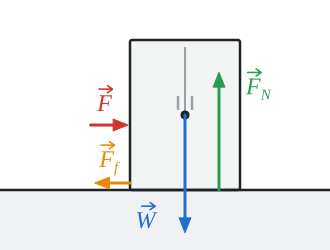
It is easy to slip up and multiply the coefficient by the mass directly. But 0.3 · 60 kg = 18 kg is not a force, it is still just kilograms. The formula needs the normal force in newtons.
What’s more, the normal force does not always equal the weight. If Lucy leaned an elbow on the wardrobe and pushed down on it too, the floor would push back on the wardrobe harder and the friction would grow. If she instead pulled it by a strap angled upwards, the strap would partly lift the wardrobe, the normal force would drop and the friction with it.
Getting the wardrobe moving takes more. The coefficient of static friction for wood on wood is about μs = 0.5, and so the maximum static frictional force comes out as
At the start Lucy has to push about two thirds harder than she needs to afterwards. And when the wardrobe breaks free and Lucy keeps pushing with full force for a moment, the push exceeds the friction by about 118 N. By Newton’s second law, this gives the wardrobe an acceleration of
The wardrobe shoots forwards and Lucy almost falls over behind it. Removal firms know this well: they prefer not to stop heavy furniture until it reaches its place, because getting it moving again is harder than keeping it sliding.
Rolling resistance and why we have wheels
Lucy could borrow a trolley with wheels instead. A wheel does not slide over the floor, it rolls. The spot where the wheel touches the floor is momentarily at rest relative to the floor, so the bumps do not have to break apart or skip over each other. Even so, a rolling wheel eventually stops. The wheel and the surface are slightly squashed where they touch, and the wheel is always, in effect, climbing out of a tiny dip. This is called rolling resistance.
It is calculated in a similar way to friction, only with a much smaller coefficient. For hard castors on a smooth floor it is about 0.02, for an inflated tyre on tarmac around 0.01, and for a steel train wheel on a rail only about 0.002. Lucy would push the wardrobe on a trolley, ignoring the trolley’s mass, with a force of
fifteen times smaller than when sliding it. That is why loads are carried on wheels and suitcases have wheels. An under-inflated tyre is squashed more, the rolling resistance goes up and the car burns more petrol.
Why a car takes so long to brake on ice
Now we can explain why a car brakes so much worse on ice than on a dry road. A car of mass m brakes on a horizontal road. We ignore air resistance, so the only horizontal force left is the friction between the tyres and the road. The road is horizontal, so the normal force balances the weight, FN = m · g, and the frictional force is
Here friction is the resultant of all the forces, and so by Newton’s second law it equals the mass times the magnitude of the acceleration, the deceleration
We divide by the mass:
The mass has cancelled. A heavier car does press harder on the road and so the friction is greater, but in proportion to that it also has more inertia to resist the deceleration. A small car and a loaded van on the same tyres would therefore decelerate equally.
We substitute dry tarmac:
Rounded, that is 7 m/s2, the usual deceleration on a dry road. For wet tarmac we get 4.9 m/s2, for snow 2.9 m/s2, and for ice
The deceleration appears in the denominator of the formula for the braking distance:
A coefficient seven times smaller therefore means a braking distance seven times longer. Take a car driving along a country road at 80 km/h, that is
On ice the denominator contains 0.1 instead of 0.7, and the braking distance comes out as about 252 m, a quarter of a kilometre. The brakes cannot do anything about that, because it is really the road that has to do the braking.
The coefficients in the table are for kinetic friction, so they apply to locked wheels that skid along the road. Cars have ABS, which does not let the wheels lock. The tyre then keeps rolling and is held to the road by static friction, which is greater, so the car stops somewhat sooner and can still be steered.
Friction calculator
Enter the mass of a body lying on a horizontal surface and the coefficient of friction from the table. The calculator works out the frictional force Ff = μ · m · g. With the coefficient of static friction (about 0.5 for wood on wood) you get the force needed to set the body moving.
So far, all the wardrobes and cars have stood on a horizontal floor, where the normal force balances the whole weight. On a hill that is no longer true, and whether a sledge slides down or friction holds it depends on how steep the slope is.
How the weight splits up on a slope and how large an acceleration the sledge gets is shown in the next article, Inclined plane.
