Air conditioner energy use: cooling cost calculator
A small split air conditioner with a cooling capacity of 2.5 kW, the kind that is enough for a bedroom or a living room, uses on average about 0.385 kWh for an hour of cooling. At 26p per kWh an hour costs you 10p. For the whole summer, which is what the energy label counts, that comes to 135 kWh and £35.10. A portable air conditioner of the same size asks for about 1 kWh an hour, which is 26p, and over the summer it swallows £91, more than twice as much.
Calculator based on the energy label
In the cooling part of the label of a split air conditioner there are three figures: the cooling capacity in kW, the seasonal efficiency SEER and the yearly energy use in kWh. You get the average use per hour by dividing the capacity by SEER:
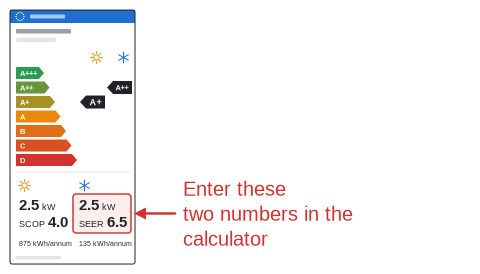
In the simplified drawing of the label, both numbers framed in red are the ones that go into the calculator.
The label counts 350 hours of full cooling, and you will find your own electricity price on your bill.
SEER says how many kWh of heat the air conditioner carries out of the room for each kWh of electricity, averaged over the cool and hot days of the summer. For heating the label has a similar figure, SCOP. The classes run from A+++ to D, and new air conditioners are usually A++ or better.
How much an air conditioner uses in summer and in winter
The table counts as the label does: 350 hours of full cooling per summer, 1,400 hours of heating per winter and 26p per kWh. The small split has a SEER of 6.5, the large one 6.1, and both have a SCOP of 4. The kW column gives the cooling and heating capacity, and the portable unit takes 1 kW of power.
| type | kW | summer | winter |
|---|---|---|---|
| small split | 2.5/2.5 | 135 kWh, £35.10 | 875 kWh, £227.50 |
| large split | 5/4 | 287 kWh, £74.62 | 1,400 kWh, £364 |
| portable | 2.6 | 350 kWh, £91 | not suitable |
Why is a portable air conditioner so expensive? It pushes the heat out through a hose in the window, and the air from the room goes with it. Warm air from outside then flows in through the gaps by the windows and doors, and the air conditioner cools it again. On top of that, the hot hose radiates heat back into the room. The test for the label does not count the air that is drawn in, which is why almost every portable air conditioner has class A even though in reality it cools worse than it promises. It will do for a rental or a few hot weeks, but anyone who cools every summer is better off with a split.
Is it worth heating with an air conditioner?
Yes. A split air conditioner heats about four times more cheaply than a plug-in electric heater. In winter it reverses its cycle and works as an air-to-air heat pump: it takes heat from the outside air and blows it into the room. With a SCOP of 4 it makes 4 kWh of heat from 1 kWh of electricity, while an electric heater makes only 1 kWh.
The heating figures in this article differ depending on how much heat the room needs. The table follows the label: a small air conditioner heats on its own at full power for the whole winter, that is 2.5 kW for 1,400 hours. That is 3,500 kWh of heat, more suited to a larger or worse insulated space, and with a SCOP of 4 it comes to 875 kWh of electricity for £227.50. A 20 m² room in an average house in a central European climate, from the article on electric heater energy use, gets by with 1,512 kWh of heat over the winter. An electric heater uses 1,512 kWh of electricity for £393.12, and an air conditioner with a SCOP of 4 only
which is £98.28. (In the article on electric heaters the heat pump comes out dearer, because there we count more cautiously with an efficiency of 3.5, and here we take the SCOP of 4 from the label.) In hard frost the efficiency drops, but over the whole winter the SCOP from the label applies. Anyone who only tops up the heating in autumn and spring uses a fraction of that.
Calculator from the power and the hours
Portable air conditioners give on the label, instead of the yearly energy use, the use per hour in kWh, that is, the power at full cooling. For older units without an energy label, look for the power on the rating plate or in the manual. With the hours of running you can work out the whole summer from it:
In the example, a portable air conditioner of 1,000 W runs for fifty hot days of seven hours each. For a split air conditioner with an inverter, the power from the manual is a rougher estimate, because most of the time it runs at a fraction of its capacity. The first calculator suits it better.
How 1 kWh of electricity makes 3 to 4 kWh of cooling
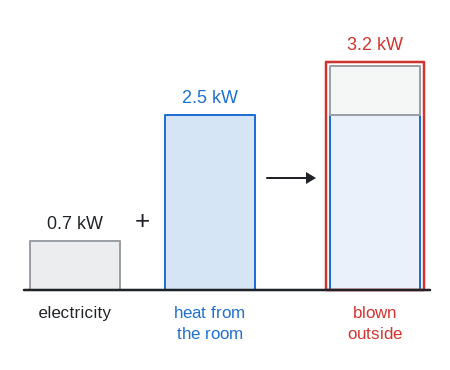
An air conditioner with 2.5 kW of cooling takes only about 0.7 kW of electricity at full running. It does not make heat, it only moves it out of the room, and the electricity drives just the compressor and the fans. The efficiency is the ratio of the heat moved to the electricity:
So 1 kWh of electricity gives 3 to 4 kWh of cooling. The 0.7 kW applies to full running in the heat. But for most of the summer it is not so hot outside and the inverter runs at a lower output, where it is more efficient. Over the season the SEER therefore comes to 6.5 instead of 3.6, and an hour of full cooling takes only about 0.385 kWh, as the first calculator showed.
How to save
- Set 24 to 26 °C and do not cool more than 6 to 8 °C below the outdoor temperature, because every extra degree costs something.
- Shade the windows from outside: an external blind or an awning catches the sun before it heats up the room.
- Close the windows and doors, because through an open window heat flows in and the air conditioner carries it out again.
- Clean the filters in the indoor unit once every two to four weeks, because clogged ones slow the airflow and the air conditioner runs for longer.
- Do not heat or cool an empty home: a timer or an app switches the air conditioner on half an hour before you return.
- Keep the hose of a portable air conditioner as short as possible and seal the gap in the window, so that warm air does not flow back.
You can work out a fridge, which cools all year round, in a similar way.
Sources
Chapters: Appliance energy use, Fridge energy consumption, Washing machine energy use, Tumble dryer energy use, Dishwasher energy use, Hot water cylinder energy use, TV energy use, Computer energy use, Electric heater energy use, Air conditioner energy use, Kettle energy use, Induction hob energy use, Oven energy use, Electric car charging cost, Hot tub energy use, Coffee machine energy use, Aquarium energy use, Vacuum cleaner energy use, Iron energy use, Light bulb energy use, Heat pump energy use, Gas consumption