Heat pump energy use: house heating cost calculator
An ordinary family house of 120 m² uses roughly 9,600 kWh of heat a year for heating. An air-to-water heat pump needs about 2,740 kWh of electricity for that. At the standard rate of 26p per kWh that is just over £710 a year, whereas electric heaters on the Economy 7 night rate would swallow £1,440, twice as much. An insulated house of the same size gets by with the heat pump for £357, and an old uninsulated one costs £1,337 or more. The heating figures are an example for a central European climate.
Calculator based on the label and the size of the house
For the calculator you mainly need the SCOP. It says how many kWh of heat the heat pump gets from 1 kWh of electricity over the whole heating season. The product fiche that comes with the label usually gives only the seasonal efficiency in per cent: you get the SCOP from it by adding 3 and multiplying the result by 0.025 (150% gives 3.8), or you can find it straight away in the technical data.
Over a year every m² needs roughly 40 kWh of heat in an insulated house, 80 kWh in an average one and 150 kWh in an old uninsulated one. The exact value is given in the building’s energy performance certificate as the specific space heating demand.
The calculator does not include heating water, which adds roughly £362 a year for a family of four. In real operation the efficiency tends to be somewhat worse than on the label, which is why the default SCOP is 3.5. The 26p per kWh is the standard rate, as explained in the section on the rate, and you will find your own price on your bill.
What heating a house costs per year
Electricity and the annual bill at a SCOP of 3.5 and 26p per kWh for the heat pump, with electric heaters on the Economy 7 rate of 15p:
| house | heat pump | electric heaters |
|---|---|---|
| 120 m², insulated | 1,370 kWh, £357 | 4,800 kWh, £720 |
| 100 m², average | 2,290 kWh, £594 | 8,000 kWh, £1,200 |
| 120 m², average | 2,740 kWh, £713 | 9,600 kWh, £1,440 |
| 150 m², average | 3,430 kWh, £891 | 12,000 kWh, £1,800 |
| 120 m², old uninsulated | 5,140 kWh, £1,337 | 18,000 kWh, £2,700 |
| 150 m², old uninsulated | 6,430 kWh, £1,671 | 22,500 kWh, £3,375 |
Insulation matters more here than the square metres. An old house also usually keeps its radiators, which need hotter water, and the heat pump then runs less economically. There you should count on a SCOP of 3 instead: for 120 m² that is 6,000 kWh for £1,560.
If the same 9,600 kWh of heat for an average 120 m² house were supplied by a condensing boiler with an efficiency of 92%, it would burn 10,430 kWh of gas. At 6p per kWh of gas that comes to about £626 a year, which is roughly £87 less than the heat pump. You will find the details in the article on gas use.
How 1 kWh of electricity turns into 3 to 4 kWh of heat
An electric heater turns 1 kWh of electricity into 1 kWh of heat, and you cannot get further than that. A heat pump does not create heat, it only moves it. It takes it from the outside air, even when it is cold or freezing outside. Only the compressor uses electricity, pushing the heat it has gained up to a higher temperature. So the electricity that flows into the house comes with another 2 to 3 kWh of heat from outside.
How hard the heat pump has to work depends on the temperature difference over which it lifts the heat. A perfect machine would give this many kWh of heat from 1 kWh of electricity, where Tv is the temperature of the heating water and To the outdoor temperature (both in kelvins, that is °C + 273):
Say it is 2 °C outside. Underfloor heating needs water at only 35 °C, so the ideal COP is 308/33, about 9.3. Radiators need 55 °C and we get 328/53, about 6.2. A real heat pump manages roughly half of the ideal, and even less in freezing weather. Over the whole season that gives about 4 for underfloor heating and 3 for radiators, and on average we count on a SCOP of around 3.5.
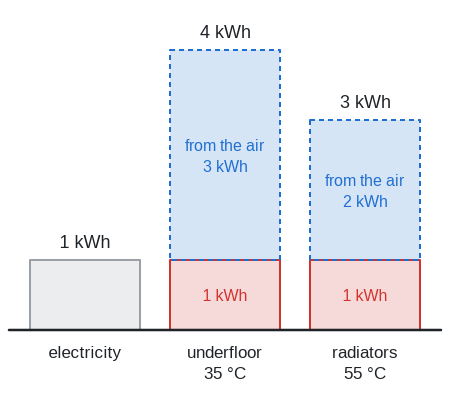
An air conditioner heats on the same principle, and a fridge uses it the other way round.
Frost and the heating element
The colder it is outside, the worse the heat pump works, and in a harsh winter it may not have enough output. That is why it has a backup electric heating element. It heats just like an electric heater, so every kWh of heat from it costs 26p instead of roughly 7.4p. A properly designed heat pump switches it on only a few days a year below −10 °C, an undersized one every winter.
A ground-source heat pump draws heat from a borehole or a surface collector that frost does not reach. Its label often shows a SCOP of 4.5 to 5, and in a real house you should count on about 4. An average 120 m² house with it uses around 2,400 kWh at a cost of £624 a year, but buying it is considerably dearer than an air-to-water one.
Which rate the heat pump pays
A heat pump runs through the whole day, whereas the Economy 7 night rate applies for only about seven hours at night. So we count its electricity at the standard rate of 26p per kWh, a typical price in 2026, and in the calculator you replace it with the price from your own bill.
Hot water
Most heat pumps also heat the water in a cylinder. It has to be hotter, so the efficiency drops to 2.5 to 3. A family of four uses about 3,900 kWh of heat a year for water. An electric hot water cylinder produces it for £585 on Economy 7, a heat pump from 1,390 kWh for £362 at the standard rate. For ordinary washing 50 °C is enough instead of 60 °C, but heat the water higher once a week because of bacteria.
How to save
- Heat with the coolest water possible, every degree off the heating water temperature raises the efficiency by roughly 2 to 3%.
- Let weather compensation control the water temperature according to the outdoor temperature, so that the heat pump does not heat the water to 55 °C when it is 10 °C outside.
Sources
Chapters: Appliance energy use, Fridge energy consumption, Washing machine energy use, Tumble dryer energy use, Dishwasher energy use, Hot water cylinder energy use, TV energy use, Computer energy use, Electric heater energy use, Air conditioner energy use, Kettle energy use, Induction hob energy use, Oven energy use, Electric car charging cost, Hot tub energy use, Coffee machine energy use, Aquarium energy use, Vacuum cleaner energy use, Iron energy use, Light bulb energy use, Heat pump energy use, Gas consumption