Kettle energy use: what a cup of tea costs, with a calculator
A litre of water boiled in an electric kettle uses about 0.12 kWh and at 26p per kWh costs 3.2p. A cup of tea comes to less than 1p. If you boil a full litre twice a day, you pay £23 a year. A price of 26p per kWh is typical in 2026; you will find your own on your bill. A kettle is cheaper than an induction hob or a ceramic hob, though only by 0.2 to 0.7p per litre. On a gas hob, however, you can boil water even more cheaply, because a kWh of gas costs less than a quarter of the price of electricity.
Water heating calculator
The energy use is determined by the amount of water and by how many degrees you heat it.
What the same water costs on a hob is shown in the table below.
What everyday heating costs
Tap water is at 10 °C and is heated to boiling unless stated otherwise. We count gas at 6p per kWh, as for a gas boiler:
| heating | kWh | pence |
|---|---|---|
| cup of tea (0.25 l) | 0.031 | 0.81 |
| a litre of water | 0.123 | 3.2 |
| a litre to 80 °C | 0.096 | 2.5 |
| a full kettle (1.7 l) | 0.209 | 5.4 |
| 2 l for pasta in a kettle | 0.246 | 6.4 |
| 2 l on an induction hob | 0.261 | 6.8 |
| 2 l on a ceramic hob | 0.299 | 7.8 |
| 2 l on a gas hob | 0.464 | 2.8 |
A gas burner uses almost twice as much energy, because only around 45% of its heat gets into the water and the rest flows around the pan into the kitchen. A kilowatt hour of gas is so cheap, though, that a litre of water on gas comes to about 1.4p.
Why a kettle loses the least heat
Heating a litre of water by 90 degrees takes 0.105 kWh of heat (energy conversion), and a kettle with an efficiency of 85% takes a little more from the socket:
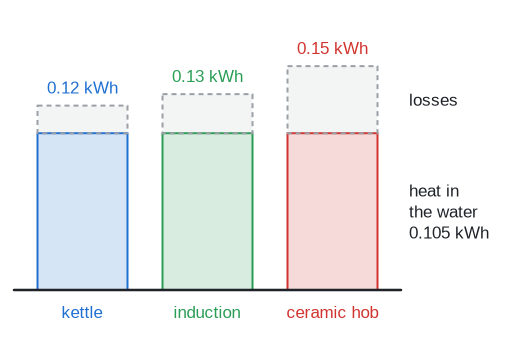
A kettle heats directly in the water, whereas an induction hob has to heat the metal of the pan as well, and a ceramic hob also heats the red-hot glass, from which heat escapes into the kitchen.
How to save
- Boil the water for pasta and potatoes in a kettle and pour it into the pan only when it is boiling.
- Heat only as much water as you will drink; a quarter of a litre is enough for a cup, but mind the minimum fill mark.
- Do not boil water for green and white tea; 70 to 80 °C is enough, and heating comes to about a fifth cheaper.
- Keep an eye on the pan on the hob: a kettle switches itself off when the water boils, but the water in a pan keeps bubbling until you notice.
- Descale the kettle from time to time, because limescale on the bottom slows down the heating.
What a whole meal costs to cook can be found in the articles on the induction hob and the oven.
Sources
Chapters: Appliance energy use, Fridge energy consumption, Washing machine energy use, Tumble dryer energy use, Dishwasher energy use, Hot water cylinder energy use, TV energy use, Computer energy use, Electric heater energy use, Air conditioner energy use, Kettle energy use, Induction hob energy use, Oven energy use, Electric car charging cost, Hot tub energy use, Coffee machine energy use, Aquarium energy use, Vacuum cleaner energy use, Iron energy use, Light bulb energy use, Heat pump energy use, Gas consumption