Electric heater energy use: winter heating cost calculator
An electric heater with a power of 2,000 W uses 2 kWh for an hour of running at full power, and at 26p per kWh that costs 52p. But it does not run at full power all the time: the thermostat switches it on only when the room cools down. A 20 m² room in an average house needs on average 7.2 kWh of heat a day, so such a heater heats it in roughly 3.6 hours of full-power running, and a day comes to £1.87. In January, when it is around freezing outside, that is about 280 kWh for £73, or £42 on the Economy 7 night rate.
An oil-filled radiator, a convector heater, an infrared panel and a fan heater with the same power cost exactly the same for an hour. We show why below.
| power | an hour at 26p/kWh | an hour at 15p/kWh |
|---|---|---|
| 1,000 W | 26p | 15p |
| 1,500 W | 39p | 22.5p |
| 2,000 W | 52p | 30p |
Electric heater energy use calculator
Electric heaters do not have an energy label with a class, as a fridge does. On the rating plate you find only the power in watts. An oil-filled radiator with three settings often has, say, 800/1,200/2,000 W there, so enter into the calculator the setting that you really heat on. Do you know the power and how long the heater is on? Then use this calculator:
You can estimate how many hours it runs at full power from the indicator light: if it is lit for about a quarter of the time, that is six hours a day. A plug-in power meter for around £10 measures it more accurately. The price of 26p per kWh is typical in 2026, and you will find your own on your bill.
How much heat a room needs
An electric heater does not use more than the heat the room loses through its walls, windows and ventilation, and that depends mainly on the insulation. With heating for 210 days from October to April and a price of 26p per kWh, a season costs this many pounds (an insulated house, an average house or a renovated block of flats, and an old uninsulated house):
| area | insulated | average | old |
|---|---|---|---|
| 10 m² | 105 | 197 | 393 |
| 15 m² | 157 | 295 | 590 |
| 20 m² | 210 | 393 | 786 |
| 30 m² | 314 | 590 | 1,179 |
The prices are at 26p per kWh, and on the Economy 7 night rate they come out about 40% lower. A corner room with two windows uses more, and a flat in the middle of a building that the neighbours heat uses less. Do you not know how long your heater is on? Work it out from the size of the room. The heat needed is a seasonal average for a central European climate, about 8 W per m² in an insulated house, 15 W in an average one and 30 W in an old uninsulated one:
For a 20 m² room in an average house the two calculators agree on the same 7.2 kWh a day and £393.12 a season, or £227 on the Economy 7 night rate. But in frost a room loses roughly twice as much as on average, which is why for such 20 m² a heater of 1 to 1.5 kW is suitable, and for an uninsulated room one of 2 kW or more. A more powerful heater does not use more over the season, it just switches off sooner.
An economy electric heater does not exist
Sellers like to claim that their heater uses a third less. But the electricity that flows into a resistive heater is all turned into heat, whether it is an electric heater, an oil-filled radiator, a convector, an infrared panel or a fan. From 1 kWh of electricity you always get 1 kWh of heat, not a bit more.
Our room needs 7.2 kWh of heat a day. An oil-filled radiator with 2,000 W delivers it in 3.6 hours, and an infrared panel with an “economy” power of 600 W in
Both use 7.2 kWh for £1.87. A lower power only means that the heater runs for longer. The difference between the types is in comfort: an infrared panel heats by radiation, so the warmth is felt quickly, an oil-filled radiator keeps giving off heat for a while after it is switched off, and a fan heater warms the room fastest but is noisy.
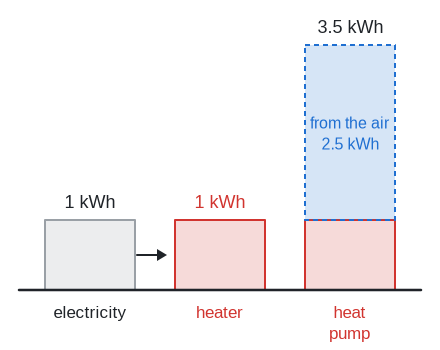
Only a heat pump gives more heat from a kilowatt hour. It pumps heat from the outside air inside and makes 3 to 4 kWh of heat from 1 kWh of electricity. Our room would cost about £112 a season with it instead of £393.12.
The Economy 7 tariff
If you heat only with electricity, Economy 7 may suit you. Electricity on it is cheaper for seven hours at night, at around 15p per kWh, so it suits storage heaters that charge up overnight. You ask your electricity supplier for it. If you only switch on an oil-filled radiator now and then, it will not pay off, because the day rate is higher than on a standard tariff.
How to save
- Heat to 20 °C, 17 °C is enough in a bedroom, and keep a room that is not in use at 15 to 16 °C, because a completely cold one gets damp and mouldy. Every degree lower saves about 6%, which for our room is about £24 a season.
- Use a weekly programme. New heaters sold in the EU in practice have to have an electronic thermostat with a timer, so set it to heat less at night and when you are not at home.
- Ventilate briefly and fully. A window left open on the vent all day lets heat out all the time.
- Do not hide the heater behind a sofa or curtains, because the thermostat then switches off according to the hot corner and you turn it up for nothing.
- Seal the windows and doors. Cheap draught-proofing pays for itself in the same winter.
Sources
Chapters: Appliance energy use, Fridge energy consumption, Washing machine energy use, Tumble dryer energy use, Dishwasher energy use, Hot water cylinder energy use, TV energy use, Computer energy use, Electric heater energy use, Air conditioner energy use, Kettle energy use, Induction hob energy use, Oven energy use, Electric car charging cost, Hot tub energy use, Coffee machine energy use, Aquarium energy use, Vacuum cleaner energy use, Iron energy use, Light bulb energy use, Heat pump energy use, Gas consumption