Coffee machine energy use: what one coffee costs, with a calculator
If you make two coffees a day in a bean-to-cup machine, you use around 20 kWh a year and pay roughly £5, and with a pod machine it is over a third less. One espresso from a bean-to-cup machine costs about 0.7p, including warming the machine up. A machine that stays switched on is much more expensive: an espresso machine with a large boiler that keeps the water hot all day swallows over 600 kWh a year, which costs more than £160. The prices in this article are based on 26p per kWh, a typical price in 2026. You will find your own price on your bill.
Coffee machine energy calculator
Coffee machines do not have an energy label. But you can put the energy use together from two parts: how much energy it takes to make one coffee, and how long the machine is switched on just to keep the water warm.
The type of machine determines the energy per coffee: about 12 Wh for a pod machine, 15 Wh for a bean-to-cup machine and 20 Wh per cup for an espresso machine or a filter machine. The default values are for a bean-to-cup machine that is switched on twice a day and turns itself off after half an hour. While keeping hot, a pod machine and a bean-to-cup machine take only 20 to 30 W, which is next to nothing, the hot plate of a filter machine takes around 60 W and an espresso machine with a boiler around 120 W for as long as it is switched on, and to the hours it is on you should add another 2 hours for warming up the boiler in the morning.
How much energy different coffee machines use
A coffee machine heats at full power only for a moment, so the annual bill depends mainly on how long it stays switched on. With two coffees a day, you get:
| coffee machine | kWh per year | cost per year | pence per coffee |
|---|---|---|---|
| pod | 12 | £3.23 | 0.44p |
| bean-to-cup | 20 | £5.22 | 0.71p |
| filter with a thermos jug | 15 | £3.80 | 0.52p |
| filter with a hot plate | 29 | £7.59 | 1.04p |
| espresso, 2 hours in the morning | 201 | £52.20 | 7.15p |
| espresso, 12 hours | 639 | £166.08 | 22.75p |
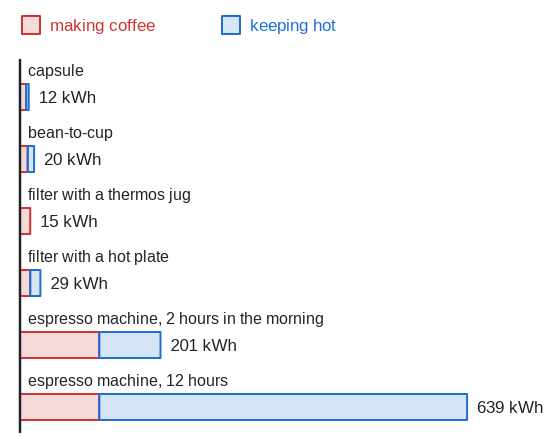
The most economical is the pod machine, followed closely by the filter machine with a thermos jug. A pod machine and a bean-to-cup machine warm up in a minute. An espresso machine with a boiler holds up to two litres of hot water and takes twenty minutes to half an hour to warm up, which is why people often leave it switched on all morning or all day. An expensive coffee machine does not have to be hungry for electricity, then: what matters is a large boiler that stays on.
With a filter machine, the jug is what matters. A glass jug sits on a hot plate, which keeps heating until you switch the machine off. A thermos jug keeps the coffee hot by itself, and the machine can switch off as soon as the brewing is done.
We have not included standby mode in the table, which adds £1.20 to £2.40 a year.
Milk froth adds roughly 15 Wh to a coffee, about 0.4p, whether it is made by the machine’s steam wand or by a separate frother. Compared with the price of the coffee itself, the electricity for one cup is negligible.
How much energy the water for an espresso needs
An espresso has about 40 ml of water, which is 0.04 kg, and we need to heat it from 10 °C to 90 °C. We work out the heat Q in the same way as for a kettle: mass times the specific heat capacity of water (4,180 joules per kilogram per degree) times the temperature difference. We convert joules to watt hours by dividing by 3,600:
The water in the cup alone therefore costs only 0.1p. But a bean-to-cup machine uses around 15 Wh for one espresso, four times as much. The rest goes on warming up the heater, on rinsing and on the heat that escapes into the room.
With an espresso machine switched on for 12 hours, the difference is huge. It uses 1.75 kWh a day for two coffees, which is 875 Wh for one. Less than half a per cent of the energy reaches the cup, and the rest heats the kitchen all day.
How to save
- Let the machine switch itself off as soon as possible. Under EU rules, a coffee machine switches off by itself within 30 minutes (a filter machine with a hot plate within 40), and you can lengthen this in the menu, so set it to 15 to 30 minutes.
- Do not leave an espresso machine switched on all day. Put it on a timer socket, switch it on half an hour before your morning coffee and then switch it off.
- Pour the coffee from a filter machine into a thermos jug, because on a hot plate it also turns bitter within an hour.
- Descale regularly and switch the machine off at the switch or at the socket when you go away: a scaled-up heater heats more slowly, and a machine that is switched off does not use even standby power.
You will find the energy use of other appliances in your home in the overview of appliance energy use.
Sources
Chapters: Appliance energy use, Fridge energy consumption, Washing machine energy use, Tumble dryer energy use, Dishwasher energy use, Hot water cylinder energy use, TV energy use, Computer energy use, Electric heater energy use, Air conditioner energy use, Kettle energy use, Induction hob energy use, Oven energy use, Electric car charging cost, Hot tub energy use, Coffee machine energy use, Aquarium energy use, Vacuum cleaner energy use, Iron energy use, Light bulb energy use, Heat pump energy use, Gas consumption