Light bulb energy use: LED and old bulbs, with a lighting cost calculator
An old-fashioned 60 W bulb uses 0.06 kWh for every hour it is on, and that costs 1.6p. An LED bulb that gives the same light takes around 8 W, which is about 0.2p an hour. If a light is on for three hours a day, the old bulb costs you £17 a year and the LED £2.28.
Calculator based on the energy label
The box of every bulb sold in Europe carries an energy label. Under the letter of the class you will find the energy consumption in kWh per 1,000 hours of use, and that number is also the power in watts. An 8 W LED uses 8 Wh in an hour, so 8,000 Wh in 1,000 hours, which is 8 kWh. Have you thrown the box away? The power is usually printed on the bulb itself, so enter it into the calculator instead of the number from the label.
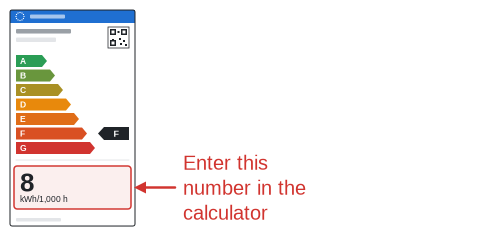
In this simplified drawing of the label, the number framed in red is the one that goes into the calculator.
Two hours a day is the European average for one light, but a lamp in the living room can easily be on for five hours in winter, so if you want a more accurate figure, work out each room separately. The price of 26p per kWh is typical in 2026, and you will find your own on your bill.
When you buy, compare mainly the two numbers on the box: the lumens (how much light it gives) and the kWh per 1,000 hours (how much it uses).
How much an incandescent bulb, halogen, CFL and LED use
All four light sources in the table give the same light as the old 60 W bulb, 806 lumens. The energy use and cost are for three hours of light a day, which is 1,095 hours a year:
| light source | power | kWh per year | cost per year |
|---|---|---|---|
| incandescent bulb | 60 W | 66 | £17.08 |
| halogen bulb | 52 W | 57 | £14.80 |
| compact fluorescent lamp (CFL) | 14 W | 15 | £3.99 |
| LED bulb | 8 W | 9 | £2.28 |
A halogen is only a slightly better incandescent bulb, and a CFL is already getting close to LED. Incandescent and halogen bulbs and fluorescent tubes are hardly sold in Europe any more, but you may still find them in a chandelier.
There is a difference in lifespan too. An incandescent bulb lasts about 1,000 hours, which at three hours a day is less than a year. An LED is rated at 15,000 to 25,000 hours, which is 14 to 23 years of the same use.
How much switching to LED saves
Enter the power of the old bulb, the power of an LED with the same lumens, how long the light is on each day and how much the LED costs:
An LED at £2.80 in place of a 60 W bulb saves 57 kWh and £14.80 a year at three hours a day, and it pays for itself in just over two months. Even in a pantry, where the light is on for ten minutes a day, switching does not lose out: it saves about 80p a year and pays for itself in about three and a half years, long before the LED wears out.
Halogens from spotlights or chandeliers are worth replacing just as quickly: an LED in place of a 52 W halogen saves £12.53 a year at the same use. You do not need to replace a working CFL, because with a difference of 6 W you wait around a year and a half.
Which LED to buy instead of a 60 W bulb
On the box, look for lumens, not watts. In place of a 60 W bulb, take an LED of around 800 lm, which uses about 8 to 9 W. The fitting must be the same as on the old bulb: the large screw cap E27, the small E14, the bayonet B22 that is common in the UK, or GU10 with two pins for spotlights. A colour temperature of 2,700 K is warm white and gives the same light as the old bulb. And do not wait for a bulb to blow: even a working one is worth replacing straight away, because an LED pays for itself in a few months.
Lumens per watt: why LED saves almost 90%
The old 60 W bulb gives 806 lumens, which is why the whole article uses this number. How much light a source gives from one watt is called luminous efficacy, in lumens per watt. An incandescent bulb manages about 13.4 lm/W, a halogen around 15, a CFL around 58 and an ordinary LED 100 lm/W, with better ones reaching 150.
For 806 lumens we therefore need a power of
For the same light, an LED uses
An incandescent bulb turns only about 5% of the electricity into light, and the rest is heat.
How to save on lighting
- The colour of the light has almost no effect on energy use: warm white 2,700 K and cool white 4,000 K with the same lumens use roughly the same.
- Do not buy more lumens than you need: a bedside lamp needs 250 to 470 lm, and 806 lm belongs on the ceiling.
- Dimming saves energy, but the LED has to be dimmable.
- A motion sensor is useful in a hallway, on the stairs and in a cellar, where the light is often left on for no reason.
Lighting with LEDs is now a small item in the household budget. How much the appliances that really cost a lot use is shown in the overview of appliance energy use. A label with kWh per 1,000 hours is also found on a television, and the watts to kWh calculator converts plain watts to kilowatt hours.
Sources
Chapters: Appliance energy use, Fridge energy consumption, Washing machine energy use, Tumble dryer energy use, Dishwasher energy use, Hot water cylinder energy use, TV energy use, Computer energy use, Electric heater energy use, Air conditioner energy use, Kettle energy use, Induction hob energy use, Oven energy use, Electric car charging cost, Hot tub energy use, Coffee machine energy use, Aquarium energy use, Vacuum cleaner energy use, Iron energy use, Light bulb energy use, Heat pump energy use, Gas consumption