Hot tub energy use: yearly running cost calculator
A well-insulated outdoor hot tub that runs all year round and that you spend three hours a week in uses about 1,940 kWh of electricity, which is around £504 a year. If you let it run only from May to September, 660 kWh for £172 is enough. An inflatable model is cheaper to buy, but over the same summer it uses almost half as much again, about 970 kWh for £252. This works with 26p per kWh, which is typical in 2026, and you will find your own prices on your bill.
Most of the electricity does not go on bathing, but on waiting between baths. A hot tub keeps its water at 38 °C even on days when nobody sits in it, and heat keeps escaping from it into the air and the ground.
Hot tub energy use calculator
A hot tub has no energy label with a class, as a fridge does. But in the data sheet manufacturers give the standby losses: how many kWh it takes in 24 hours under a closed cover when it is only holding the temperature and filtering the water. The sheet should say what air temperature it was measured at, usually 15 to 20 °C. The calculator works with 20 °C, but it is almost always colder outside.
If the losses are missing from the data sheet, enter about 2.5 kWh a day for an insulated hot tub and 4.5 kWh for an inflatable one. The calculator converts them to the average outdoor temperature of the summer or of the whole year, because heat escapes faster the bigger the difference between the water and the air. The figure from the sheet is therefore multiplied by the ratio (38 − outdoors)/(38 − 20). While you are bathing the cover is off and the heater runs almost without a break, so we count it at its full power: for an inflatable hot tub that is usually 2 kW, for an acrylic one 3 kW.
How much a hot tub uses in a year
We compare an inflatable hot tub of 800 litres with standby losses of 4.5 kWh per 24 hours and an insulated acrylic one of 1,200 litres with 2.5 kWh. We choose typical values from the range that sellers give (inflatable 3 to 5, acrylic 1.5 to 2.5 kWh a day). In both you bathe three hours a week:
| hot tub | days | kWh per year | cost per year |
|---|---|---|---|
| inflatable, summer | 153 | 970 | £252 |
| insulated, summer | 153 | 660 | £172 |
| insulated, all year | 365 | 1,940 | £504 |
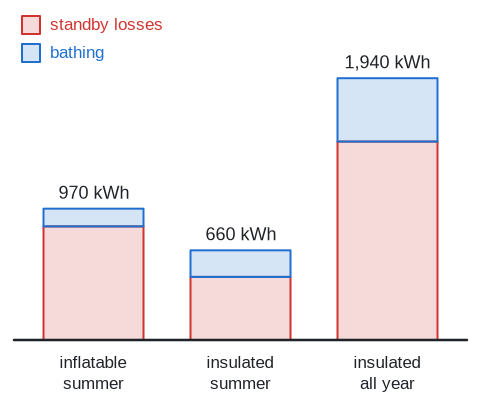
For an inflatable hot tub, waiting alone takes almost 90% of the energy in summer, and for an insulated one three quarters. The thin walls and light cover of an inflatable hot tub let out about twice as much heat as an acrylic tub wrapped in foam. Manufacturers mostly do not recommend using it in frost, so only insulated models make sense all year round. For them winter costs more than the whole summer, because as the losses per day grow, so does the number of days.
The heating alone during an hour-long soak costs about 80p. But if you add the waiting for a hot tub that is heated all year and you bathe three times a week, every hour in the water costs around £3.20.
How much it costs to fill and heat the water
After filling, the tank holds cold water from the hose. The heating element turns electricity into heat without any loss, so all we need is to work out how much heat the water can hold. As with a hot water cylinder, we use the formula
where m is the mass of the water in kilograms, c = 4,180 is the specific heat capacity of water in joules per kilogram per degree and Δt is the temperature difference. We fill a hot tub with 1,000 litres of water at 10 °C and heat it to 38 °C, a difference of 28 °C. We convert joules to kilowatt hours by dividing by 3,600,000:
At 26p per kWh the first heat-up comes to about £8.45, and to that you add £4.30 for a cubic metre of water. A heater of 3 kW needs over ten hours for it, and a little longer because of the losses.
Keeping the water warm is cheap by comparison: a closed, insulated hot tub loses about 3 kWh on a summer day, which is 78p, and 4 kWh on a yearly average, which is £1.04. According to sellers you drain an acrylic hot tub about three or four times a year, and an inflatable one more often. With 1,200 litres and four changes a year, the water with its heating costs around £61, so running it all year, water included, comes to about £565.
Why the cover matters most
For more than 95% of the time a hot tub is closed and empty. Without a cover, hot water evaporates from the surface and the steam takes heat with it, so the losses jump at least six times. A day without a cover costs over £6 instead of £1.04. Heat escapes in a similar way through a leaky or waterlogged cover.
A heat pump for a hot tub
A small air-to-water heat pump cuts the energy for heating to a third or a quarter in summer and to about a half in winter. It pays off mainly with all-year use, where by our estimate it saves around 1,000 kWh, which is about £260 a year. For summer alone it pays for itself slowly.
How to save
- Close the cover straight after bathing, even if you are coming back in an hour, and make sure it seals well and does not soak up water. A night with the cover open costs around £2, and more in winter.
- Put a thermal blanket on the surface, a floating sheet under the cover that reduces evaporation.
- If you are not bathing for a week or longer, turn the temperature down to 30 °C. At an average of 9 °C outside the losses fall by about a quarter, which is 26p a day.
- Place the hot tub in a sheltered spot and put insulation under it, because both wind and cold ground carry heat away.
- In winter, either all in or not at all: either leave the hot tub running, or drain it completely, dry it and cover it, because running it halfway risks freezing the pipes.
- Do not bathe at 40 °C. Every degree lower takes about 3% off the losses, which with all-year use is about £12 a year.
Sources
Chapters: Appliance energy use, Fridge energy consumption, Washing machine energy use, Tumble dryer energy use, Dishwasher energy use, Hot water cylinder energy use, TV energy use, Computer energy use, Electric heater energy use, Air conditioner energy use, Kettle energy use, Induction hob energy use, Oven energy use, Electric car charging cost, Hot tub energy use, Coffee machine energy use, Aquarium energy use, Vacuum cleaner energy use, Iron energy use, Light bulb energy use, Heat pump energy use, Gas consumption