
Vector product
The vector product (cross product) is an operation between two vectors in space that gives a new vector perpendicular to both of them.
What is the vector product
The vector product is defined between two vectors, and only in space. Unlike the scalar product, the result of a vector product is again a vector. The vector product of the vectors
where α is the angle between the vectors

The picture shows one possible vector product
If one vector is a linear combination of the other, then their vector product is the zero vector. This covers the cases where both vectors lie on one line. If at least one vector is the zero vector, the product is also zero.
How to find the coordinates of the resulting vector
So far we can work out the magnitude and direction of the resulting vector. It is more practical, though, to know its coordinates directly. The formula itself looks like this:
This formula is rather hard to remember, so here is a memory aid:
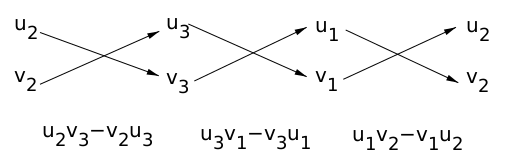
With this table we can multiply vectors with ease. For example, take the vectors
The resulting vector
Our vector
Substituting:
What is it good for
Clearly we can use the vector product to find a vector perpendicular to two other vectors. We can check that this really works using the scalar product: the result must be zero. Checking the previous example:
Another use is finding the area of a parallelogram in space. If we have a parallelogram ABCD in space and vectors
For example, find the area of the triangle in space with vertices A(1, 0, 3), B(5, 6, 8) and C(3, 5, 4).
First we have to find the vectors
Now we work out their product:
Then its magnitude:
And finally we divide the result by two:
Chapters: Vectors, Operations with vectors, Scalar product, Vector product
