
Volume of a prism
A prism is hard to describe in words, and you will understand it best from a diagram, so please take a look:
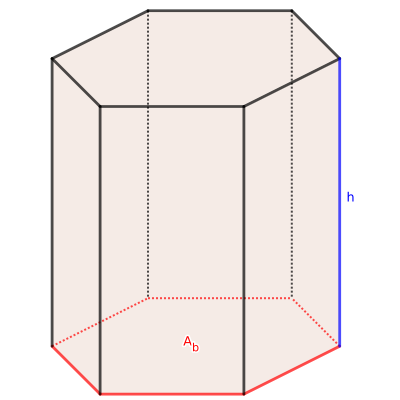
In general, you work out the volume of a prism by finding the area of its base (the cross-section), shown in red in the diagram as Ab, and multiplying this area by the height of the prism, shown by the blue line segment h. After that, it only depends on what the base of the prism looks like. If it is a rectangle, then for a right prism you get a special prism called a cuboid, and the volume of a cuboid is easy to work out.
If the base of the prism is a regular polygon, you first need to work out the area of the regular polygon and then multiply it by the height, which gives the volume of the prism.
Calculator
Enter the area of the base and the height of the prism; you can switch the units for each field.
Chapters: Volume of a sphere, Volume of a cylinder, Volume of a cone, Volume of a cube, Volume of a cuboid, Volume of a prism, Volume of a pyramid
