
Area of a regular polygon
A regular polygon is, for example, a square – a polygon with all sides the same length and all angles the same size. Here is a regular octagon:

How would we find the area of this regular octagon if we know the length of its side? As an example, let's say the side has length a = 10. We split the octagon into eight congruent triangles:
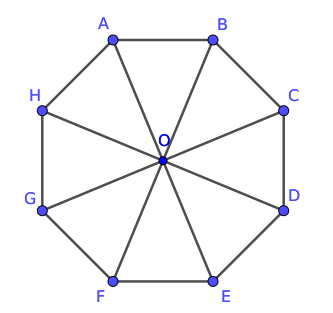
This makes the job easier – we only need the area of one triangle, and then we multiply it by eight to get the area of the whole octagon. What do we know about these triangles? They are isosceles: the two sides that go out from the centre O always have the same length, and the side of the octagon has a different length (only a regular hexagon can be split into triangles with all three sides equal). So side FO has the same length as side EO.
What is the angle between them at vertex O? For example, what is angle ∠FOE? All the triangles are the same, so all the angles at vertex O must be the same size. We also know that these angles add up to 360 degrees – one full turn. So the size of angle ∠FOE must be 360 divided by the number of angles, that is, divided by the number of triangles.
The angles in a triangle add up to 180°, and our triangle is isosceles, so the other two angles must be equal, each 67.5°:
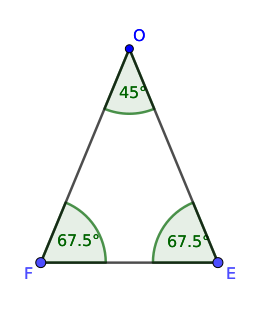
How do we find the area of an isosceles triangle? We know the length of side FE from the question: |FE| = 10. Now draw the height of the triangle through the point O:
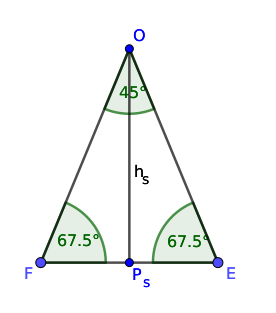
The line segment OPs has split the triangle into two smaller triangles, which are again congruent – one is just a mirror image of the other. Let's rearrange the triangles a little. Take triangle FOPs and move it so that the shape forms a rectangle:
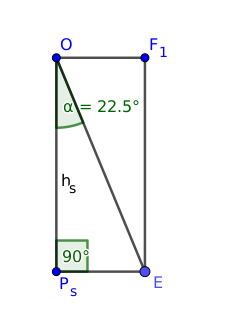
This rectangle OF1EPs has the same area as our triangle FOE. The area of a rectangle is the product of the lengths of its two sides:
We know the length of PsE: it is half the length of FE, and |FE| = 10 (it is a side of the octagon, as given). So the line segment PsE has length |PsE| = 5. The height hs is harder. Triangle PsOE is a right-angled triangle, so we can use trigonometry. Angle ∠PsOE is half the size of the original angle ∠FOE, so
Now we use the fact that the cotangent of an angle is the ratio of the adjacent side to the opposite side. To keep things tidy, let's call the angle ∠PsOE by the Greek letter α:
From this equation we need |hs|, so we multiply both sides by |PsE| to get:
Now we know what the height is equal to. Let's substitute the values:
The height is approximately 12. The area of the rectangle, and so of the triangle, is
Substituting gives:
The area of one triangle is roughly 60. There are eight triangles in all, so the area S of a regular octagon with side length a = 10 is approximately
How do we get a formula from this? For a general n-sided polygon with side length a,
So we need a general formula for
The angle α is half the angle of the triangle at the centre O, that is,
Substituting back:
And a little tidying:
In the last step, we multiply this by the number of sides of the polygon, n, and we have the final formula:
Calculator: work out the area of a regular polygon
Chapters: Area of a square, Area of a rectangle, Area of a circle, Sector of a circle, Area of a trapezium, Area of a parallelogram, Area of a rhombus, Area of a regular polygon, Surface area of a sphere, Surface area of a cube, Surface area of a cuboid, Surface area of a cylinder, Surface area of a cone, Surface area of a pyramid
