
Square
A square is a basic geometric shape with four sides of equal length, and each interior angle is exactly 90 degrees. There is also a method called completing the square.
Description
You can see an example of a square in the following picture.
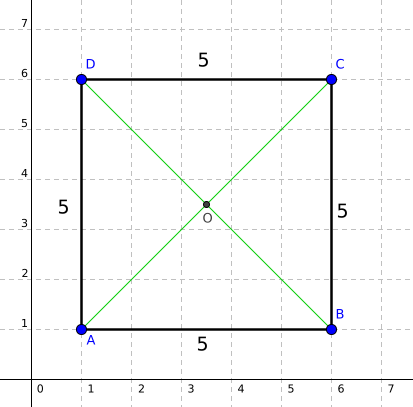
Every square has four vertices; ours has vertices A, B, C, D, marked in blue in the picture. We then speak of square ABCD. These vertices are joined by line segments to form the four sides of the square, namely AB, BC, CD, DA. In the picture the sides are drawn with thick lines. Each of these sides has the same length, namely 5.
Each side makes a right angle with its neighbouring sides, that is, an angle of 90 degrees.
Diagonals of a square
The green line segments mark the diagonals. Every square has two diagonals; this one has diagonals AC and DB. A diagonal is a line segment joining two opposite vertices of the square. More facts about diagonals:
- A diagonal is always longer than a side of the square.
- More precisely: if a side of the square has length a, then the diagonal d has length
- The diagonals always intersect at the centre of the square (its centroid).
- A diagonal splits the square into two halves. Both diagonals together split the square into four quarters.
- The diagonals bisect each other. If we mark the centre of the square with point O (as in the picture), then the length of AO is the same as the length of CO.
- A diagonal bisects the angle between adjacent sides. For example, in the picture angle ABC is 90 degrees and angle ABD is 45 degrees.
- The diagonals meet at a right angle.
Perimeter and area
The perimeter is the length of the boundary of the square, that is, the sum of the lengths of all the sides. So if a square has sides of length a, its perimeter is 4 · a. The area is the size of the surface the square covers. You take the length of one side and multiply it by the length of the adjacent side. But because all the sides of a square are equal, you can just multiply a · a. Once more, all together:
For example, the square in the previous picture has perimeter 4 · 5 = 20 and area 5 · 5 = 25.
Position of a square
Is the following shape a square?
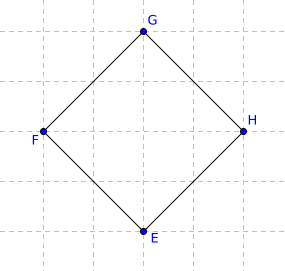
The shape above is a square, because it has four sides, all of equal length, and each side makes a right angle with each neighbouring side. If you rotate a square, it is still a square. But if we change the sizes of the angles, for example, it is no longer a square:
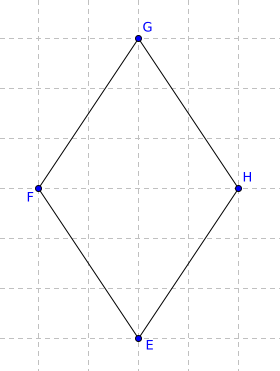
Four vertices and four sides of equal length, but not all the angles are right angles, so this is not a square.
How to draw a square
A square is easy and straightforward to draw. All you need to know is the length of a side. If the side length is, say, 3 centimetres, first draw a line segment 3 centimetres long. Label its end points as vertices A and B (or whatever you like). Then use a ruler to measure a right angle and draw two perpendicular line segments from points A and B in the direction you want. These segments again have length 3. Label the new points C and D. Finally, join points C and D with a line segment.
Circumcircle and incircle
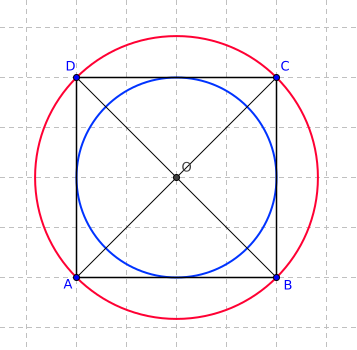
The circumcircle and incircle are two terms that go together with squares. Both circles have their centre at the centre of the square, that is, where the diagonals intersect.
The circumcircle is the circle that passes through all the vertices of the square. Its radius is AO, where A is any vertex of the square and O is the centre.
The incircle is the circle that touches all the sides of the square. Its radius is a/2, where a is the side length of the square.
Square metre
The basic unit of area is also related to the square: the square metre. What does it mean? If we say that something has an area of one square metre, it means that the surface has the same area as a square with a side length of one metre. If a room has an area of 10 square metres, ten squares with sides of one metre fit into it. Watch out: it does not mean the area of a square with a side length of 10 metres! The next picture shows this clearly:
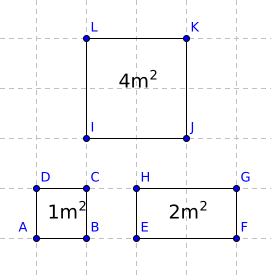
A square with a side length of 10 metres would be the unit called an are. A square with a side length of 100 metres would be a hectare.
