Rectangle
A rectangle is a parallelogram in which all the interior angles are 90 degrees – right angles. Opposite sides of a rectangle always have the same length. A square is then a special case of a rectangle, with all its sides equal.
Basic description
First look at the picture:
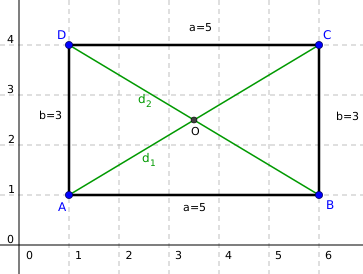 In the picture you can see a rectangle formed by vertices A, B, C and D, so it is rectangle ABCD. It has four sides: AB, BC, CD and DA. Opposite sides always have the same length, which we call a and b. In the picture the sides have lengths 5 and 3, as shown.
If all the sides were equal, that is, if a = b, it would still be a rectangle, but we usually call such a rectangle a square. A square is just a special case of a rectangle.
Diagonals
Every rectangle has two diagonals, which are line segments joining non-adjacent vertices. In our picture these are AC and BD. They are also labelled d1 and d2 in the picture. The diagonals always have the same length. They are also always longer than either side of the rectangle. More properties of the diagonals:
- The length of a diagonal is
- Unlike in a square, the diagonals do not meet at a right angle.
- A diagonal splits the rectangle into two halves. Both diagonals together split the rectangle into four quarters.
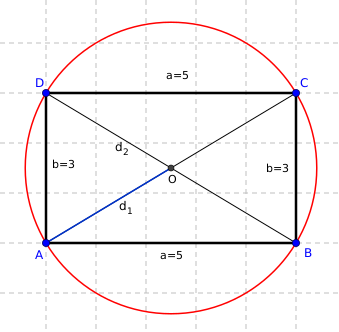
- The diagonals bisect each other. If we mark the centre of the rectangle with point O (as in the picture), then the length of AO is the same as the length of CO.
Perimeter and area
The perimeter is the length of the boundary of the rectangle, that is, the sum of the lengths of all four sides: a + b + a + b. But because two opposite sides are always equal, we can work out the perimeter as 2 · a + 2 · b.
The area of a rectangle is the size of the surface it covers. We work it out by multiplying the length of one side by the length of the other, adjacent, side. So the area of a rectangle is a · b. Once more, all together:
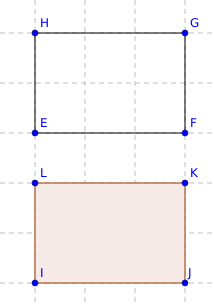
The next picture first shows the perimeter – the sum of the lengths of the line segments marked in red – and then the area – the shaded part of the rectangle.
Circumcircle and incircle
As with the square, a rectangle has a circumcircle, which is the circle whose centre is at the centre (centroid) of the rectangle and whose radius is half the length of a diagonal. The circumcircle passes through all the vertices of the rectangle. Unlike a square, however, a rectangle has no incircle, except of course when the rectangle is also a square.