
Constructing a triangle
A triangle is a polygon with exactly three sides. We label the sides with lowercase letters, conventionally a, b, c. A triangle also has three vertices, which we label with capital letters, conventionally A, B, C. Side a then corresponds to the line segment BC, side b to the line segment AC and side c to the line segment AB. Side a is always opposite vertex A, and similarly for the other sides.
We know all three sides
If we know the lengths of all three sides, constructing the triangle is quite easy. We choose one of the sides, say AB, and draw it as an ordinary line segment. Then we have to find where the third vertex is. That is simple: take a pair of compasses, put the point on B and draw a circle with radius equal to the length of side BC, say five centimetres. This shows us all the places where point C could be so that it is exactly five centimetres from point B. Then we do the same with side AC and point A. Now we have two circles, and their point of intersection is a point that is the required distance from vertex A and also the required distance from point B.
We know two sides and an altitude
Every side of a triangle has an altitude, which is defined as the perpendicular from the opposite vertex to that side. If the perpendicular does not meet the side itself, we have to extend the side as far as the point where it meets the perpendicular. The basic property of an altitude is therefore that it is perpendicular to the side it belongs to. This is often used in calculations, because we can use Pythagoras’ theorem. The altitude to side c is usually written with a lowercase letter h and a subscript showing the side the altitude belongs to. So in our case it is hc. The foot of the perpendicular (the point where the side meets the perpendicular) is labelled similarly, but instead of a lowercase h we write a capital P: Pc.

We drew the altitude from vertex C. The other endpoint lies on the opposite side AB (that is, side c), and the segment CPc is perpendicular to side c. The point Pc is called the foot of the altitude, and we call side c the base. We usually name the foot with the letter P and a subscript showing the vertex the altitude comes from. Here that is vertex C.
An altitude is quite easy to draw: take a ruler and draw a perpendicular to side c that passes exactly through point C. That is all.
We can draw an altitude from every vertex of the triangle. All the altitudes then meet at a point called the orthocentre. The orthocentre may lie inside the triangle, but it does not have to. In an acute-angled triangle the orthocentre lies inside the triangle.
We know two sides and a median
As well as altitudes, every triangle has three medians. A median is a line segment that joins a vertex to the midpoint of the opposite side. All three medians meet at a single point called the centroid. The centroid divides each median in the ratio 2:1 – the part of the median on one side of the centroid is either half or twice as long as the part on the other side. Medians are named with a lowercase letter m and a subscript showing the side they belong to. The centroid is usually named with a single capital letter G.
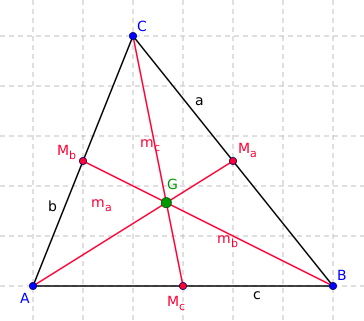
If you know two sides and the median to one of those two sides, the triangle is very easy to construct. You again start by drawing side AB and then find where point C lies by drawing two circles, the first with centre at point B (or A, if you know the length of AC) and the second with centre at the midpoint of side AB. The point where the circles meet is the required point C. The method is the same as in the first construction, except that instead of triangle ABC you first draw triangle McBC, from which you find the required vertex C.
We know two sides and a different median
First look at a sketch of how it should look:
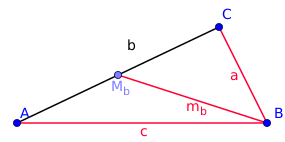
The items marked in red are the ones we know, and from them we have to construct the whole triangle. The method is as follows – we complete this triangle to a quadrilateral and finish the construction using the quadrilateral. The following figure shows it clearly (remember that the length BD is twice the length of mb).
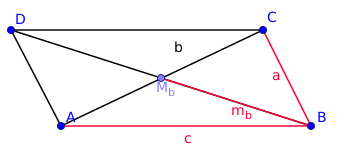
This quadrilateral is easy to construct. First we construct triangle ABD. We know the length of side AB, the length of side BD is 2mb, and the length AD is the same as the length BC. We find point C either by finding the point Mb, which is the midpoint of the line segment BD, and then drawing the ray AMb, so that the length AC is 2AMb. The other option is to draw a line parallel to side AB: point C will lie on this line, at distance |AB| from point D.
Chapters: Triangle, Altitude of a triangle, Median of a triangle, Circles in a triangle, Right-angled triangle, Constructing a triangle, Congruent triangles, Similar triangles, Area of a triangle, Pythagoras’ theorem
