
Volume of a cone
A cone is a solid that looks like an ice cream cone or a traffic cone on the road. It has a circular base at the bottom and narrows to a single point at the top, called the vertex. The volume of a cone tells us, in everyday terms, how much water we can pour into such a cone.
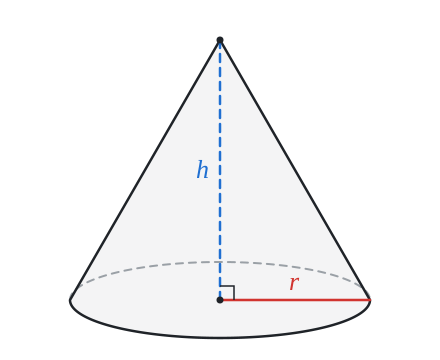
The base radius r is marked in red and the height of the cone h in blue – this is the distance from the vertex to the base. The height is perpendicular to the base. In an ordinary, upright cone it ends exactly at the centre of the base, and such a cone is called a right circular cone.
Formula for the volume of a cone
If all you need is the formula, the volume V of a cone whose base has radius r and whose height is h is
For example, a cone with base radius r = 3 and height h = 10 has volume
If you don’t like an answer with the constant pi in it, you can substitute the approximate value 3.14:
Where does it come from?
The formula is almost the same as the formula for the volume of a cylinder, except for the extra third. The volume of a cylinder whose base has radius r and whose height is h is
Now imagine a cylinder and a cone with the same base and the same height. The cone fits exactly inside the cylinder, with its vertex touching the centre of the top of the cylinder:
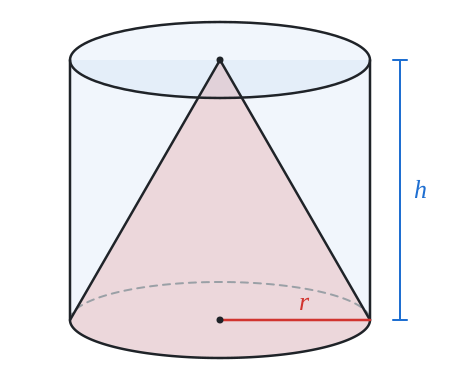
You can see at a glance that the cone is smaller – there is plenty of empty space left around it inside the cylinder. But how much smaller is it? We can try it out. Fill the cone with water and pour it into the cylinder. The cylinder is only a third full. Fill the cone a second time and the cylinder is two thirds full. Only the third cone of water fills the cylinder to the brim:
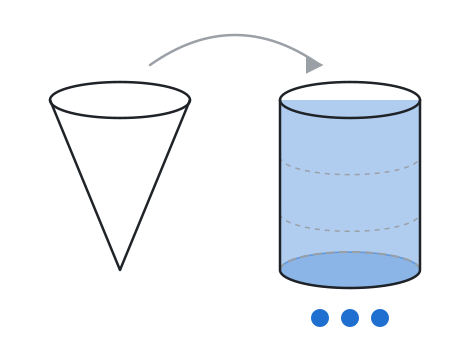
So exactly three cones of water fit into the cylinder, and the volume of a cone is therefore a third of the volume of the cylinder:
Of course, pouring water is just an experiment, not a proof – from a bucket you couldn’t tell whether it is exactly a third or, say, 0.31. That it really is exactly a third can be proved using a definite integral, but that is material for university.
Incidentally, the same third applies to a pyramid: the volume of a pyramid is a third of the volume of a prism with the same base and the same height.
Example: a pile of sand
At a building site there is a pile of sand in the shape of a cone. It is 1.5 metres high and 4 metres wide at the ground. How many cubic metres of sand are in the pile?
Watch out for the trap in the question: 4 metres is the width of the pile, that is the diameter of the base, not the radius. The radius is half the diameter, so r = 2 metres. The height is h = 1.5 metres. Substitute into the formula:
Square the 2:
A third of 1.5 is 0.5, so we can simplify the calculation:
And finally we substitute the approximate value of pi:
The pile contains approximately 6.28 cubic metres of sand. If you wanted to take it away in a wheelbarrow that holds about 80 litres, you would have about eighty trips ahead of you – one cubic metre is 1,000 litres, so
When we don’t know the height
Sometimes we don’t know the height of a cone, but we do know its slant height l – the distance from the vertex to the edge of the base. The height, the radius and the slant height together form a right-angled triangle, shown in green in the diagram:
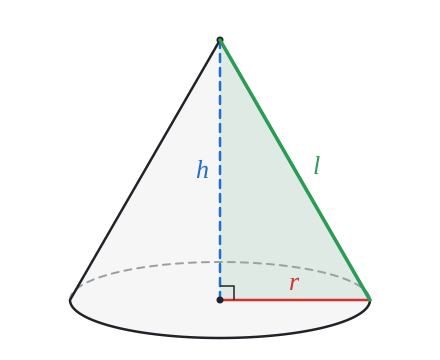
The slant height l is the hypotenuse of this triangle, and the height h and the radius r are the other two sides. By Pythagoras’ theorem,
We rearrange this to find the height:
Example: An ice cream cone has a diameter of 5 cm at the top and its side measures 6.5 cm. How much ice cream fits inside?
The diameter is 5 cm, so the radius is r = 2.5 cm. The slant height of the cone is l = 6.5 cm. First we work out the height:
Square the numbers:
And take the square root:
The cone is 6 cm high. Now we just substitute into the formula for the volume of a cone:
About 39 cubic centimetres of ice cream fit inside the cone, which is just under four centilitres. The scoop that sticks out above the cone is of course extra – that would be worked out as half the volume of a sphere.
Calculator
Enter the radius of the base and the height of the cone; you can switch the units for each field. The calculator uses the exact value of pi, so its result comes out slightly higher than 94.2.
See also
Chapters: Volume of a sphere, Volume of a cylinder, Volume of a cone, Volume of a cube, Volume of a cuboid, Volume of a prism, Volume of a pyramid
