
Volume of a cylinder
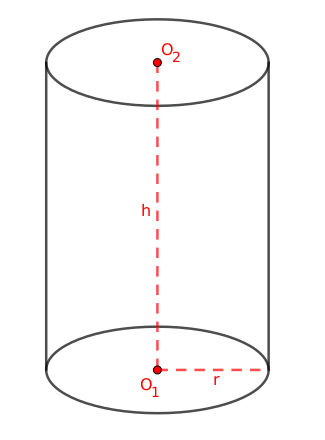
The volume of a cylinder tells us, in everyday terms, how many litres of water we can pour into it. First, let’s look at what a cylinder looks like:
Formula for the volume of a cylinder
If all you need is the formula, the volume V of a cylinder whose base has radius r and whose height is h is
Where does it come from?
It is actually quite simple. First we need the area of the base – the circle, the little disc the cylinder stands on. For that we use the formula for the area of a circle, which is
where r is the radius of the base. In the diagram it is shown by the red horizontal line segment. Next, we can imagine that the cylinder itself is built by stacking these circles on top of each other. If the height of the cylinder is to be fifty, we stack fifty such circles. We get the volume of the cylinder by multiplying the area of the base by the height of the cylinder, which is shown in the diagram by the vertical red line segment:
For example, if our cylinder had height h = 50 and the radius of its base were r = 10, the volume of the cylinder would be
If you don’t like an answer with the constant pi in it, you can substitute the approximate value 3.14 and work out an approximate volume:
Calculator: work out the volume of a cylinder
Chapters: Volume of a sphere, Volume of a cylinder, Volume of a cone, Volume of a cube, Volume of a cuboid, Volume of a prism, Volume of a pyramid
