
Volume of a pyramid
A pyramid is a solid you know from the pyramids of Egypt. At the bottom it has a base, most often a square, and triangular faces rise from the edges of the base and meet at a single point at the top, the vertex. The volume of a pyramid tells us how much sand would fit into such a pyramid if it were hollow.
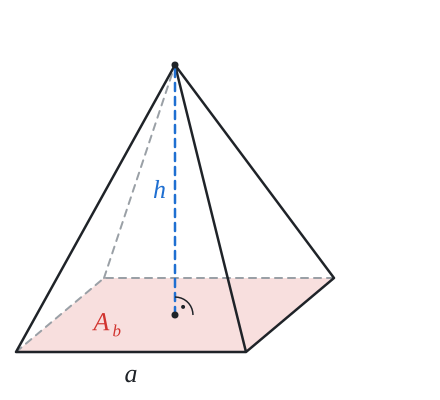
The base is coloured red, and we will write its area as Ab. The height of the pyramid h is marked in blue – the distance from the vertex to the base. The height stands perpendicular to the base, so we don’t measure it along the sloping face, but vertically down from the vertex.
Formula for the volume of a pyramid
If all you need is the formula, the volume V of a pyramid whose base has area Ab and whose height is h is
The most common case is the regular square-based pyramid, a pyramid with a square base of side a. The area of the base is then the area of a square Ab = a2 and the formula looks like this:
For example, a pyramid with base side a = 6 and height h = 5 has volume
Why is there a third?
Without the third, the formula Ab · h would give the volume of a prism with the same base and the same height. So a pyramid is a third of a prism. Why exactly a third can be shown nicely using a cube.
Take a cube with edge a and one corner of it, orange in the diagram. From this corner we now stretch pyramids to the three faces of the cube that do not touch the orange corner: the bottom, the back and the right one. This gives three pyramids, a red, a blue and a green one. Together they fill the whole cube, with no space left over and no overlap:
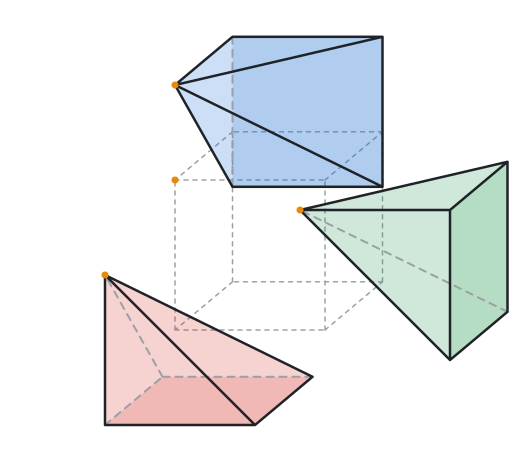
All three pyramids are the same, each just lies a different way. Each has one face of the cube as its base, that is a square with area a2, and each has height a, because its vertex is exactly one edge of the cube away from the opposite face. The volume of a cube is a3 and it is divided equally among the three pyramids, so each has volume
And that is exactly our formula.
The cube is of course just one particular case, but the third holds elsewhere too. If we stretch the cube in height or in width, it becomes a cuboid, and all three pyramids stretch in the same way – each of them is still a third of the cuboid. And if we tilt a pyramid, its volume does not change. Let’s imagine building it from thin slices, like a chimney of ever smaller squares. If we slide the slices sideways, we get an oblique pyramid, but the slices are still the same and take up just as much space. This trick is called Cavalieri’s principle. It also works for pyramids with differently shaped bases: if two pyramids have bases of the same area and the same height, their slices at every level have the same area, whether the base is a square or a triangle, and so they have the same volume. That is why the formula
holds for absolutely every pyramid, right or oblique, with a square, rectangular or triangular base. Just be careful with an oblique pyramid: its height is still the vertical distance from the vertex to the base, not the length of the sloping edge.
You come across the same third in the volume of a cone: a cone is a third of a cylinder with the same base and height. A cone can be thought of as a pyramid with a circle in place of the square as its base.
Example: the Great Pyramid of Giza
The largest Egyptian pyramid, the Great Pyramid at Giza, originally had a square base with a side of roughly 230 metres and was roughly 146 metres tall. Today it is about eight metres shorter, because it has lost its tip and its outer casing. How much stone fitted into it?
First the base, a square with a side of 230 metres:
The base covers 52,900 square metres, which is roughly seven football pitches. From that we can work out the volume:
Multiply:
All that remains is to divide by three:
The Great Pyramid has a volume of about 2.6 million cubic metres. If we took it apart and filled Olympic swimming pools with the stones, each 50 metres long, 25 wide and 2 deep, so with a volume of 2,500 cubic metres, we would fill more than a thousand of them.
The forgotten third is quite costly here. Anyone who leaves it out gets over 7.7 million cubic metres and builds two extra pyramids in their head.
When we don’t know the height
Often, though, we don’t have the height of a pyramid to hand, but we do know the length of the slant edge l – the edge that runs from a corner of the base to the vertex. This is the case with a real building, for example: you can get a tape measure to the edge more easily than to the vertical height inside.
The height h, the slant edge l and half of the diagonal of the base (in red) form a right-angled triangle, coloured green in the diagram:
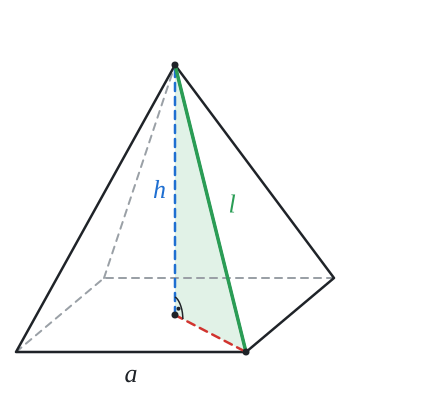
The height comes down from the vertex to the centre of the square, and the distance from the centre to a corner is exactly half of the diagonal of the square. The diagonal of a square with side a has length
From this we rearrange to find the height:
Example: In front of the Louvre in Paris stands a glass pyramid with a square base of side 35.4 metres and slant edges about 33.1 metres long. How much air is inside?
We start with the diagonal of the base:
Half of the diagonal is therefore approximately 25.03 metres. In the formula for the height it looks like this:
Square the numbers:
And take the square root:
The pyramid is about 21.66 metres tall. That fits, as the officially stated height is 21.64 metres. With the height in hand we work out the volume:
There are roughly 9,000 cubic metres of air inside the pyramid. Almost three hundred such pyramids would fit into the Great Pyramid.
A pyramid with a different base
The base of a pyramid doesn’t have to be a square. The formula
Try sawing a corner off a wooden cuboid with a sloping cut that passes through the three corners next to it. The offcut is a triangular-based pyramid: its base is a right-angled triangle and its height is the vertical edge of the cuboid, which stands perpendicular to the base.
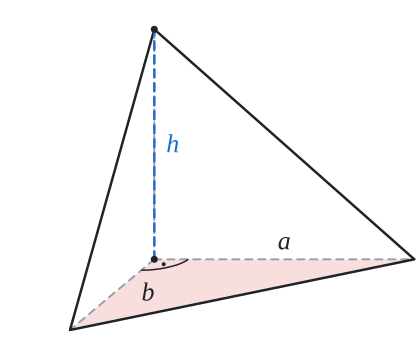
Let’s say that the two perpendicular sides of the base measure a = 8 cm and b = 6 cm and the height is h = 9 cm. First we find the area of the triangle in the base. For a right-angled triangle it is enough to multiply the two perpendicular sides and divide by two:
We have the area of the base, so the volume comes out as:
We sawed 72 cubic centimetres of wood off the cuboid.
To be sure, let’s check the result. This pyramid can also be laid on a different face: the left face is also a right-angled triangle, this time with perpendicular sides b = 6 cm and h = 9 cm, and standing perpendicular to it is the edge a of length 8 cm, which is now the height. The area of the base is
It matches. The pyramid is still the same one, it just lies differently, so the volume must come out the same.
Calculator
You can also work out the volume of a regular square-based pyramid here. Just enter the side of the base and the height, and you can switch the units for each field.
See also
Chapters: Volume of a sphere, Volume of a cylinder, Volume of a cone, Volume of a cube, Volume of a cuboid, Volume of a prism, Volume of a pyramid
