
Areas and volumes
First, a very brief bit of theory, in case anyone doesn’t know it. The perimeter of a shape is the sum of the lengths of all its sides, and it is measured in metres and units derived from them. The perimeter is usually written with the letter P. The area of a shape is the size of the surface the shape covers, and it is measured in square metres; mathematically, the square metre is written with a 2 as a superscript: m2. The area is usually written with the letter A. The volume is the space a solid takes up; simply put, it says how much water you could pour into it. Volume is measured in cubic metres and units derived from them, and three-dimensional measures are written with a 3 as a superscript: m3. The volume is usually written with the letter V. We can also express area and volume in other units (which are probably used more in everyday life), such as the are or hectare for area and the litre for volume. Area or volume can in general be calculated using integrals.
Square and rectangle
Both shapes are two-dimensional, so we find only a perimeter and an area here. The square is the simplest of all, because by definition a square has all its sides equal. So when we calculate the perimeter of a square, we just take one side of the square and multiply it by four (the number of sides): P=4a. The perimeter of a rectangle is only a tiny bit more complicated. A rectangle always has two pairs of equal sides, so there are two ways to go: either simply add up all the sides, or take the lengths of two different sides, multiply them by two and add: P=2a+2b.
The area of a square is no more complicated than its perimeter. You take one side and multiply it by the other side. Because all the sides of a square are equal, we get the formula: A = a·a = a2. A rectangle works in exactly the same way as a square, except that a rectangle does not have all its sides equal, so you must multiply two different sides that are perpendicular to each other: A=a·b.
Parallelogram
A parallelogram is a shape similar to a rectangle, but with two opposite sides slanted, see the picture below this paragraph. The perimeter of a parallelogram is simple and essentially the same as for a rectangle: P=2a+2b, but the area is a little more interesting. To work out the area of a parallelogram we have to turn it into a rectangle, otherwise it won’t work. And how we turn it into a rectangle is shown in the following picture:
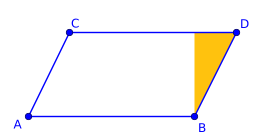
First we cut off the overhanging part of the parallelogram (the shaded part) and attach it to the other side of the parallelogram, which gives us a rectangle:
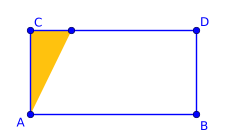
Only now can we easily work out the area of the parallelogram; the formula is the same as for a rectangle. However, converting the parallelogram graphically is not convenient, so we use a simple formula that comes straight from that conversion. Side a is the same in the rectangle and in the parallelogram, and only the other side differs. So for the parallelogram, instead of side b we use the height of the parallelogram, which equals side b in the rearranged rectangle. The following picture shows it clearly (we multiply the sides highlighted in red):
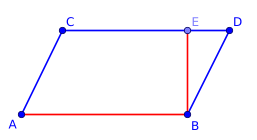
The formula looks like this: A=ha·a.
Trapezium
The perimeter is obvious: we add all the sides together. The area of a trapezium is a tougher nut to crack. In theory we could proceed in the same way as for a parallelogram, but we don’t know whether to take the longer side (AB) or the shorter side (CD).
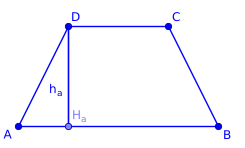
So we use a trick – we work out the average length of the two parallel sides and use that. We add the lengths of sides AB and CD, divide by two and then carry on as for the parallelogram – multiply by the height and we have the area. A=(a+c)/2 · ha.
Triangle
A triangle is a two-dimensional shape, so we can work out its perimeter and area; it cannot have a volume, and it doesn’t. We work out the perimeter of a triangle by adding all its sides. So the general formula would look like this: P=a+b+c. Of course we can find special cases; for example, it is clear that an equilateral triangle has all its sides equal, so we only need to know the length of one side and multiply it by three. Then the formula would look like this: P'=3a.
For the area of a triangle we will need one small adjustment. To work out the area of a triangle, we have to turn it into a parallelogram (just as we turned a parallelogram into a rectangle). How to turn a triangle into a parallelogram is again shown by the following little drawing:
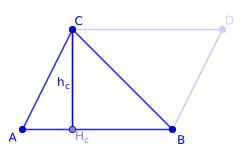
From this picture it should already be clear how to work out the area of a triangle – you proceed just as if you were working out the area of a parallelogram, except that you divide the result by two: A=(hc·c)/2
Circle
A circle is special in that neither its circumference nor its area can be written exactly as a decimal. Whatever we want to calculate with a circle, we hardly ever manage without the constant pi – π. The decimal expansion of π never ends; it is an irrational number, but the approximate value that we usually use (unless you have its value stored in your calculator) is 3.14.
Now on to the formulae. Thinkers in ancient times were already finding out how to work out the circumference of a circle (the curve itself, see circle; the circle as a curve has no inside and so no area, whereas the circle as a region, the disc, has an area, because it includes the inside). It was found that the ratio of the diameter of a circle (which is easy to measure) to its circumference is always the same, and over time people also worked out how many times longer the circumference is than the diameter. And, amazingly, it is exactly pi times. So we work out the circumference as C=π·d=2·π·r (the second, more complicated formula is given more often, because we usually know the radius rather than the diameter), where d is the diameter and r is the radius of the circle.
The area of a circle is then A=π·r2; I don’t know what more to say about it :-).
Cube and cuboid
These are the first three-dimensional solids, so here we work out the surface area and the volume. Since a cube has six faces and all of them are squares, the method is clear: you work out the area of one face and then multiply it by six. A=6a2. For a cuboid it is longer, because it has several different faces. Basically, you work out the areas of three different faces, add them up and multiply by two, and you have the surface area of the cuboid: A=(a·b + b·c + a·c)·2.
The volume of a cube is worked out exactly like the area of a square, with the small difference that we mustn’t forget we are working in three dimensions. You simply take the side length and raise it to the power 3: V=a3. For a cuboid it is similar, but we have to multiply the three sides separately, because they have different lengths: V=a·b·c.
Sphere
The surface area of a sphere is worked out as A=4·π·r2 and the volume of a sphere is V=4/3·π·r3. If you want to read a fairly complicated derivation of the volume of a sphere, take a look at Cavalieri’s principle.
Cylinder
We work out the surface area of a cylinder as the sum of the areas of the two bases and the area of the curved surface. A base is an ordinary circle, so the area of one base is equal to the area of a circle, that is, we work out the area of one base like this:
The curved surface of a cylinder is nothing other than a “rolled-up” rectangle, where the length of one side equals the height of the cylinder (we call it h) and the other equals the circumference of the circle at the base. So the area of the curved surface is:
The surface area of the whole cylinder is therefore:
The volume of a cylinder is simpler: it is the height multiplied by the area of the base. We have already worked out the area of the base in the previous step. The result:
Pyramid and cone
The surface area of a pyramid is in general worked out as the sum of the area of the base and the areas of all the faces. There is not much of a general formula for it. The volume of a pyramid has something in common with working out the area of a triangle – you take the area of the base and multiply it by the height of the pyramid. You then divide the result by three and you have the volume of the pyramid. V=(Ab · h)/3, where Ab is the area of the base.
The surface area of a cone equals the sum of the area of the base and the area of the curved surface. The area of the base is clear; it is an ordinary circle, so A=π·r2. The area of the curved surface is a little more complicated: you have to imagine that you “unroll” the curved surface onto a table, which gives you a kind of sector of a circle, whose area equals A=π·r·l, where l is the slant height (the distance from the apex of the cone to the edge of the base, essentially something like an edge of a pyramid). The volume of a cone is V=(π · r2 · h)/3, where h is the height of the cone.
Examples of areas
Work out the area of the following shape (assume that the measurements on the axes are in metres):
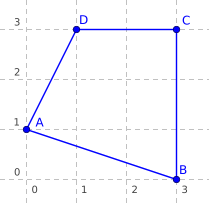
At first glance we see that this shape is a general polygon, to which we cannot apply any formula as a whole. So we have to split it into smaller parts that we can already work out. It is easiest to make a triangle of the bottom part and a trapezium of the top part. The split is shown in the following picture:
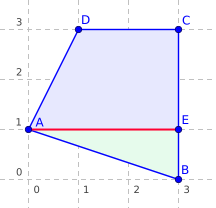
Now we work out the area of triangle ABE using the formula A=(a · ha)/2. Side a is side AE here, and the height onto this side is side EB. We can see that |AE|=3 m and |EB|=1 m. Substituting into the formula, we get: A=(3 · 1)/2=1.5 m2.
In the second step we work out the area of the trapezium using the formula A=(a+c)/2 · ha. Side a is side AE in our case and side c is side DC. The height can again be read easily from the picture; it is the length of line segment EC. Substituting into the formula, we get: A=(3+2)/2 · 2=5 m2.
We simply add the two partial results and we have the area of the shape. A=1.5 m2 + 5 m2 = 6.5 m2.
Work out the area of the following shape (assume that the measurements on the axes are in metres):
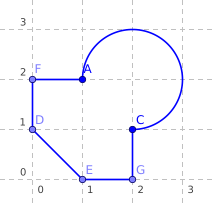
Again it is probably clear at first glance that one little formula won’t be enough for us and that we will have to adjust the shape somehow. We will work it out as follows: work out the area of the “square”, add three quarters of the area of the circle and subtract the small triangle at the bottom left:
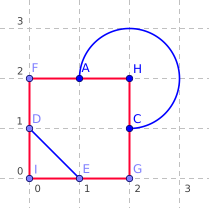
We work out the area of the square simply: A1 = 2 · 2 = 4 m2. In the second step we work out the area of the circle. Again we just substitute into the formula and work out A2 = π · 12 · 3/4 = 3π/4. All that remains is to work out the area of triangle DEI and subtract it from the area of the square. Side EI and its height DI both have length 1 m, so the area of the triangle is A3 = ½.
In the last step we add and subtract the partial results: A = A1 + A2 − A3 = 3.5 m2 + 3π/4 m2.
